Showing posts with label Post-Apocalyptic Earth. Show all posts

Friday, April 8, 2016

Book Review: Do Androids Dream of Electric Sheep?

Philip K. Dick
1968
Nominations: Nebula
Rating: ★ ★ ★ ★ –

It is truly a pleasure to be able to review another book by the brain-twisting, reality-suspending Philip K. Dick.

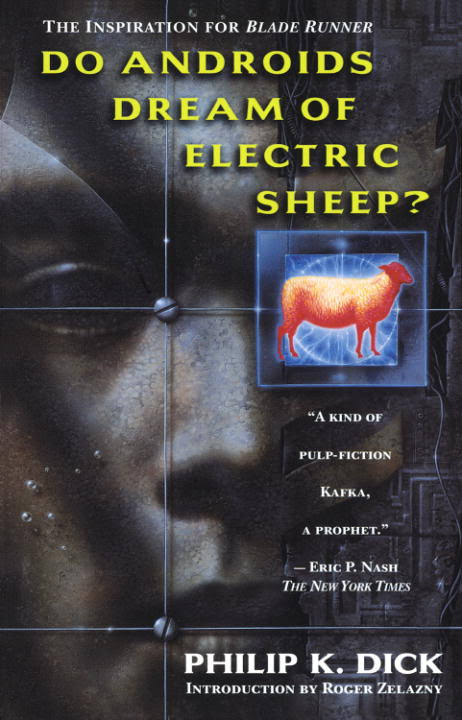
This novel is probably one of his most famous since it was, as the front cover of my 1996 paperback version says, “the inspiration for the movie Blade Runner.” The book was really just that, however—an inspiration. No one should read Dick’s novel expecting it to be a direct parallel to Ridley Scott’s 1982 movie.
   
Both share the same basic plot skeleton: in a technologically advanced Los Angeles of the near future, protagonist Rick Deckard is hired by the L.A. police department to hunt down a group of dangerous androids who have escaped from an off-world colony.
   
However, the meat covering the book’s and movie’s respective skeletons is almost completely different. Which, as I will explain later, is not necessarily a bad thing; both are superb in their own ways.

The novel is set in the 2020s (which would have been pretty far in the future for Dick in 1968). A nuclear war has killed off most of the world’s animals and the radioactive dust that remains is slowly killing everything that was able to survive the war itself. Most of the planet is vacant, desolate desert. All of the humans who could afford to have fled to off-Earth colonies elsewhere in the Solar System; the people who remain eke out their livings while trying to avoid sterilization and death.
   
To cope with the pervasive atmosphere of despair, most people own Penfield mood organs, which offer hundreds of different settings. The machines allow them to be in complete control of their feelings at all times, whether they want to feel happy, or calm, or raunchy, or even profoundly depressed.

Most people also subscribe to Mercerism, the new masochistic religion of the times. Special devices let them connect their brains into the brain of the religion’s founder, Wilbur Mercer. They stay connected to him and to each other for hours, seeing what he sees, which mainly involves him trudging steadily uphill on a path in a desert, often being pelted with rocks by from unseen persecutors.

On an Earth with hardly any animals, owning a pet is the ultimate status symbol. But because the scarcity of real flesh-and-blood animals has driven their prices through the roof, most people can only afford mechanical copies. No one wants their neighbors to know they can’t afford a real animal, so corporations are making money hand over fist by building increasingly realistic robotic animals that can usually pass for the real thing.

Robot technology has not stopped at animals, however. Corporations are now also able to build incredibly highly-functioning androids as well. In fact, the latest models, the Nexus-6s, are indistinguishable from humans without sophisticated empathy testing. Androids are used as slave labor on off-Earth colonies, but they are illegal on Earth. Every once in a while a slave android will escape, make it to Earth, and try to blend in.

This is where our main character, Rick Deckard, comes in. At the beginning of the book, Deckard gets an emergency assignment: find and kill six escaped Nexus-6s who are believed to be hiding out in L.A. They are clever and very dangerous; one of them has already put his superior in the hospital.

Deckard and his wife Iran have so far only been able to afford a mechanical sheep. Bounty hunting is an extremely risky job, but he thinks that with the staggering reward he’d get from bagging six androids—which would be an industry record—he’ll be able to afford a much higher-status animal—maybe even a real one. Maybe even a Percheron. His wife, who is so depressed that she actually regularly sets her mood organ for more depression, urges him on.

The police chief suggests that Deckard first fly to Seattle to talk to Rosen Associates, the company that makes the Nexus-6s, so he can see a sample before he goes after them. There, he meets Rachael Rosen, a staffer who at first is presented as a relative of the company’s founder but who he learns through testing is actually one of the Nexus-6s herself.

This throws him for a loop, because he would have sworn she was human; and it’s even more disturbing to him because she didn’t know she was a robot either.

Back in L.A., Deckard methodically finds and kills the first three of his six androids. Each one is a different challenge, but the most difficult are the ones who try to befuddle him by making him doubt his entire sense of reality. They set up their own false, staffed, police station and they try to convince him that all his memories are fake, that he’s not working for the police at all, that they are the real police, and that perhaps he is an android himself. They are very convincing and he just about believes them (as do you). It is very anxiety producing—and classic Philip K. Dick.

Rachael Rosen, who is very upset upon learning she is an android, begs Deckard for help and they end up sleeping together. This makes him falter and start having doubts about his ability to kill androids and even to see them as non-people. It turns out, though, that Rosen was just trying to distract him in the hopes that he won’t go after one of the remaining androids—the one named Pris—who is the same model as her.
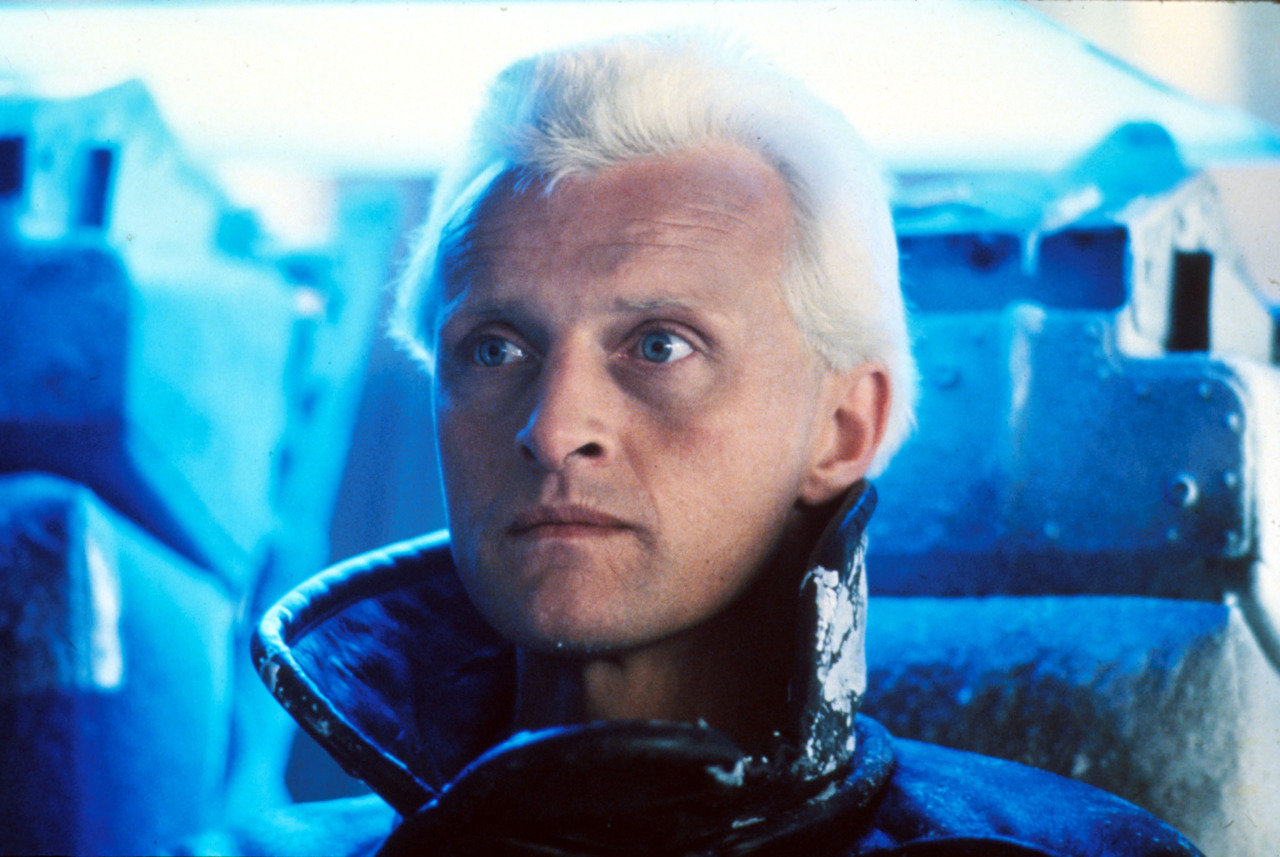
Roy Batty!
Eventually, the final three androids—Roy Batty, Irmgard Batty, and Pris Stratton—worm their way into the confidence, and thence the apartment, of J.R. Isadore, a sterilized, mentally deficient “special” person who lives in a vacant building in the suburbs. They hole up there until Deckard tracks them down and brings on the final showdown.

The book has just about everything: a clever premise, a gripping plot, and a sympathetic main character. It takes place in a creative but still realistic setting that you can picture yourself in, and Dick provides plenty of colorful emotional and physical details to ground you in the book’s world. His writing style itself is clear and straightforward, which is good because his ideas can be pretty twisty.

The movie Blade Runner is really, really, really good also. And the fact is that Blade Runner would probably not have been as great as it is if it had followed the book any more closely. Indeed, in spite of what an ingenious and prolific writer Dick was, there are actually only a couple movies made out of his books that are very good.

Dick’s best writing is about the questions that obsessed him—questions about the nature of reality and humanity that have a lot of potential for cerebral terror: who am I? Is what I perceive real? If someone insists my reality is wrong, should I trust them or my memories? If an android has been given feelings and memories to make it think it is human, is it human? How do I know I’m not an android that has been programmed to think I am human?

These are scary concepts that work well on the page and in the brain but seem to be difficult to translate to the screen. Usually—Total Recall aside—they don’t make for successful popular films.

Blade Runner’s screenwriters were smart to cut out Deckard’s wife, the Penfield mood organ, the Mercerist religion, and the robotic pets. And they were smart to trim down the number of androids and to make them a lot more scary and formidable. All of these changes made the movie into a different, but equally good, animal—a thrilling, gritty, futuristic film noir.

Friday, November 6, 2015

Book Review: Blackout

Seanan McGuire (writing as Mira Grant)
2012
Nominations: Hugo
Rating: ★ ★ ★ – –

BEWARE… SPOILER ALERT FOR FEED, DEADLINE, AND BLACKOUT.

And at last we arrive at Blackout, the third and final novel in Mira Grant’s Newsflesh trilogy.

Blackout has most of the same pluses and minuses as Deadline. It has the same engaging post-zombie-apocalypse setting and the same appealing cynicism and irreverence in its main characters. It’s got the same witty writing style, which is mostly still fun to read but at times, in this third book, seems to be getting a bit sloppy.

It has the same annoying conversational techniques for attempting to draw out the suspense. It has the same crazy Shaun hearing Georgia’s ghost in his head, and the same unnecessarily disruptive commentary about it. And the plot seems similarly haphazard and forced, especially when it comes to Shaun’s story line and the motivations of the evil CDC.

But at least Georgia is back, in the flesh, which makes a huge difference for the good. Georgia is by far the best character and narrator Grant has got, and it’s great to have her again.

Blackout picks up where Deadline ended, with Georgia waking up in a cell in a CDC facility. She quickly figures out that she is a recently-awakened clone of her original self with all her memories intact, right up to the moment Shaun shot her in the back of the head when she was about to turn into a zombie.

Aside from confirming that she is a clone, the CDC staff won’t tell her anything; they won’t tell her where she is or what’s going on or even let her go to the bathroom without an escort. But through secret messages passed to her she finds out that the EIS—the Epidemic Intelligence Service, a subdivision of the CDC—has undercover agents inside the CDC and that they are working on a plan to break her out.                

The EIS agents show her other Georgia clones being grown in the lab and explain that she’s just one of many. The CDC is trying to build a malleable, docile version of her that will do what they say, and then they will use that clone to lure Shaun in and imprison him. She herself is too much like the original Georgia, inquisitive and rebellious, so she is on a time limit. Once they are able to build a more brainwashable clone, she will be “decommissioned.”

She is also able to find out one key thing on her own. Her CDC doctors let her walk for exercise in an agricultural biodome attached to the facility, which, because of her knowledge of CDC installations, lets her know that she’s in Seattle.                                                                              

Meanwhile, her brother Shaun and the rest of the After the End Times blog staff are hiding out from CDC security at Dr. Abbey’s CDC-blacklisted lab in Oregon. Their main goal is the same as it was in Deadline, which is to find out why the CDC wants to kill people who have Kellis-Amberlee reservoir conditions when they are the best hope for adaptive immunity, and to publish the answer online for the entire world to know.

And Dr. Abbey also wants to know more about the Cuban mosquitoes that are now spreading Kellis-Amberlee through Florida. The virus is too large for a normal mosquito to carry, which suggests that the Cuban species was deliberately bred.                                                           

What follows is a series of contrived misadventures designed to get Shaun and Georgia back together so they can pursue the truth as a team again. It starts with Dr. Abbey sending Shaun and Becks on a mission to Florida to try to get a sample of the mosquitoes, so she can do genetic testing to find out where they came from. Shaun and Becks make the mistake of stopping first at his adoptive parents’ house in Berkeley to get a map—a questionable plan in the first place—only to find that the Masons have told the CDC they were coming. They escape from the CDC police and flee from Berkeley, not to Florida, but instead to…

…Seattle, of course, where they meet up with Mahir and Maggie, who have gone up there to get fake IDs from a shady character called “The Monkey.” The Monkey agrees to give them IDs if, conveniently enough, they first break into the Seattle CDC and plant bugs for him.

At this point, the EIS determines it is time to enact Georgia’s escape. They have just surgically removed all her tracking chips and self-destructing bio-bombs when Shaun’s invading team causes the CDC to go into lockdown. The EIS doctors think that the lockdown is because of them, and stay to distract security while sending Georgia off in the direction of the exit, where she runs smack into Shaun without either of them running into any CDC staff first.

After fighting off a horde of zombies and at least two more CDC security detachments, they make their way back to Dr. Abbey’s lab, where it is determined that they really need to go all the way to Washington, DC, to ask the president the truth about Kellis-Amberlee and the mosquitoes and all that.

When they finally make it in to see the president, he is, of course, there with an evil CDC doctor who tells them the truth about Kellis-Amberlee and the mosquitoes and all that, and then tries to enlist them into his evil PR machine to keep it secret. And, of course, when it turns out they won’t keep it secret, he tries to kill them, and they, the president, vice president, and a bunch of Secret Service agents have to escape by shooting their way out of the White House through another horde of zombies.

A bad guy whose motivation
I can understand
The main issue I had with Blackout, as with Deadline, is that I just do not buy the bad guys’ motivation. Usually bad guys are motivated by money, revenge, religious fervor, or a desire for world domination, all of which I can completely understand. But these CDC guys seem to really be doing what they’re doing because of an always vaguely and often incomprehensively articulated societal benefit argument that doesn’t have much convincing pull. I don’t understand how they could have been willing to spend millions of dollars and kill people, much less die, for their cause.

I’ve read and re-read the sections of Deadline and Blackout where the bad guys explain themselves. From what I can piece together, their thinking seems to go like this:

  • In a very, very small minority of cases, some people with reservoir conditions can either develop immunity themselves, or convey immunity to people who are close to them.
  • The CDC doesn’t want to tell people that there is a tiny possibility that some people with reservoir conditions could recover or that some people might be immune, because then people will hesitate to pull the trigger when somebody amplifies, and then more people will die. Most of the time the person will turn into a zombie and then will turn around and eat the person who should have pulled the trigger.
  • So, for the time being, they are killing people who have reservoir conditions.
  • They think they will eventually find a strain of Kellis-Amberlee that doesn’t cause reservoir conditions. When they do, they want to infect the entire world with it.
  • The genetically-engineered mosquitoes were supposed to be their distribution method, once they came up with a strain they liked. But they got out too early. So, oops—they killed millions of people on the U.S. Gulf Coast.

Killing people who have reservoir conditions seems like way too much of a leap, even for crazed evil CDC doctors. I cannot believe they would really do that just based on the fear that knowing that people have the potential to be immune would lead to a few more deaths by recently-turned zombies. How about developing a test for immunity instead? Maybe that would be easier than having a secret cloning program and a secret mosquito genetic modification program and finding subtle ways to kill thousands of innocent U.S. citizens?

Early on in Blackout, Georgia observed, almost in passing, that the CDC was keeping people controlled “through unnecessary security and exaggerated fear.” We see this in real life all the time when we are required to go through blood tests or loyalty tests or other security checks to go about our normal business, security checks that are more stringent and intrusive than the real odds of danger would warrant, as a way to keep us as a population cowed and obedient. There would be plenty of potential for realistic governmental evil and oppression by means of security theater; it seems like maybe that would have been a ripe area to explore further, instead of the medical mumbo-jumbo.

Friday, October 2, 2015

Book Review: Deadline

Seanan McGuire (writing as Mira Grant)
2011
Nominations: Hugo
Rating: ★ ★ – – –

BEWARE… SPOILER ALERT FOR FEED

Deadline, the second book in Grant’s zombie-apocalypse Newsflesh trilogy, picks up the story about a year after where the first book, Feed, left off. It is 2041; Senator Peter Ryman has gone on to be president of the United States; and Shaun Mason is running the After the End Times online news agency by himself, following the assassination of his sister Georgia by former vice presidential candidate David Tate.

Like Feed, this novel opens with a gripping action scene. In this one, Shaun has to rescue his most seasoned reporter and a trainee out on his first field test from a sea of about thirty zombies.

The difference this time is that Shaun’s heart is no longer really in it. His sister's death has filled him with a profound loneliness. He has gone a little bit crazy, conducting frequent, extremely realistic two-way conversations with Georgia in his head. And he worries that, without her, maybe there’s no longer any point to any of what he does. To avoid endangering his staff with his distractedness and lack of enthusiasm, he has even taken himself out of the field work he was so good at before.

But, sure enough, something happens to suck him back in. At his office in Oakland, he gets a visit from Kelly Connolly, a CDC doctor who has faked her own death and escaped from her employers so that she could get to Shaun and have him expose a sinister conspiracy that she has discovered. And this conspiracy is related to Georgia’s untimely death, which is the only reason Shaun takes the case.

Dr. Connolly’s discovery is that people like Georgia, who have non-lethal “reservoir conditions” associated with the Kimberlee zombie virus, are dying of seemingly accidental causes at much higher rates than the average population. And anyone who notices this trend and tries to research it, or even bring it up to their superiors at the CDC, winds up dead themselves.

Not coincidentally, just as Dr. Connolly is revealing her discovery to the After the End Times staff, the entire city of Oakland is massively bombed by the U.S. military, which excuses the action by claiming it is trying to stop a zombie outbreak. Shaun, Dr. Connolly, and several of Shaun’s reporters barely escape to rural California with their lives.

They are then almost constantly on the run for the rest of the book. They visit rogue scientists unaffiliated with the CDC to have them look at Dr. Connolly’s data; they go to a branch CDC office in Portland to ask them about the results; and inevitably they wind up going to CDC headquarters in Memphis to confront the director. Everywhere they go, they are held at gunpoint, threatened, shot at, or “accidentally” shut into buildings with hordes of zombies. And after they finally get out of Memphis and head home to tell the world what they know, they have to survive a cross-country drive back to California during the middle of the largest zombie outbreak in recorded history.

Deadline is set in exactly the same world as Feed, has many of the same characters, and is similarly filled with near-constant action and suspense. But it is nowhere near as compelling a story.

For one thing, the characters aren’t as interesting. Grant killed off three of the best characters in Feed—two good and one bad—leaving us mainly with second-stringers in this second book. I wasn’t really attached to any of them, so when they are in danger or even die, there wasn't nearly as much of an emotional pull. The news agency staffers’ styles are not very differentiated, so most of their blog excerpts sound very similar to each other. And there are two short-lived romantic entanglements thrown in which serve only as pointless distractions rather than plot- or character-enriching experiences.

For another thing, the chief villain’s master plan is, well, weak. It’s a tremendous anticlimax when we learn what it is. It’s hard to believe that even he believes in his goals enough to kill for them.

The medical discussions and explanations—of which there are many in this book—are abstract and confusing. It’s hard to build up enough horror or suspense about substrains, reservoirs, chimera, and immunology when the explanations of them are so muddy. Grant said that while writing Deadline she got a lot of advice from real scientists and doctors about how to talk about virology, and it almost seems like maybe that was a mistake.

I also became irritated with Grant’s technique of having the characters realize something before we (the reader) do—usually because we don’t know all the information they know—and then excruciatingly slowly drawing out the reveal of what they know as a way to amp up the dramatic tension. One conversation in which Shaun knew perfectly well what Dr. Connolly was avoiding saying went on for three pages while he tried to get her to say it instead of just explaining it himself and moving on. It was filled with dialogue like this:
     “I’m going to ask you one question, Doc, and I want you to think really hard about your answer, because you’re legally dead, and if we want to hand you to this nice lady,” I gestured toward Dr. Abbey, “for her experiments, well, there’s really not much you can do about it. Don’t lie to me. Understand?”
     Kelly nodded mutely.
     “Good. I’m glad to see that we have an agreement. Now tell me: The reservoir conditions. What do they do? What do they really do?”
And then she wouldn't answer, and he'd try another tack. I think you should either have the characters tell us what they have figured out, or don’t tell us, but don’t tell us over and over that they’ve figured out something, and then make them go pale or have their eyes widen with horror, and then act all cagey about it for several pages. It doesn’t make it more suspenseful; it makes it annoying.

And Shaun, our lone remaining hero from Feed, who I really wanted to pin my faith on, is revealed to have a serious anger management problem. When he is stressed out, or anxious, or mad, he handles it by being nasty to underlings, slamming cell phones, punching walls, and shoving computer equipment. Once, in the past, he actually punched one of his employees in the face. It made me miss Georgia’s rational, steadying influence quite a bit.

And, finally, speaking of Georgia’s steadying influence: Shaun’s conversations with Georgia’s ghost do bring her back into the book a little and do mitigate his personality problems somewhat. But Shaun consistently interrupts the nice flow of those conversations by commenting on just how whacked out everyone must be by him talking to his dead sister. To wit:
     Don’t be so hard on yourself, said George. You’re tired.
     “That’s easy for you to say,” I snapped, before I could stop myself. Then I froze, casting a careful glance toward Maggie. I was expecting… I don’t know what I was expecting. I get a lot of reactions to the fact that I still talk to my sister. Most of them aren’t good ones.

     My eyes were normal until I was almost at the amplification threshold, said George thoughtfully. The retinal distortion didn’t kick in until then.
     “I know,” I mumbled, keeping my voice low, so as to hopefully avoid reminding my team that I was crazy. 
Commenting on it a couple times, early on, to show how people are reacting to his craziness, would be fine. But when every single time he talks to Georgia he also has to make some mention of how someone rolls their eyes or looks at him funny, or how he mumbles because he doesn’t want people to hear him, it distracts from these often crucial conversations and makes them herky-jerky. I'd rather just hear what Georgia's ghost has to say.

Anyway... while reading Deadline, I really thought I was going to be done with the Newsflesh trilogy. But then, of course, Grant added a twist—or actually two twists—at the end of this book that still made me want to read the next one. So forget everything I just said, and let’s go read Blackout.

Friday, September 4, 2015

Book Review: Feed

Seanan McGuire (writing as Mira Grant)
2010
Nominations: Hugo
Rating: ★ ★ ★ ★ –

Feed is a zombie apocalypse novel. Zombies are trendy subject matter. And, as I’ve said before, zombies are the only fictional monsters that I’m terrified of enough that I studiously avoid watching even supposedly great movies and TV shows about them. But this book is really, really fun, and it’s making me rethink my sweeping anti-zombie-story stance.

The story takes place in 2047, three decades after a zombie apocalypse has killed off much of humanity and changed America into a shuttered, defensive, constantly vigilant society.

What happened was that back in 2014, medical researchers developed two separate helper viruses: the Kellis virus, a cure for the common cold, and the Amberlee virus, a cure for cancer. Both worked as planned on their respective targets. And, separately, the two cures would have been miracles for humanity.

But when the two came into contact with each other, as they quickly did, they combined to form the highly virulent hybrid Kellis-Amberlee virus, which not only spread like wildfire through the human population, but also had the unfortunate effect of causing people to die, and then after they were dead, to rise again as flesh-eating zombies, mindlessly seeking live people to gnaw on, until they eventually fell apart and died a final, permanent death

At first, most people didn’t really know (or want to believe) that a zombie apocalypse was really happening. It was George Romero fans and people in the sci-fi internet community who first recognized it for what it was and developed strategies for survival. They rapidly discovered that everything about the Living Dead movies was true, and the films became survival guides. To wit:

  • To kill a zombie, you have to shoot it in the head (or otherwise decapitate it)
  • A zombie bite will kill you and then cause you to become a zombie
  • Recently-turned zombies are faster and slightly more intelligent (and thus more dangerous) than longer-turned zombies
The disproportionate survival of internet users meant that by 2047, the primary news medium has become internet blogging, which provides the world’s only real information lifeline. And, accordingly, the main characters in Feed are Georgia and Shaun Mason, brother and sister journalist bloggers, whose job it is to go out into the still-dangerous parts of the country to report what is going on to the majority of the population that is too afraid to leave their homes.

Georgia is the primary narrator of the story. She is snarky, witty, anti-establishment, and standoffish to all but her closest friends. She is also entirely devoted to her brother and to reporting the truth. The fact that she has a Kellis-Amberlee-related eye condition is a constant challenge for her to overcome, and a constant tension-raising reminder of the virus.

Georgia’s brother Shaun is a little wilder; he likes to go into the countryside and poke zombies with sticks to keep the viewers entertained. But underneath the daredevil image, he is devoted to his sister and to the team of support people who work for them, and would never seriously endanger them on purpose.

The book opens with a dramatic motorcycle zombie chase scene in which Georgia and Shaun barely escape with their lives. It hooks you in immediately and the action and/or suspense don’t really let up from there. Moments after returning from the motorcycle chase, Georgia and Shaun’s news team is invited to cover Senator Peter Ryman, who is running for president. They are embedded with the Ryman campaign and are thus in the middle of it all when, after a speaking appearance, the senator’s entourage is attacked by someone who sabotages the warning systems and injects some of the supporters and security personnel with the zombifying Kellis-Amberlee virus. Georgia, Shaun, and the remainder of the senator’s staff are able to fight off the recently-turned zombies, but then the senator’s home is attacked in a similar way, and one of his daughters is killed.

At that point, they all realize that someone is set on seeing the senator dead, and it becomes a race against time for Georgia and Shaun to figure out who and why before the election—and before they get killed themselves.

Feed is as fun and easy to read as a Stephen King novel, but with an extra Generation-X snarkiness that is really appealing. This book is proof that you don’t have to have an obscure writing style or a zillion ultra-clever intertwining plot lines to make for an absorbing and fulfilling read. Engaging characters, a well-planned plot and ending, snappy and funny dialogue, and near-constant suspense will do that just fine. And although the book reads mostly as a light horror-mystery-action adventure, there is a large twist at the end that adds a great deal of seriousness and depth to the plot—and probably kills any chance of it being made into a Hollywood movie.
                                                                                            
One warning: this book is the first in a three-part trilogy. (I'll be reviewing the second installment, Deadline, in my next post.) If you think this novel might be one you want to read, and you don't like spoilers, do not read the descriptions on the backs of any of the subsequent books or any reviews of any of them before you read this one.

Friday, November 8, 2013

Book Review: Stand on Zanzibar

John Brunner
1968
Awards: Hugo
Nominations: Nebula
Rating: ★ ★ ★ ★ –

Stand on Zanzibar is set in the 2010s which, in 1968, was the relatively near future. The world has become severely overpopulated, which has serious effects on everyday life.

Internal combustion engines are banned in most large cities and have been replaced by fuel-cell and fly-wheel vehicles. Almost everyone has to share housing, even the rich. In jails, prisoners are tranquilized and stacked one on top of another on bunk beds which can be pulled in and out of cells like drawers in a filing cabinet.

Rich countries have enacted various forms of eugenic legislation to control birth rates. In the US, for example, you are forbidden to have children if you have genes for certain hereditary conditions like hemophilia, diabetes, phenylketonuria, or color-blindness.

~~~~~~~

The book has two semi-intertwined main plots, each of which is centered on one of the two somewhat asocial main characters, Donald Hogan and Norman House. Donald and Norman are roommates and are also probably as close to being friends as would be possible for either of them.

Norman is black, Muslim, and a VP at General Technics, the world’s largest technology firm. His company sends him to Beninia, a remote African country, to work out a deal to allow GT to mine Beninia’s natural resources before its neighboring countries can invade and do so. While there, Norman finds that Beninians are very strange – no wars, no murders, not even lost tempers – and he sets himself to learning why.

Donald is white, Christian, and a spy for the US government. He gets sent to Yatakang, a remote Asian country, which has announced that it is developing the technology that will allow it to clone embryos, select out the ones with undesirable traits, and then implant the best in any woman. This may have disastrous capacity consequences for governments, as it will allow anyone to get around eugenics laws and have a child. Donald’s mission is to either expose their claim as a fraud or, if it is not a fraud, to make it not come to pass.

~~~~~~~

Reading Stand on Zanzibar is a little like reading Shakespeare or A Clockwork Orange, in that it is pretty hard to follow at first. Brunner creates a whole new vocabulary for this future dystopia that you have to get used to. Some of the new terms are abbreviations (“dicty” for “addict”); amalgamations (“Afram” for “African-American”); free-associations (“codder,” from “codpiece,” for “man”); or just plain slang (“shiggy” for “girl”).

But if you persevere, by the time you’re halfway through the book, you can read and understand a sentence like “Sheeting hole, Frank, I’ll never forgive those bleeders!” without batting an eye.

Even the table of contents is wacky. Chapters are listed not in chronological order but by category, of which there are four:

“Continuity” (the main plot)
“Context” (explanations of the main plot)
“Tracking with Closeups” (side stories about minor characters)
“The Happening World” (jumbles of ads, gossip, conversations, and news)

The four types of chapters are interwoven throughout the book. It is a little chaotic, but that is part of what Zanzibar is all about. The combination keeps the plot going, helps you understand it, provides detail and color, and gives you an idea of the volume of stimuli constantly bombarding the populace.

~~~~~~~

Stand on Zanzibar is also similar to Neuromancer in many ways. It has a trippy style and a unique vocabulary. It has advanced technology such as fuel-cell cars and internet-like, real-time global media. It has widespread use of hard-core drugs. It has a massive self-aware computer that controls many everyday operations for all of humanity worldwide. And it even has a woman with metal eyes (in this case, chromed contact lenses).

The main difference (aside from the fact that Zanzibar came out 16 years earlier than Neuromancer) is that it is less about the self-aware central computer and more about humans coping with each other in a crazy, overcrowded world. Brunner is bitingly sarcastic and cynical and, at the same time, handles complex issues with a lot of sensitivity and understanding.

Brunner’s main focus is how the loss of privacy and property affects us psychologically and sociologically. Humans are social animals able to deal with each other pretty well...until we get overcrowded, and then we turn on each other. The world of Zanzibar is full of violence: individual killing sprees, terrorism, riots, and war. Many people try to escape from it all with drugs, most of which are legal or at least tacitly allowed: everything from marijuana to powerful, laboratory-synthesized hallucinogens with names like Triptine and Skulbustium.

Brunner shows that the pressure created by overpopulation both exacerbates the gap between rich and poor and, at the same, binds them more closely. His message (sent primarily through the character of the popular, cynical sociologist/commentator Chad Mulligan) is that even though you may think you are rich, you are not, really, if the rest of the world is horribly poor. And many elements of his analysis have come depressingly true; Mulligan (presciently) points out that water is eleven times more expensive than it was fifty years ago; that all our foods are prefabricated in factories; and that the fanciest new building being built in the world is a jail.

And throughout the whole book runs another brave, touchy debate about reproduction. In an overpopulated world, choosing to have a child is itself a political statement. There are a million different ways to have a child: donor eggs or sperm, externally-fertilized ova, adoption, cloning. Each option brings anxiety and pain. And when the Yatakangis announce their cloning program, it brings up new questions about tailored babies. Is it right to breed for certain traits and against others? And do parents really want children who are more advanced than them?

And whether or not you want a child, you still have to deal with complex emotional issues. Some couples desperately want to have a baby but are not allowed to because one partner has a bad genotype. Some have good genotypes but are infertile. Some people have excellent genotypes but don’t want children, and are constantly questioned (and constantly question themselves) why they don’t. Brunner handles all of this with perceptiveness and sensitivity, as well as humor.


An earlier version of this review originally appeared on Cheeze Blog.

Friday, September 13, 2013

Book Review: The Einstein Intersection

Samuel R. Delany
1967
Awards: Nebula

Nominations: Hugo
Rating: ★ – – – –
 

SPOILER ALERT (Not that it matters)
 

Samuel Delany published his first novel at age 20, which earned him a reputation as a prodigy. The Einstein Intersection, which he wrote at 24, seems like a desperate effort to hold on to that reputation. 

Everything about this book – the ambitious but half-resolved plot lines, the trippy sentence structure, the trendy 1960s themes, the inclusion of his own writer’s journal in the quotations that start each chapter – gives the impression of a writer using every technique he can think of to impress us with his brilliance without having the content to back it up.
The story takes place 30,000 years after humans have disappeared from Earth for unspecified reasons. Aliens from “the other side of the universe” have colonized the empty Earth and have somehow taken human form in an attempt to adapt better to the planet. But the human form doesn’t work quite right for the aliens, so every generation has a lot of mutation. Those who are mutated range from “functionals,” who can mix with “normals” in everyday society, to “non-functionals” who have to be kept in a “kage” and tended all their lives.

The characters keep talking about how there is a lot of prejudice towards anyone who is considered “different.” You are “different” if you have a mutation of any kind, whether it is a harmful mutation or a special ability like telepathy or telekinesis (like the X-Men). According to the book’s publicists this is supposedly one of the most powerful elements of the book, but we never run into any situations where this prejudice is really manifest or where it has any major impact on the story.


The main character, Lobey, is “different.” His difference is that he can hear the music that is playing in somebody else’s head and he can play it on his flute. Lobey falls in love with a “different” woman, Friza, who is telekinetic. Friza is mysteriously killed and Lobey is told by the elders of his village to go discover what killed her and kill it.


Through a series of hallucinations and/or visions he learns that Friza’s murderer is another “different” person named Kid Death, who can look through other people’s eyes anywhere they are and see what they see. When he gets bored with looking through their eyes, he closes their eyes permanently and thereby kills them. Lobey leaves his small village, joins up with a group of dragon herders and travels with them to the big city where the Kid is. Eventually he does manage to kill the Kid with the help of the herders and manages to also learn some life lessons in the process.


There are several bothersome things about the book, not least of which are the bold but half-explained and semi-developed themes.


One of these central themes is myth. Lobey is a rough parallel to Orpheus, who was a musical genius (on the lyre) and who traveled (unsuccessfully) to Hades to bring the woman he loved back from the dead. A modern retelling of a myth is a good device in theory but Orpheus’ story seems kind of pointless to me – his lover dies, he goes to Hades to go get her, he isn’t able to bring her back so he comes back home. I’m afraid that Lobey’s journey seems equally pointless.


Another theme of the book is the
“convergence of rational and irrational thought” (whatever that is). One of the elders explains to Lobey that long, long ago, Albert Einstein defined the rules of the rational world and Kurt Gödel came as close as anyone can to defining the rules of the irrational world. At the intersection of the two… well, this is where the explanation kind of peters out, but it has something to do with society reaching a pinnacle of both scientific and spiritual development. It’s not really clear how it relates to Lobey’s journey, but it certainly sounds very cool to talk about.

Myth also shows up in the cheesy references to 1960s pop culture which have supposedly become lore in Lobey’s world – the tale of the Myth of Ringo, the swearing in Elvis’ name, the referring to death as “returning to the great rock and the great roll.” These might have been funny when the book first came out but seem trite now.


Delany starts each chapter with a quotation or two. Most of the quotations are from a self-consciously eclectic mix of writers from Bob Dylan to Thomas Chatterton and the Marquis de Sade, which is annoying enough. But some of the quotations are also from the author himself, from the journal he kept while traveling through Europe and writing this book. The entries always casually mention his current exotic location while talking about how he’s struggling with telling Lobey’s story: Oh, I’m having a devil of a time expressing Lobey’s pain while sitting in a small tea shack on the Bosporus with a group of Turkish sailors with whom I’m conversing in French.


At the very end of the book, he signs off the story with “— New York, Paris, Venice, Athens, Istanbul, London / Sept. ’65 – Nov. ’66.” Almost makes you feel like he wrote the book just so he could show off where he went.


In keeping with the era in which it was written, this book uses a psychedelic vocabulary and sentence structure. This sometimes works (“Chills snarled the nerves along my vertebrae”) but often doesn’t (“My ear is funnel for all voice and trill and warble you can conceive this day”). I think the main times that it doesn’t work are when Delany himself hasn’t fully thought out what he is trying to say, as in: “Music is the pure language of temporal and co-temporal relation.” What?


Delany is self-conscious about this writing style, which also makes us too conscious of it. In one of his journal entries, Delany says, “In a week…I can start the meticulous process of overlaying another filigree across the novel’s palimpsest.” I think if your novel needs to be multi-layered and obscure, just write it that way – you don’t need to tell us that’s what you’re doing so we’ll be impressed.


One thing I do have to give Delany credit for is that he gave the people in this book three sexes – male, female, and androgynous. And this book came out two years before Ursula K. LeGuin’s Left Hand of Darkness, which was considered groundbreaking for its treatment of androgynous characters. 


This review originally appeared on Cheeze Blog.

Friday, August 23, 2013

Book Review: Where Late the Sweet Birds Sang

Kate Wilhelm
1976
Awards: Hugo, Locus
Nominations: Nebula
Rating: ★ ★ ★ – –

Kate Wilhelm’s writing is subtle and understated. It grows on you gradually.

This story sucked me in so slowly, in fact, that at first I thought it was going to be boring.

Also, the first part of the book, which takes up about a quarter of its total length, is basically an introduction to the rest. So many major events happen and so much time passes during that first section that it seemed like too much; I thought I was never going to be able to get into any of the characters. I would just start to get attached to one and then they were gone.

The later sections of the book go at a better speed, however. And for them to work as well as they do, I have come to think that the first part has to cover that much ground.

This is a post-apocalyptic story in which we have destroyed our environment with radiation and toxic chemicals. All the pollution and contamination cause people to become infertile and, over time, Earth’s human population gradually dies off and dwindles down to almost nothing. And, to top it off, another ice age begins and glaciers start crawling all the way down into Maryland.

Only one very organized, very wealthy family in the Shenandoah Valley continues to reproduce – by cloning themselves. They saw the writing on the wall, trained themselves on the necessary technology, and built themselves a secret compound complete with hospitals, laboratories, incubators, schools, and dormitories.

This is all very well and good and controlled at first, but then instead of sticking to producing one child at a time, the family scientists begin to produce multiple sets of identical children. At first there are twos and threes and eventually they get up to sevens and eights.

The sibling sets start to discriminate against oddball “singles” with increasing viciousness. And, at the same time, the sets grow progressively more and more group-focused until they are completely dependent on their clone brothers or sisters to function. They are unable to think originally or creatively on their own.

Ironically, this means that the clones themselves are headed for extinction, since they cannot invent new technology or repair their equipment when it breaks, much less adapt to the approaching glaciers. And they have ostracized the single children, the only ones who have a hope of doing these things.

I did think that the ending was a little too neat. But, overall, I liked the book. In particular, I thought that Wilhelm did a good job of taking an idyllic setting and a group of happy fresh-faced youths and gradually making them into something more and more sinister and unpleasant. Something almost as sinister and unpleasant as… junior high school.


This review originally appeared on Cheeze Blog.

Friday, July 19, 2013

Book Review: Timescape

Gregory Benford
1980
Awards: Nebula, Campbell
Rating: ★ ★ ★ – –

Timescape is set in the very near future. The back story is that pesticides developed in the past few decades have made their ways into our oceans and have started changing the cellular structure of microorganisms there. These altered microorganisms consume oxygen-producing algae and are spreading like mad, slowly destroying the entire food chain. By 1998 (which is the future, in this book) this has led to massive shortages, poverty, and crime, and things are getting worse fast.

Meanwhile, a group of scientists has discovered that if they broadcast tachyons in controlled bursts to a specific location in galactic space – to a location that the Earth used to occupy – they can send a coded signal back in time. If they want to send a signal back 50 years, for example, they would beam the tachyons towards the point in space where the Earth would have been 50 years ago. They figure if they can do this, they can let the scientists of the past know about the dangers of the pesticides before the pesticides even get manufactured, and thus the future will be changed for the better.

The tricky part is that the scientists of the past don’t know about tachyons yet and won’t know the message is coming so they won't be looking for it. So the scientists of 1998 have to beam the tachyons to a time when they know there were nuclear resonance experiments going on and basically cross their fingers, hoping that the tachyons will come up as noise in those experiments and that the scientists of the past will see the noise, realize that the noise has a pattern, figure out how to decode the pattern, and believe it once they have decoded it.

The nuclear resonance experimenters of 1963 do pick up the noise, fortunately, but then have to go through a methodical scientific process of trying to figure out what it is. It feels agonizingly slow. They go down several blind alleys and get distracted by outside events. I wanted to yell at them, “It’s a message from the future already! Hurry up and figure it out before it’s too late!” But it is also realistic; you can't expect responsible scientists to go any faster with something like this. And this creates good suspense.

The science is, in fact, the best part of Timescape. Gregory Benford is a physicist himself, so the theories, processes, laboratories, and equipment are believable and solid.

The details of academia also add a lot of color and clearly are written by someone who knows what he's talking about. The characters go through totally realistic classes, publications, advisory sessions, departmental squabbles, presentations at inter-disciplinary colloquia, and even a doctoral candidacy examination.

Being a time-travel story of a sort, the book raises the usual questions about paradoxes. In particular, if the scientists of 1963 prevent the development of the pesticides, then the scientists of 1998 won't need to send the message back in time anymore. Will that mean that they won't have sent it after all and we will get stuck in an endless paradox loop? Or will the scientists of 1998 emerge from their lab babbling like madmen about an environmental catastrophe that everyone else knows was avoided decades ago? Benford’s resolution of all this is interesting.

What drags the book down is the human-interest filler stuck in between the scientific parts. I was totally bored by the personal lives of the scientists in both 1963 and 1998. I didn’t care about their love interests or their emotional baggage.

Also, when the characters are not talking about physics, their conversations are stilted and awkward. This is particularly true for the British characters, who sound forced and inauthentic. One of the Britons uses the word “sod” three times on one page and it clunks all three times.

Fortunately, the human interest sections make up only about a third of the book. If you skip over all of them, it makes for quite a good story.

(Note: see No Enemy But Time for a slightly different resolution to a similar time-travel paradox.)


This review originally appeared on Cheeze Blog.

Friday, July 5, 2013

Book Review: Dreamsnake

Vonda N. McIntyre
1978
Awards: Nebula, Hugo, Locus
Rating: ★ ★ ★ - -

SPOILER ALERT

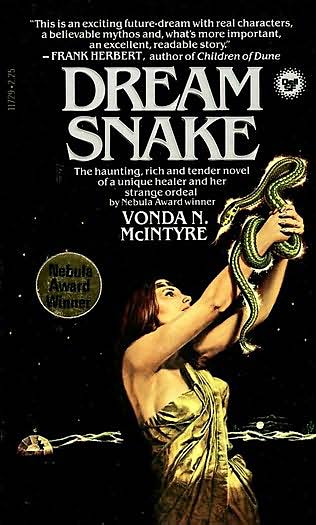
Yes, the cover of this book's 1986 mass-market paperback edition makes it look like it’s going to be one of those super-goofy magical fantasy novels. But it’s really quite good.

It takes place on a post-nuclear-war Earth (always a good start). Nobody remembers what society was like before the war – or even that there was a war. They are all living either in small towns or as nomads in the countryside. All overt modern science and technology has been lost.

Or – that is what it appears at first. It turns out that some science does remain, although it is not very well understood, even by its practitioners.

For example, the main character, Snake, is a healer. She has a set of venomous snakes that she uses to cure people. At first it seems like random ritual but it turns out that the snake venom actually is an antibiotic and that the training the healer received was essentially first aid and basic nursing – so there is a reason why it really does work.

At the beginning of the story her key medicinal snake, the Dreamsnake, accidentally gets killed by scared townspeople and Snake has to go on a long journey to find another one. Along the way she also happens to be able to get the people of the towns and the people in the countryside to stop being prejudiced against each other. It is an okay road trip story; the characters Snake meets up with are mostly interesting and the locations are good. I especially liked reading about how the land is spotted with giant pits—which everyone avoids—that you gradually realize are nuclear bomb craters still full of radioactivity.

But I definitely thought the best part of this book was the way McIntyre presented an apparently undeveloped, backwards world and then gradually allowed you to see how science lay under the superstition. Like A Canticle for Leibowitz, it was a good take on how knowledge might survive but be transformed after the sophisticated structure around it is lost.


An earlier version of this review originally appeared on Cheeze Blog.

Friday, June 14, 2013

Book Review: Riddley Walker

Russell Hoban
1980
Awards: Campbell

Nominations: Nebula
Rating: ★ ★ ★ ★ –
 

When I originally set myself the project of reading all the Nebula and Hugo award-winning novels, I told myself I would get through all the winners of those two awards before reviewing those that had won others or were “just” nominees.

But when this book came across my transom, I could not resist breaking my own rules for it. I’m so very glad I did.

This book is set in England thousands of years after a 20th-century nuclear war destroyed most life on earth. Almost all literacy and technical knowledge was lost with the war, and humanity—what’s left of it—has reverted to Iron-Age-level hunting and gathering and some agriculture. The history-turned-mythology of the war is passed on through a sort of confused puppet show put on by traveling actors.

In general, the populace has a natural hostility towards education and what they call the “clevverness,” or scientific knowledge, which led to the war in the first place. But there are nevertheless people here and there who are surreptitiously working to regain that lost knowledge.

The narrator of the book, Riddley Walker, is a somewhat slow but sympathetic character who isn’t actively pursuing knowledge, but whose natural curiosity makes him want to make sense of the myths he’s being fed. This is one of the reasons he is our narrator—he is one of the few who had the desire to learn how to read and write. At the age of twelve, Riddley sees his father killed on a foraging job and has to take over his father’s role of “connexion man,” a sort of seer or interpreter of events. This special status separates him subtly from his peers and further encourages him to analyze and question what he sees around him.

Eventually, through a series of misadventures partially brought on by his inquisitiveness, Riddley discovers key pieces of information and material that could help to restore bomb-making knowledge and he has to go on the lam to escape from those who would kill him for it and/or use it for their own nefarious purposes.

The most striking thing about this book is not the story, however, but how it is written. The book is written by Riddley in his own native post-apocalyptic language, which is a semi-literate jumble of phonetic spelling, altered grammar, and long words broken down into shorter one- or two-syllable words. Some examples of the language used by Riddley and his peers:
"Down it come that girt big thing it made a jynt splosh and black muck going up slow and hy in to the air. That girt old black machine fel back in to the muck with my dad unner neath of it."
"'If you cud jus suck your thumb qwyet for a wyl and stop giving me inner fearents I cud tune in better.'" 
"'To have them boats in the air which they callit them space craf and them picters on the wind which that wer viddyo and going out beyont the sarvering gallack seas.'"
It is pretty darned hard to read, especially at first. When I try to imagine why this book didn’t win the Nebula in 1981, all I can think is that the voters that year didn’t have the patience to make it through the first twenty pages or so to get used to Riddley’s speech, so they gave up and gave the award to a lesser book that was easier to read (Gene Wolfe’s Claw of the Conciliator). Fortunately, the John W. Campbell Memorial Award committee had a little more perseverance.

Hoban said that he wanted to write the book this way to slow the reader down to Riddley’s level of comprehension. And it does give you time to think about what is going on at the same pace Riddley does; it brings you into his mindset—and his world—in a way you wouldn’t necessarily get if he used contemporary English.

I found myself, naturally, comparing this book to other pieces of post-apocalyptic literature. It reminded me a tiny bit of The Road, in its desolation and occasional cannibalism, but (unlike The Road) it wasn’t so nightmarish as to be unreadable.

No, happily, the book it reminded me of the most was the great Canticle for Leibowitz. Like Leibowitz, it takes place on Earth after a devastating nuclear war has set society back several thousand years. As in Leibowitz, the story of the war and resulting devastation had been turned into barely-remembered, largely misinterpreted, and often pretty funny legend and myth. And both books suggest that humanity has a scary homing instinct; that even after such an awful war, the survivors will eventually try to regain the scientific knowledge that caused the war in the first place. You get the gnawing feeling that we will keep destroying ourselves over and over in a dreadful cycle.

I didn’t realize until after I had read Riddley that I had already read one of Russell Hoban’s other books long ago: The Mouse and His Child. That book was pretty dark and disturbing, too, especially for a children’s story, and I loved it. 


An earlier version of this review originally appeared on Cheeze Blog.