Showing posts with label Space Stations. Show all posts

Friday, August 23, 2019

Book Review: Cuckoo’s Egg

C.J. Cherryh
1985
Nominations: Hugo
Rating: ★ – – – –

SPOILER ALERT...but does it really matter?

You just never know where your most excruciating reading experiences are going to come from. My most recent came in the form of Cuckoo’s Egg: a slim, 200-page novel that offers the reader a unique combination of boredom and pain, and which took me a good two months to force my way through.

Cuckoo’s Egg is purportedly the story of a rigorously dutiful, misunderstood warrior and the child he sacrifices nearly everything to raise alone. But it is really the story of a co-dependent, abusive relationship, thinly disguised by an abstract writing style and held together by the thinnest of plots.

On a distant planet orbiting a distant star lives an intelligent, bipedal dog-like species with nascent spacefaring technology and a highly developed social structure. Duun, one of our two co-protagonists, is one of these dog-creatures. He is a battle-scarred, tough-as-nails, high-ranking member of the hatani, a class of soldiers who are bound by tradition and duty to do the unpleasant but necessary work that more polite society won’t do itself. The hatani are on the fringes of respectability: needed and respected by the common folk for the work that they do, but, at the same time, feared because of their military skill, and resented for the fact that they have to exist at all.

For reasons we don’t learn until the very end of the book, Duun is assigned a human baby to raise as his own. The baby is called Thorn. Duun raises Thorn as his own son, on his country estate, with no one else around but the peasants he displaced to claim his ancestral lands, who are a bit ticked off about being displaced.

As Thorn grows from babyhood into teenagehood, Duun raises him to be tough—very tough. Dunn challenges him constantly, both physically and with tricky, hostile riddles. And the masters of the hatani also put Thorn through somewhat ridiculous Kung-Fu-like tests, which include things like having to scour his rooms for the tiniest pebbles that were put there to see if he could find them all. 

But Thorn is sensitive. He can’t really be as tough as Duun wants him to be. His heart is in his throat every time he is tested; indeed, his heart has been in his throat for almost all of his entire short life up to this point. And there is no obvious reason why his upbringing has had to be this harsh. He lives in seemingly pointless fear and suffers seemingly pointless cruelty from Duun and the hatani masters, all under the guise of it being for his own protection.

When Thorn is a teenager, he actually gets up enough gumption to run away. But he is almost killed by scared villagers, and Duun has to rescue him, and has to kill a villager to do it. Which, in turn, means that Duun and Thorn have to abandon the country estate for the city where there won’t be angry villagers at every turn waiting for either one of them to make a misstep.

I think Thorn believes that Duun loves and protects him. And I think Duun believes that he loves Thorn. And I think Cherryh believes that she’s portraying a loving and protecting relationship that has been forced into harshness by circumstance. But their relationship is really one of toxic abuse and manipulation.

When they move to the city, Thorn finally gets to have company his own age; he is put into an actual classroom with four classmates. But they are more his tutors than his peers; they stay aloof from him even as they teach him; and they reinforce for him just how different he is from everyone else. And when Thorn falls for one of his classmates and tries to kiss her, he gets in trouble and she is immediately removed. (To add insult to injury, she is also revealed to have been an agent of the ghotanin, unscrupulous mercenaries who are the rivals of the hatani and who are trying to gain information about Thorn.)

As the nearly irrelevant plot plugs along, eventually, as part of his education, Thorn is forced to learn to reproduce what seem to be nonsense vocalizations, played on tapes, sound for sound. Gradually, though, he realizes that the taped voices are actually speaking a strange language, and the only known source of that language is the tapes that they’re making him memorize. And the more he listens to the tapes, the more he starts to understand them. And his dreams start to match what he hears: he starts to dream about a space station, filled with people like him—humans.

Meanwhile, the ghotani step up their attacks against the hatani, forcing Duun to step up his Thorn timeline, and finally, mercifully, forcing Cherryh to reveal Thorn’s purpose. It turns out that the tapes Thorn was forced to memorize are indeed from humans. Apparently a ship of them arrived at Duun’s planet a very long time ago. Duun’s people accidentally killed them all, but the humans back on Earth are still sending messages in an attempt to reach their long-lost ship. So the hatani created Thorn as a clone based on genetic information taken from the original ship’s passengers, and they hope that he will be able to translate what the human messages are sayingso as to hopefully either serve as an ambassador to broker a peace, or at least warn them when more humans will be coming.

Duun takes Thorn up into space, to a space station, to interpret the new messages being received from Earth by the station’s radio. And there, after about 150 pages of the total 175 or so, Duun stops manipulating and playing needless mind games, and finally gives Thorn a little honesty.

But it is about 149 pages too late. And I barely was able to make it that far as it was. Most of the time, while reading this book, I would read one paragraph and then, before I got very far into the next one, find myself zoning out, looking up, reading the ads on the bus, making grocery lists in my head. 

Sometimes it was because of the unrelentingly, needlessly cruel relationship between Duun and Thorn. It was a life that kept Thorn constantly off balance, with Duun one moment seemingly on the verge of kindness and then the next moment spinning off into anger and violence. Thorn lives in desperation; he hates Duun, but is terrified of being abandoned on a world where he knows no one else. All of his needs for trust and friendship and kindness and love are denied and invalidated.

And other times it was because I just did not care. Neither one of the main characters is in any way appealing, and neither one gave me any reason to want to find out what happened to him. And, in fact, nothing ever really does. There is zero reward for sitting through the unremitting cruelty of this dysfunctional relationship.

Friday, July 28, 2017

Book Review: Jack Glass: The Story of a Murderer

Adam Roberts
2012
Awards: Campbell
Rating: ★ ★ ★ – –

MINOR SPOILER ALERT

Adam Roberts says in his acknowledgements that in Jack Glass he was trying to blend Golden Age science fiction (the era of Campbell, Asimov, and Heinlein when space-exploration sci-fi first began to capture a larger audience) with Golden Age detective fiction (the era of the classic Miss-Marple-type misdirection whodunit).

He has done an able job of it. His novel is a series of relatively fast-moving brain-teasers, and the puzzling circumstances surrounding each of the murders are clever and creative. He has also created a credible science fiction environment in which humanity has colonized several planets, moons, and asteroids. And, for the most part, the storytelling keeps you turning the pages.

Roberts breaks the story up into three parts, each one centered on a different murder, with each murder involving the notorious, elusive criminal Jack Glass in some way. The first part of the book is definitely the most gripping (and also the most gory).

In the universe of Jack Glass, our solar system is run by a set of hereditary oligarchs, the Ulanovs, who rule with a firm hand. In their criminal justice system, if you commit any crime short of than murder, your penalty is to be taken out to the asteroid belt and sealed into a hollowed-out asteroid with an air scrubber, a drill, and some food spores. They come back to get you in eleven years and if you survive until then, you’re free. If you don’t, well—you don’t.

In the first part of the book, Jack Glass, the notorious, legless criminal who, some say, has killed thousands (or possibly millions) of people, is captured for a lesser crime and thrown into an asteroid with six other convicts. The story follows them as they scrabble for life during the first couple years of their term, drilling for ice, growing food, and establishing a somewhat tenuous and ruthless hierarchy.

It is a horrific situation, especially for Jack, as one of the lower men on the totem pole. He’s clearly the smartest of the prisoners, and he has flashes of anger when the others behave idiotically and cruelly towards him and each other. But, for the most part, he is able to hold himself in, maintaining incredible control, realizing his life depends on patience.

The story gets progressively harder to take emotionally, even as the men are able to achieve some stability in their physical comfort. But, finally, Jack is able to escape in a brilliant (if gruesome, twisted, and murder-filled) getaway.

Many years then pass between Jack’s asteroid escape and the second part of the book, which is the weakest section of the novel.

In the Ulanov’s solar system, many specialized functions are done by noble houses of elites bred specifically for their jobs: transport, commerce, science, and so on. The Ulanovs need these noble houses, but are also wary of them, since they are all potential rivals for power.

The story slows to a crawl as we follow 16-year-old Diana, one of the daughters and heirs of the one of these houses: Clan Argent, the Transport House. Diana has been bred for creative problem-solving, so when one of her servants is murdered while she’s vacationing on Earth, the police defer to her to solve the murder. But she is a typical bratty, privileged 16-year-old—breathless, impatient, haughty, inconsiderate, self-centered, and full of aristocratic prejudice and cruelty. It’s difficult to find the motivation to keep reading through most of part two when Diana is the one you have to follow.

If you keep plugging, the story finally does start to pick up a bit when someone bombs the compound where Diana is staying and she has to flee. Diana and her servant Sapho are bundled into a shuttlecraft and rescued—by none other than the notorious, unassuming criminal Jack Glass.

Diana doesn’t realize it, but rumors have been swirling around the solar system that her clan has the secret to faster-than-light propulsion. The three escapees theorize that the other clans—or possibly the Ulanovs themselves—are trying to kidnap her in an attempt to get the FTL technology.

During their escape, cut off from her ever-present technology, realizing people are trying to kill her and that she has no more control over her surroundings, Diana finally starts to grow up. She feels ashamed of how she acted, and starts to take more responsibility for herself and others. This starts to make it a lot easier to read again, and somewhat more appealing again as a story…

…Just in time for part three of the novel (the second-best part), which lopes along relatively easily (albeit not as excitingly as part one) to the end of the book. This part starts with Jack, Diana, and Sapho caught up in the circumstances of yet another murder: this time, the murder of celebrated police detective Bar-le-Duc.

The third part starts with Jack, Diana, and Sapho fleeing from Earth to Jack’s secret bubble house in the “Sump,” the haphazard settlements beyond the moon where the poor subsist on spore-based food and recycled air. The Sump is also a hive of rebellion against the Ulanovs, which is why Jack has his house there; it is at this point that we discover that he is actually a highly principled anti-imperial activist who cares deeply about the entire human race.

And, it turns out, his rescue of Diana was not a coincidence at all. Jack knows that the physics of any FTL drive—including the one that Diana’s house theoretically has—by definition put it at risk of being made into an enormous bomb that could wipe out the solar system and thus the whole human race. Jack is willing to protect Diana with his life to prevent anyone from getting hold of it.

Thus they plan to hide in Jack’s house to prevent anyone from getting at Diana. Celebrated police detective Bar-le-Duc catches up with them, but, before he can bring them in, he is shot from inside the house, but by no one who was in the house at the time. And it is all caught on video by a robot.

They are thus faced with yet another mystery to solve, in a race against time before they are caught by authorities and accused of Bar-le-Duc’s murder. And, while they’re at it, they have to figure out who is behind Diana’s attempted assassination/kidnaping, if the FTL device really exists, and if they can prevent it from ever being used.

All three murders are “locked-room” mysteries, and all three are pretty clever. On the whole, Jack Glass is a good blend of classic sci-fi and detective fiction, as the author intended. Jack is charismatic and a good character to follow; a touch sinister but with strong, valiant political ideals. (Although, as I say, Diana leaves something to be desired.) The plot does step along apace, for the most part. (Although, as I say, the first section is definitely the most riveting and might have made for an excellent novella all by itself.) And one fun thing is that Roberts certainly is not hesitant about describing gore in incredibly creative ways—particularly the behavior of blood in zero gee (or in one gee, from the point of view of someone who has lived their whole life in space, which is a mind-warping way to look at it).

Friday, June 3, 2016

Book Review: Moonfall

Jack McDevitt
1998
Nominations: Nebula
Rating: ★ ★ ★ – –

Moonfall is a disaster novel that does not hold back. It contains just about every kind of space- and Earth-based natural disaster you could possibly think of, except possibly killer tornadoes.  And the disasters come one after the other in rapid succession—just as one is being solved, a worse one is looming on the horizon—so the characters have no time to plan very far ahead, much less to sleep.

Before this, I had only read McDevitt’s space exploration novels, which I like very much and which are shorter and crisper and tend to be more about intrigue than action. But with Moonfall I was impressed with his creativity, his realism, and how he managed the pacing to keep the tension going at a high level from beginning to end in this longer format.

This book starts, as any good disaster novel should, with calm opening scenes of ordinary people going about their work and hobbies and family lives as usual, never suspecting that within hours everything is going to change drastically.

One of these ordinary people is Tomiko Harrington, an amateur astronomer out on a clear night in 2024 near St. Louis observing a total solar eclipse. During the eclipse she spots a star she has never seen before and that shouldn’t be there, and reports it to the authorities.

Gradually, the authorities realize that (a) the anomalous star is a comet; (b) it’s an interstellar comet traveling about a hundred times faster than a normal comet; (c) it’s headed straight for the moon and will get there in a matter of days.

Charlie Haskell, the U.S. vice president, actually happens to be on the moon at the time. He’s there with a whole bunch of staffers and Secret Service personnel to do a ribbon-cutting ceremony for the official opening of the U.S.’s new Moonbase installation. And there are also about 1,700 scientists and administrators living at Moonbase already. But nobody is all that worried; they think they have enough space vehicles of various kinds to evacuate everyone to safety either to Earth or to an orbital space station by the time the comet hits.

Except that, of course, they have mechanical difficulties with a couple of the space planes. And, with the complications that result, it turns out that they don’t actually have enough time to get everyone off the moon after all. And, unfortunately for Vice President Haskell, he has already said publicly that he’d be the last one off—to “close the door and turn out the lights”—never thinking that might mean he’d be in mortal danger.

Because by now the astronomers have realized that since the comet is traveling so fast, it has the force to actually break the moon apart completely when it hits.

And to make matters worse, if the moon breaks up, there is the distinct possibility that chunks—potentially really big chunks—of moon rock will fall onto the Earth.

As this is all happening, the tension is gradually increasing, ramping up slowly but steadily until you and all the characters are wound as tight as drums. By the time the last plane arrives at Moonbase to try to pull off a daring rescue of the vice president and five other people who have volunteered to be the last to leave, everyone is racing around, trying to get the vehicle fueled and loaded and off the ground as fast as possible. There is no time to spare, and the anxiety is palpable.

Then, seconds after they lift off, the comet actually hits the moon and everything switches almost into slow motion. The impact itself is beautifully written; it seemed very realistic, with the blinding light of the actual explosion sweeping over the moon and then the moon’s surface first shuddering and trembling and then starting to collapse.

And then, after that moment’s pause, the pace shifts into high gear again as the vice president’s plane attempts to outrun the rapidly expanding shock wave of fire and chunks of moon debris the size of city blocks.

After that, the characters have to discover, evaluate, and solve one disaster after another that with the barest of resources and almost no sleep. Sure enough, the moon does break up and pieces do fall to earth, causing earthquakes, landslides, and super-giant tidal waves that wipe out most of both U.S. coasts. And the whole time, the passenger-bearing space planes have their own mini-disasters, running out of fuel and air and being hit by moon shrapnel. McDevitt also often gives you clues as to what is about to go wrong, which is great because knowing that it’s going to happen and having to wait for it makes it all the more tense.

Eventually, the little multivariate disasters subside and the main characters’ concerns narrow down to one central final crisis: a moon rock a kilometer and a half long that is headed straight for Earth. This is a giant civilization-killer of a meteor and everybody has to pull together to figure out a solution. Except that by now they’re down to their last seven remaining space planes, and right-wing militia members, misguidedly seeing an opportunity in the pending apocalypse, are trying to use rocket launchers to shoot down the planes.

The only real issue I had with the book was that the narrative had a tendency to get scattered. McDevitt does spend most of his time on the stories of his main characters: the vice president, the president, some key space station personnel, and a couple of the space pilots. But he also sprinkles in lots of little vignettes about random minor characters, many of whom only appear once or twice: a woman at a Manhattan cocktail party; a Coast Guard cutter captain off Long Island Sound; a retiree in Rhode Island; a nurse in San Francisco; a furniture factory manager in Pennsylvania.

He does create a good diversity of characters, and it might have seemed a good way to help us monitor what was happening in different parts of the United States while the central action was happening in space, but it was just too many stories to follow, especially when they didn't lead anywhere. I didn’t know which ones to settle into and which ones I could safely coast through as just background color. And we often snapped from one to the other very quickly, so at times it made the flow feel choppy.

But, in general, McDevitt’s pacing, realism, and talent for telling the central story make up for the sometimes choppiness. As would happen in a catastrophe of this size, lots of people in leadership positions do not come out looking very good (including the president). And all kinds of people become heroes who never expected to be (including the vice president, who somehow ends up single-handedly solving almost every problem that crops up in space). And many people do die. And the tension continues right to the end; even up to the very last two pages, you still aren’t sure, after everything the Earth's people have been through, if they’re going to survive the final mega-meteor disaster or not.

Friday, March 20, 2015

Book Review: Mindscan

Robert J. Sawyer
2005
Awards: Campbell
Rating: ★ ★ – –  

Mindscan is another of Sawyer’s forays into the gray area between life and artificial intelligence, and into unanswerable philosophical questions such as: what is consciousness? And how can you prove objectively whether someone or something has it? The book is a quick read, but it is not as fully formed or as well resolved as his earlier novel The Terminal Experiment, which dealt with similar topics.

In the prologue to Mindscan, our protagonist, Jake Sullivan, is a young man in his twenties. Jake is having an argument with his father when his father suddenly drops dead due to what turns out to be a congenital defect in the blood vessels in his brain. Jake then learns that he has the same condition that killed his father, and that, in all likelihood, it will kill him, too, at an early age. Jake is then forced to severely curtail his activities to try to prolong his life.

By the time Jake is in his forties, a private company called Immortex has developed a process by which they can port a complete copy of your brain—including memories, thoughts, and feelings—into an artificial, upgradable robotic body that is durable enough to last virtually forever.

In effect, the process splits you into two identical people: one in your original organic body and one in a new mechanical one. To avoid the potential legal hassles that could come from you having two instantiations of yourself, the artificial version stays on Earth and is given all of your legal rights, and the organic original is sent up to an all-inclusive luxury resort on the dark side of the moon, where it whiles away the rest of its natural life in isolated comfort.

Because of this, and because the whole package is very, very expensive, it is primarily done only by extremely wealthy older people who have at most a year or two to live. Jake is atypically young, but he is the heir of a vast Canadian brewery fortune so he has the money to do it. Frustrated by the way his life is circumscribed by his condition, he opts to get the procedure. Afterwards, we follow the story lines of both the original organic Jake and the new mechanical one.

The new mechanical version—the “Mindscan”—has a hard time adjusting at first. His mother, his dog, and the girl he likes are all creeped out by his new form and don’t accept him as the real Jake. Fortunately, he is eventually able to find acceptance and even love with his fellow Mindscans.

Soon after he starts dating his Mindscan girlfriend Karen, Karen’s original organic version dies. Her son then files suit to have her legally declared dead and her assets distributed to him, even though the mechanical copy of her is still alive. The whole thing then turns into a big legal civil rights battle over whether a mechanical body with a mind-scanned copy of a brain is actually the person it claims to be.

Mindscan Jake stays supportively at Karen’s side through the entire trial. As it drags on, though, he starts hearing voices in his head—specifically, his own voice—which makes him suspect nefarious doings at Immortex, including them possibly making additional copies of him with whom he is somehow mentally connected.

Meanwhile, Jake’s original body—the “shed skin”—wakes up pissed off when he realizes that he is the copy of the consciousness that is going to die. (What did he think was going to happen? Of course one of them has to be the original instantiation of his brain, stuck in his original body.) He goes to the moon to live out the remainder of his life, but he remains cranky and has a hard time settling into his new lunar environment.

And then matters are complicated when a doctor on Earth develops a cure for his brain condition. His corporate caretakers/jailers agree to let the doctor fly up to give him the cure, but afterwards they won’t let organic Jake leave the moon. Too many legal complications, for them and for him, they say.

Organic Jake’s anger builds until he eventually takes drastic action to force the issue. This inevitably results in the two Jakes meeting each other—with disastrous consequences.

This book's subject matter had good solid potential. Unfortunately, its execution was awkward and uninspiring.

  • First and foremost, the legal battle over Karen’s personhood, which takes up a large portion of the book, is unconvincing. The defense reveals surprise information during cross-examination that the judge already knows about but the prosecution doesn’t, which doesn’t seem allowable. Objections are sustained and overruled at weird times for tenuous reasons. And the arguments used by both sides are primarily emotional and philosophical, and practically free of legal content.
  • The Mindscans’ physical construction seems inconsistent. They can feel some things (touch, heat, wind) but not others (air pressure, pain, smell).
Wall-e
  • It’s strange to me that everyone reacts so negatively to the Mindscans. Almost every organic human they come in contact with on Earth is at least uncomfortable with and often overtly hostile to them. I mean, this isn’t 1938; this is the mid-21st century. Is there really no one ready to accept a sentient robot? Has no one read any Asimov? Has no one heard of R2-D2? Data? Wall-E?
  • The story takes place in a North America of the very near future, and the narrative jars badly when the author’s guesses about our current time are wrong. For one thing, in this book, Pat Buchanan is a former U.S. president, when I don’t think he will realistically ever try to run again. In the book, gay marriage is illegal across the U.S., when it looks very much like that tide is moving irrevocably in the opposite direction. And perhaps the saddest non-true historical-future fact in the book is that Christopher Reeve is alive and walking, a testament to advancement in the neurosciences.
  • And, finally, the whole Immortex conspiracy business is wrapped up at the end very abruptly, almost as an afterthought. It turns out to be disappointingly unambitious without any real evil intent behind it, and it is quite dissatisfying.
As I said before, this book does raise big, interesting questions, such as: Can you prove an entity has consciousness? How about a mechanical entity? If an entity of any kind passes the Turing test, and no one can tell that it isn’t conscious and self-aware, is that the same thing as it being conscious and self-aware? Should we consider it to be legally alive?
                                               
These questions deserve a solid story line to explore them. As I was reading this book and feeling frustrated by its inadequacies, I remembered that just such a solid story line did exist—in the form of the Star Trek: The Next Generation episode “The Measure of a Man.” 

In that episode, a scientist wants to take the android Data apart and dissect his brain for research. Data naturally objects, and eventually the controversy leads to a trial in which Data essentially has to prove that he is a sentient being and therefore deserves not be dissected if he doesn’t want to be dissected. 

The episode is wonderfully done, and is a much better presentation of the issues than Mindscan. The Star Trek trial is much more focused than the Mindscan trial on figuring out appropriate criteria for sentience and the legal provability of self-awareness. And the episode's writers are good at exposing arguments that are either red herrings or are too undefined to use as legal proof.

Friday, November 7, 2014

Book Review: Helliconia Spring

Brian W. Aldiss
1982
Awards: Campbell
Nominations: Nebula, Locus
Rating: ★ ★ – – –

SPOILER ALERT

Sometimes it seems to me that every lengthy science fiction novel published in the ‘50s and ‘60s was promoted as “the greatest epic since The Lord of the Rings,” and that every lengthy science fiction novel published in the ‘70s and ‘80s was promoted as “the greatest epic since Dune.”

Very few of the books thus described actually measure up to either of these standards. Helliconia Spring is a case in point, advertised on its back cover as “the most magnificent epic since Dune.” It certainly is epic in its ambition, but as for its magnificence, I beg to differ.

Helliconia Spring is set on Helliconia, an Earth-like planet orbiting a binary star system. Helliconia circles its primary star once every 2,000 Earth years. During each of these Helliconian years the planet suffers through a devastating, icy-cold winter that is 600 Earth years long.

This means that the inhabitants are stuck in a stultifying cycle: civilizations flourish and advance technologically during the summers, but then any progress they make is wiped out when winter comes; the cold drives them back to a hunter-gatherer existence, leaving them to scrape out whatever kind of living they can.

The novel sweeps across hundreds of Earth years, starting in the middle of one of these prolonged winters and ending with the onset of spring. It mainly tells the life stories of three principal patriarchs of the same family, several generations apart (but there are plenty of digressions into other characters’ narratives along the way).

The first of these patriarchs is Yuli, a nomadic hunter living deep in the heart of winter. Yuli and his father are out on a hunting trip when they are attacked by a band of the other intelligent beings living on Helliconia: the horned, furry, goat-like, human-hating phagors. The phagors kill Yuli’s father but Yuli himself escapes. Eventually Yuli finds his way to Pannoval, a huge and relatively advanced but repressive underground city where he is adopted into a foster family. He gets the best education Pannoval can give him and even becomes a priest, but he never forgets his former life above ground. Eventually he runs away from Pannoval with a few friends and makes his way back up to the surface where he founds a new village, Oldorando.

The story is then taken up many generations later with Yuli’s direct descendant “Little” Yuli, who is the leader of the now much larger town of Oldorando. Little Yuli gets pretty short shrift; he dies soon after he is introduced, and we learn more about his life from the stories told by the citizens gathered at his funeral rather than seeing events happen for ourselves. The main contribution Little Yuli makes to the novel is that his death opens up a succession controversy; his only child is a daughter (and everyone knows that women cannot rule), and his only grandson, Laintal Ay, is too little to govern.

The rest of the book is a frustratingly aimless recitation of Laintal Ay’s twisting, turning early life story. He grows up under a series of interim town leaders, none of whom are model citizens. He becomes a trusted lieutenant of one of them, then falls out of favor; he falls in love and is rewarded, and then rebuffed; he goes on a heart-stricken pilgrimage far away during which he contracts a horrible disease, then he comes back.

I started out optimistically at the beginning of this book, moderately bored but hopeful that it would pick up steam, and ended up actively resentful at sitting through meandering story lines with little resolution to them. Time really whips along: people grow, marry, have children, and die, and you can barely keep track of them (and barely want to). At one point, in just six pages, Oldorando changed from a backwards agricultural settlement to a village that launched mounted raids on other villages to a trade economy using metal currency.

There are occasional tantalizing hints of more interesting things we could explore further—in particular, an approaching phagor invasion, a woman who revolts against traditional women’s work and founds an academy of learning, and an Earth observation satellite hovering unseen above all the action—but we get no real long-term satisfaction from of any of them.

I think Lord of the Rings and Dune worked as epics because, even though they are incredibly long and detailed, they also center on distinctive, charismatic characters that I really grew to know and understand and often care about. Helliconia Spring, on the other hand, is more of a dispassionate biblical litany, a string of names and places and incidents happening to people to whom I felt no particular attachment.

The tone isn’t helped by Aldiss’ somewhat formal prose and his frequent use of the passive voice, as in “the Vakka had been bridged” and “his figure could be seen.” The characters’ names also tend to be a little bit ridiculous, and are easy to confuse with each other if you aren’t paying close enough attention. To wit:
                                          
Raynil Layan
Laintal Ay
Loil Bry
            Loilanun
Eline Tal
Rol Sakil
            Dol Sakil
            Hrr-Brahl Yprt
Yhamm-Whrrmar

I think I am probably more disappointed in this book than I might otherwise be because I had higher expectations for Aldiss. His novella The Saliva Tree, which won the Nebula in 1965, was really very good. It just may be that the epic is not his best format.

Friday, September 26, 2014

Book Review: Titan (by Ben Bova)

Ben Bova
2006
Awards: Campbell
Rating: ★ ★ – – –

Before I begin trashing the plot and characters of Ben Bova’s Titan, let me say first that the parts of this book that were actually directly related to science fiction are fine. Bova does a perfectly reasonable job of describing futuristic capabilities of medical nanotechnology, the components of a space station habitat, and the methane slush and smog on the surface of Titan. Not as great a job as, say, Kim Stanley Robinson, but perfectly good.
                                                                      
Unfortunately, the science fiction parts of this book are largely drowned out by the irritating, unlikeable characters and the tiresome soap opera going on among them. Not to mention the tremendously awkward presentation of gender conflicts.

In Titan, a group of ten thousand people have all flown out together from Earth on the spacecraft Goddard and are now living in it in the orbit of Saturn. Their voyage has been funded by a coalition of universities and is primarily meant for scientific research, but the Goddard also carries Earth exiles, administrators, mechanics, and rich tourists interested in exploring the solar system.

The book has a huge cast of characters, few of whom have identifiably distinct personalities. And they are all introduced rapid-fire in the first part of the book, so there is no real chance to get to know any of them well. This is just one book in Bova’s multi-part “Grand Tour” series of solar system exploration and it’s possible that some of these characters would be more familiar and appealing to me if I had read the earlier installments of that series, but I haven’t, and they aren’t.

If any characters can be said to be particularly central to the plot, I guess it would be protagonist Pancho Lane and antagonist Malcolm Eberly. Lane is the retired former CEO of a giant tech company and an accomplished space pilot. She is on Goddard partly because she’s there visiting her sister Holly, and partly because she’s bored with life back on Earth. Eberly is the nauseatingly selfish and manipulative chief administrator of the Goddard habitat, and he is willing to do anything it takes to enhance his own power.

For most of the book, the main dramatic tension centers around Eberly’s run for reelection. He initially thinks he is a shoe-in, since he promises untold wealth for everyone in the habitat if they allow him to mine water from Saturn’s rings for export to other space outposts. But he doesn’t count on two things:

(1) Pancho Lane teaming up with an admiral, a stuntman, and a plucky group of scientists to try to prove that there are living organisms in the rings of Saturn, which would prevent them from being mined; and

(2) Pancho’s sister Holly Lane, who decides to run against Eberly in the election.

There is also a good amount of time spent on a secondary plotline about an exploratory probe sent to Titan. The probe goes dead as soon as it gets to the moon’s surface, and the leader of the project, Edouard Urbain, drives his staff over the edge of exhaustion trying to reactivate it. This story had far more potential than the election melodrama, but, unfortunately, nothing major plot-wise ever really came from it, so I sort of wondered what the point of it was.

No, unfortunately, far more time is spent not on exploratory moon probes but on internal habitat politics and, in particular, the grossly mishandled topic of zero population growth. The Goddard has limited space, so everyone on it signed an agreement that they wouldn’t have any children on the flight out to Saturn. Now that they have reached Saturn, however, they want to start having babies. Eberly refuses to even talk about it, so Holly runs against him, not because she thinks she has a prayer of winning, but just to force the issue.

The debate quickly divides the habitat cleanly down gender lines. Nearly 100% of all women aboard are apparently universally in favor of and desperately in need of the unfettered production of children, and nearly 100% of the men aboard, are at the very most, neutral on the topic, if not actively against it.

Some women on the ship refuse to have sex with their husbands until they agree to Holly’s platform—and their men, of course, relent. Holly’s rallies are almost 100% women except for a few men who have either been forced to come by their wives or who are there to cover it for the media.

And her speeches are smugly described by her supporters as “women’s issues,” even though population control in this context is hardly only a women’s issue. People are motivated to reproduce—or not—for a host of complex motives. There are plenty of men who want to have children. There are plenty of women who don’t. There are people of both sexes who are unsure. I think Bova thought that he was making a relevant cultural statement with this presentation of the topic. I couldn’t decide whether it was actually offensive, or just plain ridiculous.

Bova handles the writing of competent women, and their relationships with men and between each other, pretty badly in general. At one point, the head of the nanotech lab doesn’t want to re-assert a request for something she needs for her work because she doesn’t want to be thought of as a “nagging little woman.” At another point, two women—the head of the biology department and the leader of the project to find life in the rings of Saturn—can’t find a way to talk to each other professionally at first, but at last bond like giggling schoolgirls over lunch talking about how to get a man to like them.

And in another sparkling incident, one of these same women, the biology department head, tries to convince Urbain to let her work on a different project than his stuck probe. He refuses and she leaves his office crying, where she bumps into the meek, shy head of the computer science department. Her crying suddenly transforms the computer science head into a paragon of assertiveness who marches into Urbain’s office and demands that he treat his employees better. And then the biology department head and the computer science head promptly start dating.

One other thing I can’t help mentioning is that the sisters Holly and Pancho Lane have an incredibly annoying accent. One of them (Holly) is the head of human resources for the habitat and is running for chief administrator, and the other (Pancho) is a former head of a giant tech company and an accomplished space pilot. And yet they have this accent in which they use slang, jargon, and contractions in ways that make them sound like Valley Girls. It’s hard to take someone seriously when their vocabulary is sprinkled with f’real, c’mon, prob’ly, coupla, damfino, dontcha, jeeps, and terrif.

Okay, one more thing. Bova seems to be preoccupied with the chin as an indicator of emotion. I counted six instances where he had someone “dip” his or her “chin” to signify agreement (instead of, I suppose, just nodding). There are also a couple of times where someone scratches their chin to indicate confusion, and a couple times when people tipped their chins in surprise. It is a habit worthy of the lip-biting of Cyteen.

Friday, January 31, 2014

Book Review: Way Station

Clifford Simak
1963
Awards: Hugo
Rating: ★ ★ ★ ★ –

This is a little gem of a book. Simak’s writing is calm and un-showy, but it also keeps you very much engaged. His main character, Enoch Wallace, is a very appealing person: unusually understanding and tolerant of strangeness.

As a young man, Wallace was a soldier in the Civil War. Very disturbed by the experience, he returned from the war to his small house in an isolated part of rural Wisconsin to become basically a hermit.

As the years go by, Wallace keeps very much to himself. His neighbors comment to each other that he doesn’t really seem to be aging very fast but otherwise they hardly give him a thought.

The decades come and go and eventually it is the 1960s. The government authorities have finally started to pay attention to the vague local folklore about this man who supposedly was a soldier in the Civil War and yet still looks like he’s thirty. So they start snooping around his innocuous-looking shack of a house.

What they don’t realize is that Wallace is the keeper of a way station for interstellar travelers. When he first came back from the war, a benevolent intergalactic travel consortium identified him as someone who would be receptive and open to them and also as someone who could keep a very large secret. They began to use his house as a rest stop and a transfer point during their light-speed journeys across the universe. In return, they provide him with everything he needs to maintain the station, and they have made it so that he does not age at all when he’s inside his house. The only time he gets any older is when he goes outside to get the mail.

An added benefit to Wallace is that, as the keeper of the way station, he gets to meet many different kinds of extraterrestrials. He is a curious person, and wants to learn about these other beings, and even makes friends with some of them. He manages, with the aliens’ help, to keep up to date on technology and physics and current events so he knows what is going on in the world around him.

He very much enjoys his job--and I enjoyed it with him. I found myself admiring the open-minded, galactic-level perspective of the aliens. And I got caught up in the easy pace of Wallace's intellectually-stimulating responsibilities, wishing that the snoopers would just go away and his station-keeper life could just go on and on the way it has been forever.

But, inevitably, of course, there is trouble. The whole situation threatens to blow wide open after an alien traveler dies at his house while waiting for a transfer and the government investigators discover the body respectfully buried outside in Wallace’s 19th-century family plot.

The only real problem I had with the book was a bit of deus ex machina used at the end to resolve everything, which was unfortunate. But overall this was a fun and unexpectedly touching story.


An earlier version of this review originally appeared on Cheeze Blog.

Friday, December 20, 2013

Book Review: Foundation's Edge

Isaac Asimov
1983
Awards: Hugo, Locus
Nominations: Nebula
Rating: ★ ★ ★ – –

SPOILER ALERT…
…for all of Isaac Asimov’s other Foundation novels.

This is one of the last books in Asimov’s Foundation series (one of the most excellent and seminal bodies of work in science fiction), and builds on the characters and themes developed over the course of that series. It is therefore hard to describe this book without giving away a lot about the previous books in the set.

This book also incorporates elements of Asimov’s Robot series (yet another excellent and seminal work).

And, because the Foundation series deals with thousands of years of galactic history, it is hard to describe this book without going into a ridiculous amount of back story, which I’m not going to do here.

Clearly, then, the only thing for you to do is to read all the Robot and other Foundation books, in the correct order, and then to read this review, and then to read Foundation’s Edge. (To help you in this pursuit, a complete chronology of Asimov’s books can be found here.)

In the 1950s, Asimov began writing a series of books telling the story of the development of humanoid robots in our near future (the Robot series). He simultaneously began a separate series of books about the rise and fall and rise again of a galaxy-wide empire ruling millions of inhabited worlds in our very far future (the Foundation series). He wrote Foundation’s Edge about thirty years after finishing the last of the original Foundation and Robot novels, but he intertwines elements of both multi-ologies in this book in his same familiar, clear style as if there had been no break at all. This is a testament to the solidity and endurance of the characters, worlds, and concepts he created.

The Foundation novels are built around one primary character, Hari Seldon, the developer of the science of psychohistory. Psychohistory is sort of a combination of mass psychology, sociology, statistical modeling, and complex mathematics. Seldon is able to use it predict the future of all of galactic society.

What he forecasts is the inevitable decline of the decadent galactic empire (which is in its heyday while Seldon is alive), followed by a painful, chaotic period of several thousand years of division and war, and then the rise of a second (more benevolent) empire bringing peace and stability back to the galaxy. 

The violent interregnum has the potential to last from one thousand years to thirty thousand years, depending on which of several courses of action people take. So Seldon sets up a secret foundation of scholars and directs them to guide humanity towards the choices that will shorten the period of chaos as much as possible. He also records a series of holographic animations of himself to be played at key times in the future so he can help guide humanity himself even after he is dead. The Foundation series plays out this “Seldon plan” across hundreds of years of ups and downs and danger and turmoil.

One strange thing about the Foundation series is that it keeps your attention even though there is usually very little action. Often the major crisis in each book involves the characters working to prevent something from happening, rather than to make something happen. These crises usually center on a single skeptic who challenges the assumptions of the majority and who has to use logic and persistence to turn the others around. But it is Asimov’s particular genius that he makes this kind of story interesting and keeps the pages turning.

It helps that the whole concept of psychohistory is awesome and the character of Hari Seldon is enduring and appealing*. And, because Asimov covers thousands of years of history in his various novels, he has to invent a ton of other characters, not to mention worlds and governments and advances in technology, and he always does it with extraordinary clarity, believability, creativity, and humor.

This book, Foundation’s Edge, takes place 500 years into the chaotic interregnum. The original First Foundation (of regular people) and the Second Foundation (of telepaths) both appear to have things well in hand. Things are going perfectly in accordance with the Seldon Plan. Maybe a little too perfectly. People in both foundations grow suspicious that someone is manipulating all of them to align with the Plan, depriving them of independent action. Eventually, their investigations center on a mysterious lost planet, Gaia, which may or may not be the original Earth, and which may or may not be controlling them all without their knowledge, and which may or may not be able to control and/or destroy the entire universe.

Foundation's Edge was a mixed bag. It exhibits all the good characteristics of Asimov’s work. It also exhibits his annoying tendencies to give his characters silly names and to include a number of pert, very young women who are attracted to much older, professorial-type men.

I liked the First and Second Foundationers, their slow realization that they are being manipulated, and their search for the source of that manipulation in the first half of the book. But the second half was unsatisfactory. I didn’t really like what Gaia turned out to be. And I didn’t buy the climax of the plot, where there was a multiple-choice decision that had to be made to determine the fate of the galaxy and only one guy in the universe could make it. I didn't feel that this book necessarily deserved the Hugo Award, and it made me think that perhaps this book won it as a sentimental choice--a win to make up for all the other Foundation series novels that came out before the award was invented.

-----------

* Nobel-Prize-winning New York Times columnist Paul Krugman admits here that part of the reason he went into economics is because it is the closest thing we have to psychohistory.


An earlier version of this review originally appeared on Cheeze Blog.

Friday, November 29, 2013

Book Review: Seeker

Jack McDevitt
2005
Awards: Nebula
Rating: ★ ★ ★ ★ –

This book is great in many ways. It is an exciting detective story with appealing central characters, plenty of outer-space travel, and a satisfying ending.

The story takes place many centuries in the future, after humans have developed faster-than-light travel and colonized several worlds. It is narrated by Chase Kolpath, an interstellar pilot. Kolpath and her boss, Alex Benedict, make up the staff of Rainbow Enterprises, a company that explores remote sections of space, finds ancient artifacts from abandoned space stations and failed colonies, and sells the artifacts to collectors.

It is lucrative. But Kolpath and Benedict are always running afoul of academic archaeologists and historians who view their business as theft, and this tension pervades the entire book.

The book’s adventure begins when a woman asks Rainbow Enterprises to appraise an antique cup with the seal of the starship Seeker on it. The cup turns out to be 9,000 years old and to be, just possibly, a relic of an ancient lost colony.

In researching the cup, Kolpath and Benedict find out that back in the 25th century, Earth was poor, overpopulated, plague-stricken, and ruled by a series of harsh authoritarian regimes. A small group of idealists, the Margolians, fled Earth in two rickety starships, one of which was named Seeker. They may have successfully established a new Eden for themselves or they may have died in the attempt, but, either way, they were never heard from again.

Their fate at first became the subject of novels and films but gradually their memory faded to the point where most people in Kolpath & Benedict’s time now think they are merely a legend and never existed at all.

If the cup can be proven to be from this lost colony, and if it can be used to trace the colony’s location, it could be Rainbow Enterprises’ greatest find ever.

Together, Benedict and Kolpath unravel the secrets of the ancient emigrants. They do library research; they talk to avatars of the long-lost Margolians; they explore remote sections of outer space; they have daring adventures and evade several attempts on their life.

This was the first time I had read anything by Jack McDevitt. I liked it so much I immediately read the prequel, Polaris, which was just as good and which suffered not at all from being read out of order.

Stephen King has called McDevitt “the logical heir to Isaac Asimov and Arthur C. Clarke.” That is a pretty high bar, but King may just be right. McDevitt’s writing is straightforward and the process of putting together the pieces of the puzzle keeps your attention the whole time.

One of the things I liked best about this book (and about Polaris, too) was Chase Kolpath. She is matter-of-fact and thrives under pressure. People naturally call her by her last name. She is a great pilot and her boss respects her as such. Benedict is a better sleuth, but when his investigations repeatedly put their lives in immediate physical danger, she’s always the one who keeps her head clear and gets them out of it. She has a private life and keeps it private, from both her boss and largely from the reader, too. She likes a party and goes out with guys but doesn’t get attached to any one of them.

As a side project, Kolpath decides to watch all the films based on the Margolian legend. Her summaries of the plots of the movies she watches are really quite funny.

I also liked the ways that McDevitt layers fiction within fiction. He puts a quote at the beginning of each of his chapters, for example; sometimes it is from a real (19th-20th century) author, but more often it is from fake fiction or fake philosophy, written sometime during the 21st-26th centuries. Even the fake quotes don’t feel like the rest of McDevitt’s writing, so it really does feel like he is borrowing from other authors.


An earlier version of this review originally appeared on Cheeze Blog.

Friday, November 15, 2013

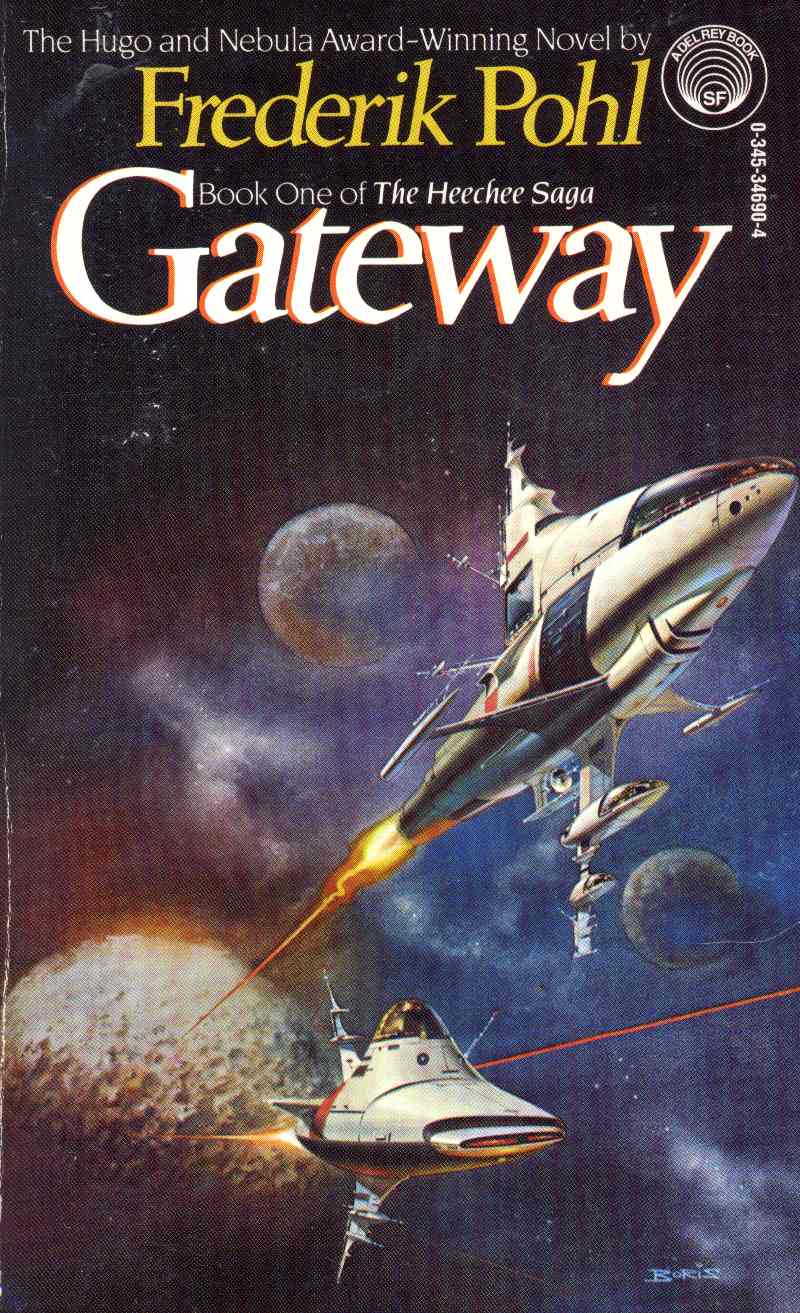
Book Review: Gateway

Frederik Pohl
1977
Awards: Nebula, Hugo, Campbell, Locus
Rating: ★ ★ ★ – –


The best thing about Gateway is the unique setting and very cool premise. And Pohl explores that setting and that premise with a story line that is interesting enough that it doesn't seem like it was created half-heartedly just to show off the universe he invented.

It is the relatively near future. During our exploration of nearby space, we have discovered a spaceport, which we have named "Gateway," which was been abandoned long ago by an alien species, who we have named the "Heechee."

The Heechee were highly technologically advanced and left behind an array of valuable artifacts at Gateway, including spaceships with the capability for hyperspace travel. There are many of these ships still fueled up and docked at the spaceport’s gates. Everything is in perfect working order. It is like the Heechee just up and left one day, leaving everything intact and running.

This discovery is a boon for mankind. And, conveniently, the Heechee appear to have been about our size and to have had similar environmental requirements as us, so it is possible for us to use their station and their ships in relative comfort.

The only catch is that we can’t read any of their instruction manuals or any of the indicators on any of their equipment. Everything we know about their technology we have learned from brute force experimentation – by getting into the ships, pressing a bunch of buttons, and seeing what happens.

We have learned some very basic things. We have figured out how to select a destination code and to start the ships on their journey. We know that once the ship is started, it will not deviate from its pre-programmed course and it will automatically return to Gateway on its own.

But we don’t know what the vast majority of the destination codes stand for. So most of the time we don’t know where the ship is going. We don’t know how to program it to turn around or go somewhere else while it is in flight. We don’t know how to tell how long the voyage is going to be. And we don’t know whether or not the ship actually has enough fuel to get there.

So an industry has grown up around Gateway in which a corporation hires people to risk their lives flying the Heechee ships to where ever the ships might take them, and then gives them a share of the profits if they (a) survive the trip and (b) find something that is useful to the company.

Sometimes the ships end up in the middle of a supernova. Sometimes they run out of fuel and never come back. Sometimes the ships return with a dead crew whose food or oxygen ran out before the trip was over.

But sometimes the ships take the crew to a brand-new planet that is habitable or has a supply of valuable ore. Sometimes it takes them to a new Heechee port with still more artifacts. And sometimes the trip gives us more of a clue to the navigation system. When anything like that happens, it makes the lucky crew on that ship very wealthy.

The main character, Bob Broadhead, is one of these Gateway pilots. His first two missions were small and uneventful. His third mission made him wealthy beyond his wildest dreams, but left him a traumatized wreck with guilt and nightmares that he can’t get rid of. 

The book starts with Broadhead in therapy (with a computerized therapist he calls Sigfrid von Shrink) after this third mission. Through flashbacks and sessions with Sigfrid, we learn first about Gateway and the Heechee, and then gradually what happened to Broadhead to make him both so wealthy and so messed up.

The best part of the book is the core premise: the Gateway spaceport and the ships that can set people up for life or kill them in any number of horrible ways. I also found it interesting to try to put together a picture of the Heechee from the stray bits that pilots discover here and there. 

Broadhead himself is not a terrifically inspiring character, however. And the story is not tremendously strong or arresting; it was adequate, but it was mainly the strength of the premise that carried my interest through to the end of the book.

And I do have to admit that although I can see that Broadhead’s third mission was scientifically very important, I don’t understand why it was of concrete monetary value to a corporation.


An earlier version of this review originally appeared on Cheeze Blog.

Friday, October 25, 2013

Book Review: Downbelow Station

C.J. Cherryh
1981
Awards: Hugo
Rating: ★ ★ ★ – –

This is a pretty complicated book about the economic and military conflicts surrounding the colonization of Pell’s World – the first habitable planet to be discovered outside our solar system.

In this story, space exploration is financed by The Company, an Earth-based corporation with Earth-centric views of how the natural resources of other planets should be used. The Company maintains their own military Fleet to protect those interests.


For years, missions to other solar systems have been limited because they could only travel so far from Earth, the only resupply center. But when Pell’s World is discovered, everything changes.

The Company builds a space station orbiting Pell and then a station on the surface of the world itself (which becomes known as Downbelow Station). Once they do this, spacefarers no longer have to rely solely on Earth for resupply, and can explore farther and farther out into the galaxy, which allows them to discover even more habitable worlds. And once there is a critical mass of humans living on planets other than Earth, they begin to question whether space exploration should still be entirely about exploiting other planets for Earth’s benefit or whether these other planets deserve to be self-supporting worlds of their own.

The Company doesn’t like this kind of thinking, of course, and it inevitably leads to tension between the Company, its Fleet, the union of non-Earth planets, and the independent merchant ships that fly between them, all of which culminates in a huge battle at Pell.

I have to admit that I didn’t really get into all the clashing ambitions of the various interest groups. The story was okay, but not always exciting enough to keep my attention through 500+ pages.

I also didn’t find many of the characters all that likeable. My favorite character, Emilio, was in Downbelow Station on the surface of Pell and most of the action took place in the space station orbiting the planet, so unfortunately I didn't see too much of him. There were also the Hisa, an intelligent species of animal indigenous to Pell, who are a little like chimpanzees and who are hired and/or exploited as workers by the humans. The Hisa were very nice and gentle but maybe just a little too annoyingly naive.

Cherryh does, however, do a great job constructing a realistic universe on a large scale and vivid settings on a small scale. The station orbiting Pell was well thought-out and well described; I could practically draw a map of it. The environment on the just-barely-habitable planet of Pell was also believable; it’s not a ridiculous Eden. Humans have to wear special breathers and the weather is chilly and dank.

And I think the greatest strength of this book is that it paints a believable picture of humans in the first stages of space colonization. It made total sense to me how the discovery of one habitable planet (and then another, and another) would fundamentally change both commerce and psychology. I could see how people would naturally start to split into those still attached to Earth and those who want to look beyond it.

It was what I imagine the early conditions would be that would lead up to Asimov's Foundation universe. It makes it seem entirely possible that over thousands and thousands of years of exploration, Earth could get left farther and farther behind until it is eventually forgotten. 


This review originally appeared on Cheeze Blog.

Friday, September 6, 2013

Book Review: The Forever War

Joe Haldeman
1974
Awards: Nebula, Hugo, Locus
Rating:

The Forever War is a novel about a centuries-long outer space war between our Earth forces and an alien enemy we know almost nothing about.

Haldeman, a Vietnam veteran, wrote The Forever War as a deliberate counterpoint to Robert Heinlein’s Starship Troopers, which was published fifteen years earlier. In Starship Troopers, the insect-like enemy is relentlessly vicious and homicidal, giving the soldiers a clear purpose and justification for their fight. In The Forever War, the humanoid enemy is about as competent (and incompetent) and about as aggressive (and cautious) as we are; we seem just to battle each other to a stalemate on remote outposts over and over and over again. And the reasons for the war become ever murkier as the decades roll by.

The Forever War may have originated as a response to Heinlein, but it ended up as a key work of science fiction in its own right. The book has a good plot and good characters, vivid battle scenes, and inventive futuristic technology. It is a realistic story of the monotony and anxiety of war preparation and the terror and confusion of battle told by someone who clearly went through it himself.

The novel’s main character is William Mandella, a relatively ordinary guy blessed with common sense, luck, and a master’s degree in physics. In 1997, at the age of 22, he is drafted into Earth’s interstellar army to fight the Taurans, a humanoid species from many light years away.

We on Earth first learned about the Taurans in 1996 when one of our spaceships on a routine colonial mission (near the constellation of Taurus) went missing, and data from a follow-up probe revealed that the ship had been destroyed by an alien vessel. Based only on this information, we naturally immediately launched an all-out war against them. We don’t know where their home planet is, and they don’t know where ours is, so we fight each other in relatively even-handed skirmishes around intermediate portal planets near where the first incident happened.

Earthlings and Taurans alike get to these portal planets by going through collapsars, wormhole-like features which let you travel to a specific point light years across the galaxy in a matter of days. While traveling through collapsars, soldiers experience time dilation: they age only the time it takes to get to the other side, while years and sometimes decades are passing by in the rest of the galaxy.
                                                                                 
This means that a battalion may arrive at a new post after what feels to them to be only a few months after their last assignment, but that the Taurans they meet next may be from decades in the real-time future, with correspondingly improved weapons. Soldiers never know from battle to battle what foe they will face.

This also means, of course, that any friends and relatives the soldiers leave behind on Earth will age for many years, and even decades, while the soldiers age only months. Each time the soldiers return to port, they have to cope with lost loved ones, as well as adjusting to new customs, language, money, and technology. This is, needless to say, very hard, and causes them to bond much more closely to their fellow soldiers than to people back home.
                                                                                                
Our hero, William Mandella, starts out as a private at the beginning of the war who manages, through a combination of luck and initiative, not to get killed in his first several battles. Racking up hundreds of years of seniority on Earth after each of his collapsar jumps, he gets inexorably promoted higher in the chain of command until he is a major after only a few real-time years of service.

But the more wartime experience Mandella has, the more he wonders whether there is any point whatsoever to what he is fighting for. No one seems to have idea of a general strategy; even after hundreds of years have gone by, the soldiers still fight ad hoc battle after ad hoc battle and make adjustments on the fly. Soldiers are not interested in winning a glorious, justified war, but in avoiding being killed. The training they go through takes place in conditions that bear no relationship to actual battle situations. There is little or no recognition from home of their sacrifice, aside from the fact that Earth’s economy has grown dependent on it and will collapse if the war ends. And during his entire term of service, Mandella has had to cope with the death of almost everyone he knows and loves, whether through time dilation or gruesome death in battle.

There are a few clunky aspects to the story, and others that seem to carry too obvious of a message to work. One in particular is the way Earth’s overpopulation prompts the planet at one point to create a program of enforced homosexuality and selected cloning.

But for the most part, Haldeman writes clearly and colorfully and doesn’t trip you up with vagueness or inconsistency or too-obvious messages. He tells a good story and at the same time leaves you with a deep sense of the cost—in lost lives, friendships, wealth, and mental stability—of a pointless, protracted war.