Showing posts with label Androids. Show all posts

Friday, February 7, 2020

Book Review: Project Pope

Clifford D. Simak
1981
Nominations: Hugo
Rating: ★ ★ ★ – –

I like Clifford Simak’s novels a lot, and I think part of the reason might be because he started out as a journalist. His writing is clear and accessible without being simplistic. His main characters tend to be thoughtful loners who still care about other people. And he is able to use his kind, thoughtful little stories to raise big questions about big topics, without being didactic about it.

Project Pope’s big questions all revolve around the reconciliation of faith with science in the search for truth. And as a framework for these questions, Simak invents a paradoxical thing: a society of robots trying to build a religion.

The actual plot is a little peculiar. There are certainly moments of violence, danger, and even at least one murder. But his main characters are generally trying to do the right things even if they mess up sometimes. And even though they face threat, they face it with kindness and an earnest interest in puzzling out the solution.

---

The book starts with a pretty darned exciting scene. On the remote planet of Gutshot, doctor Jason Tennyson has just run afoul of the law for the crime of having his boss, a city bigwig, happen to die on his watch. In a daring escape, he stows away on the next vessel leaving Gutshot’s spaceport, which turns out to be headed to the planet End of Nothing.

As the name would suggest, End of Nothing is the most remote planet in the known galaxy. And, for that reason, it was chosen by a group of cast-off robots from Earth to be the site of their project to create a new robot Vatican, complete with a robot Pope.

On Earth, robots were forbidden from developing their own religion So the ones who founded End of Nothing are extremely skittish about visitors and publicity, and this has piqued the interest of the only other human passenger on Tennyson’s ship, reporter Jill Roberts. Having received no response to her many written requests for information from the new Vatican, she is headed there in person to get some answers.

When they arrive at the End of Nothing, one of the human residents has had a severe accident, and the only human doctor there has recently died. So the robots, who don’t ask too many questions about legality anyway, ask Tennyson to stay and be their new doctor. He assents, not having too many other options. And, in an attempt to make things more palatable for Tennyson and to co-opt Roberts, they offer her a position as Vatican historian.

Roberts and Tennyson learn that the new Vatican employs a select group of semi-telepathic humans as sort of cosmic scouts; these people are able to travel in their minds to other worlds, and they do so, searching one world after another for Heaven.

They do this in service of the new Pope, who is convinced that religion can be derived from science. He believes that if he is able to search wide enough and far enough, he will discover the physical location of Heaven, and then he will be able to have a scientific basis for his faith.

But there is an underground faction of robots that believe that this is the wrong way to approach it; that faith must come first, and science must come after. This is the fundamental tension of Project Pope: the conflict between robots who believe faith must be derived from science, and those who believe science must be derived from faith. And, unbeknownst to our main characters or the Pope, both sides have adherents that are willing to make deadly cases for their beliefs.

While this dispute is simmering, Tennyson strikes up a friendship with Decker, a cabin-dwelling loner who has been on End of Nothing for most of his life, and Decker’s close companion, a sparkly trans-dimensional being named Whisperer that can also itself travel telepathically to other worlds. Whisperer takes Tennyson and Roberts on several journeys to meet the various wacky inhabitants of different worlds, and there they make the acquaintance of a group of aliens that look like giant dice that can print mathematical equations on their surfaces.

Eventually, one of the Vatican’s scouts finds Heaven--or is at least convinced that she has. She suffers a nervous breakdown as a result, but Whisperer is able to read enough of her mind to trace the scout’s journey back to the world she thought was Heaven, and to bring Tennyson and Roberts there.

What they discover there is not actually Heaven but instead a strange city world peopled by a motley group of aliens--including a duplicate of Decker, a furry alien shaped like a haystack, and an octopus-being that constantly plops up and down making a sound like liver being slapped on a countertop. One of these creatures turns out to be one of the faith-firsters, and it is determined to destroy Heaven, and possibly the rest of the universe along with it, by blowing itself up. There is a simultaneously tense and funny climactic scene in which Whisperer, Tennyson, and Roberts are able to avert catastrophe by bringing in their equation-surface-dice friends, and everybody lives, if not happily ever after, at least to see another day, albeit with lingering questions about God, the Devil, Heaven, and the nature of the universe.

---

In the introduction to her novel The Left Hand of Darkness, Ursula LeGuin explained that the great thing about descriptive science fiction is that each piece is a “thought-experiment.” She said:
In reading a novel, any novel, we have to know perfectly well that the whole thing is nonsense, and then, while reading, believe every word of it. Finally, when we're done with it, we may find - if it's a good novel - that we're a bit different from what we were before we read it, that we have been changed a little, as if by having met a new face, crossed a street we never crossed before. But it's very hard to say just what we learned, how we were changed. 
The artist deals with what cannot be said in words. The artist whose medium is fiction does this in words. The novelist says in words what cannot be said in words.
To some extent, Simak does this with Project Pope. It is not the world’s greatest piece of science fiction. But, at the end, if he has done his job for you, you wind up having enjoyed a somewhat quirky story about robots and aliens, while also simultaneously engaging your mind on questions that might not otherwise be easy to conceptualize. Is it better, he asks, to search for universal scientific truths, and to allow religious belief to develop from that? Or to grab hold of a religion--to search for Heaven--first, and then to use that idea of truth to frame your search for scientific knowledge?

Each reader is going to have to answer that question for themselves, of course. Simak provides the framework that enables you to think about it, but does not (and cannot) provide an answer. As Tennyson tells the robot Pope: if you asked a hundred humans whether faith should come out of knowledge or knowledge out of faith, you’d get all sorts of different answers, and any of them may be right.

But, being humans, we still want to ask the question. “We grasp for knowledge;” says Simak, through the thoughts of his main character. “Panting, we cling desperately to what we snare. We work endlessly to arrive at that final answer, or perhaps many final answers which turn out not to be final answers but lead on to some other fact or factor that may not be final, either. And yet we try, we cannot give up trying, for as an intelligence we are committed to the quest.”

Friday, November 16, 2018

Book Review: Brute Orbits

George Zebrowski
1998
Awards: Campbell
Rating: ★ ★ ★ – –

Brute Orbits is set in the near future, in the middle of the 21st century. Beset by global warming, overpopulation, and rampant criminality, the governments of Earth have come up with a solution to their problems: they capture nearby asteroids, hollow them out, fill them with criminals, and use them as flying prisons.

It seems to be the perfect answer. As each rock is filled with prisoners, it is sent out on a long elliptical orbit timed to return that batch of convicts to Earth at the end of their sentences. The habitats are self-servicing and don’t need wardens, or guards, or maintenance staff, so they are worry-free and much cheaper than the existing supermax penitentiaries.

And if a rock is accidentally sent into an orbit that is longer than it was supposed to be, so that it has no chance of coming back before all its inhabitants are dead, so much the better. And if, among the rapists and murderers and thieves, there are also some political prisoners--insurgents and radicals whose only crime was advocating for alternatives to the governing regime--so much the better.

It is pretty clear that Zebrowski wrote Brute Orbits primarily as a vehicle for expressing his (legitimate) frustration with our current prison system. He was writing during the 1990s, but the problems he illustrates through his book are similar to those we have today. The majority of the book consists of not of plot or character development, but of exposition and backstory, which explain the history of the asteroid capture program, the thinking of the leaders who implemented it, and its failings.

There are a few characters whose narratives we follow loosely here and there. The one we follow most consistently is Yevgeny Tasarov, career criminal, political agitator, and philosopher. He is famous on Earth for masterminding the semi-successful Dannemora prison break, during which he escaped; after the breakout, he lived under a false ID for a while until authorities caught up with him and put him into rock #1. We also follow (very briefly) a couple of small-time crooks on some of the other rocks, and Abebe Chou, a political agitator on rock #3--the first one to allow women. (Chou is raped by a circle of high-minded intellectuals during a blackout, in what must be some kind of horrible statement on intellectualism.)

For the most part, however, the characters are incidental and irrelevant, except insofar as they further Zebrowski’s polemicizing. The themes that Zebrowski keeps coming back to--sometimes repeating in the exact same words, through the mouths or pens of different characters--are these: that ruling aristocracies think that they can perfect society by simply physically removing undesirable elements. That they think that by eliminating the criminals, there will be peace and safety for the perfect citizens remaining. But that it is impossible to separate criminality from humanity; it is inherent to who we are. And that even if you remove the most obvious criminals, more will invent themselves--whether overtly or more discreetly violent.

And, further, by treating criminals with incivility, as if they were less than other humans--such as sending them into unending orbits with no chance to connect to those back home, no chance of parole, and no chance of redemption--society is committing an irredeemable crime against the criminal, and become criminals ourselves. A true justice system, he says, is one where the criminal is tried and sentenced and then allowed to serve that sentence without the system perpetuating additional crimes against them.

Tasarov, the person who comes the closest to being the main character in this novel, is also undoubtedly Zebrowski’s representative in fictional form, since he is preoccupied with the same themes that recur in the exposition. As Tasarov writes in his journal:
“The arrogance of the Earth that had sent them out continued to astonish him. It worked its criminal justice systems with the illusion of clean hands, but they were not even moderately clean hands. The Earth was a mosaic of interlocking corporate societies and extortionist governments, where criminality was in fact the legal way of things. The system in fact created most criminals and then sought to punish them. For most of the human history he knew, social systems were the criminal’s true parents, whelping lawbreakers uncontrollably like the mythical salt mill which could not stop making salt. Certain kinds of criminality could be prevented, and that would eliminate most crime. But he was certain that even a very advanced social system, one that gave its citizens nearly everything they needed, leaving them nothing to covet, might still harbor the creative criminal, one who would undertake special projects simply because they were possible. Could that kind of enterprise be socially engineered out of human beings?
“It had always been clear to him that a sane criminal justice system was possible: one that would try the criminal, assess the prince he must pay, short of death, and strive to commit no crimes of its own against the criminal.”
I happen to think Zebrowski is right on about all of these criticisms. The problem is that it is all done as exposition, not embedded into the plot as it unfolds. The themes and how we’re supposed to feel about them are explicitly explained to us, rather than us being made to learn them or feel them ourselves. It is far too polemical and too didactic to make it a really readable story. And his points are repeated so often, in his own words and in those of his characters’, it reaches the point where even those who most agree with him may start getting a little tired of it.

Gradually, over the decades, Earthbound society does improve in Brute Orbits, mainly because humans hand over their governments to artificial intelligences who do all the planning and make all the tough decisions. Scarcity becomes relatively unknown on Earth, leading to plummeting crime rates.

Eventually, the first prison asteroid makes its way back to the vicinity of Earth, many decades after its promised thirty-year return. Two historians whose job it is to document all of humanity’s history (and seemingly drawn straight from Asimov’s Foundation series) go out to near-Earth space to investigate it. There they find Tasarov’s diary and read about the injustices he and the other criminals experienced.

It hits their consciences hard. “For thousands of years,” Justine the historian says, “we lacked the tools and knowledge to deal with social evils, so in place of tools and knowledge we applied religiously derived exhortations and enforced them as best we could with police forces.” They are so appalled by the asteroid strategy developed by primitive Earth that they decide that, in the name of justice, they must investigate all the other rocks as well.

What they discover is somewhat surprising. Some of the asteroids contained both men and women, which means that, even though the original prisoners are almost entirely long since dead, their descendents live on. And, after all the lectures Zebrowski has given us about how violence will only beget more violence, and how criminality is inherent in humanity, the space-traveling penal colonies that still house living humans have created their own peace out of necessity. What started out as ruthless gladiator arenas have all eventually settled into a curious, sustainable equilibrium of nonviolence.

And, in an ironic sort of fulfillment of the original plan, once they are contacted and given the option to decide their own fate, all of the rocks decide to break permanently from Earth. 

This ending feels abrupt, and maybe a bit naive, and entirely contradictory to the bulk of the rest of the book. But it is at least a lot less depressing than an ending in which they just lived in unremitting violence until their supplies ran out. It could be that Zebrowski was at last trying to give the prisoners some sort of final victory over the crimes committed against them.

Friday, April 8, 2016

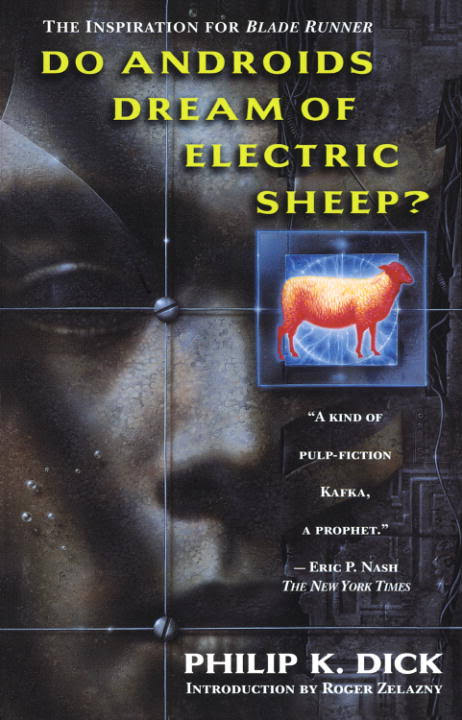
Book Review: Do Androids Dream of Electric Sheep?

Philip K. Dick
1968
Nominations: Nebula
Rating: ★ ★ ★ ★ –

It is truly a pleasure to be able to review another book by the brain-twisting, reality-suspending Philip K. Dick.

This novel is probably one of his most famous since it was, as the front cover of my 1996 paperback version says, “the inspiration for the movie Blade Runner.” The book was really just that, however—an inspiration. No one should read Dick’s novel expecting it to be a direct parallel to Ridley Scott’s 1982 movie.
   
Both share the same basic plot skeleton: in a technologically advanced Los Angeles of the near future, protagonist Rick Deckard is hired by the L.A. police department to hunt down a group of dangerous androids who have escaped from an off-world colony.
   
However, the meat covering the book’s and movie’s respective skeletons is almost completely different. Which, as I will explain later, is not necessarily a bad thing; both are superb in their own ways.

The novel is set in the 2020s (which would have been pretty far in the future for Dick in 1968). A nuclear war has killed off most of the world’s animals and the radioactive dust that remains is slowly killing everything that was able to survive the war itself. Most of the planet is vacant, desolate desert. All of the humans who could afford to have fled to off-Earth colonies elsewhere in the Solar System; the people who remain eke out their livings while trying to avoid sterilization and death.
   
To cope with the pervasive atmosphere of despair, most people own Penfield mood organs, which offer hundreds of different settings. The machines allow them to be in complete control of their feelings at all times, whether they want to feel happy, or calm, or raunchy, or even profoundly depressed.

Most people also subscribe to Mercerism, the new masochistic religion of the times. Special devices let them connect their brains into the brain of the religion’s founder, Wilbur Mercer. They stay connected to him and to each other for hours, seeing what he sees, which mainly involves him trudging steadily uphill on a path in a desert, often being pelted with rocks by from unseen persecutors.

On an Earth with hardly any animals, owning a pet is the ultimate status symbol. But because the scarcity of real flesh-and-blood animals has driven their prices through the roof, most people can only afford mechanical copies. No one wants their neighbors to know they can’t afford a real animal, so corporations are making money hand over fist by building increasingly realistic robotic animals that can usually pass for the real thing.

Robot technology has not stopped at animals, however. Corporations are now also able to build incredibly highly-functioning androids as well. In fact, the latest models, the Nexus-6s, are indistinguishable from humans without sophisticated empathy testing. Androids are used as slave labor on off-Earth colonies, but they are illegal on Earth. Every once in a while a slave android will escape, make it to Earth, and try to blend in.

This is where our main character, Rick Deckard, comes in. At the beginning of the book, Deckard gets an emergency assignment: find and kill six escaped Nexus-6s who are believed to be hiding out in L.A. They are clever and very dangerous; one of them has already put his superior in the hospital.

Deckard and his wife Iran have so far only been able to afford a mechanical sheep. Bounty hunting is an extremely risky job, but he thinks that with the staggering reward he’d get from bagging six androids—which would be an industry record—he’ll be able to afford a much higher-status animal—maybe even a real one. Maybe even a Percheron. His wife, who is so depressed that she actually regularly sets her mood organ for more depression, urges him on.

The police chief suggests that Deckard first fly to Seattle to talk to Rosen Associates, the company that makes the Nexus-6s, so he can see a sample before he goes after them. There, he meets Rachael Rosen, a staffer who at first is presented as a relative of the company’s founder but who he learns through testing is actually one of the Nexus-6s herself.

This throws him for a loop, because he would have sworn she was human; and it’s even more disturbing to him because she didn’t know she was a robot either.

Back in L.A., Deckard methodically finds and kills the first three of his six androids. Each one is a different challenge, but the most difficult are the ones who try to befuddle him by making him doubt his entire sense of reality. They set up their own false, staffed, police station and they try to convince him that all his memories are fake, that he’s not working for the police at all, that they are the real police, and that perhaps he is an android himself. They are very convincing and he just about believes them (as do you). It is very anxiety producing—and classic Philip K. Dick.

Rachael Rosen, who is very upset upon learning she is an android, begs Deckard for help and they end up sleeping together. This makes him falter and start having doubts about his ability to kill androids and even to see them as non-people. It turns out, though, that Rosen was just trying to distract him in the hopes that he won’t go after one of the remaining androids—the one named Pris—who is the same model as her.

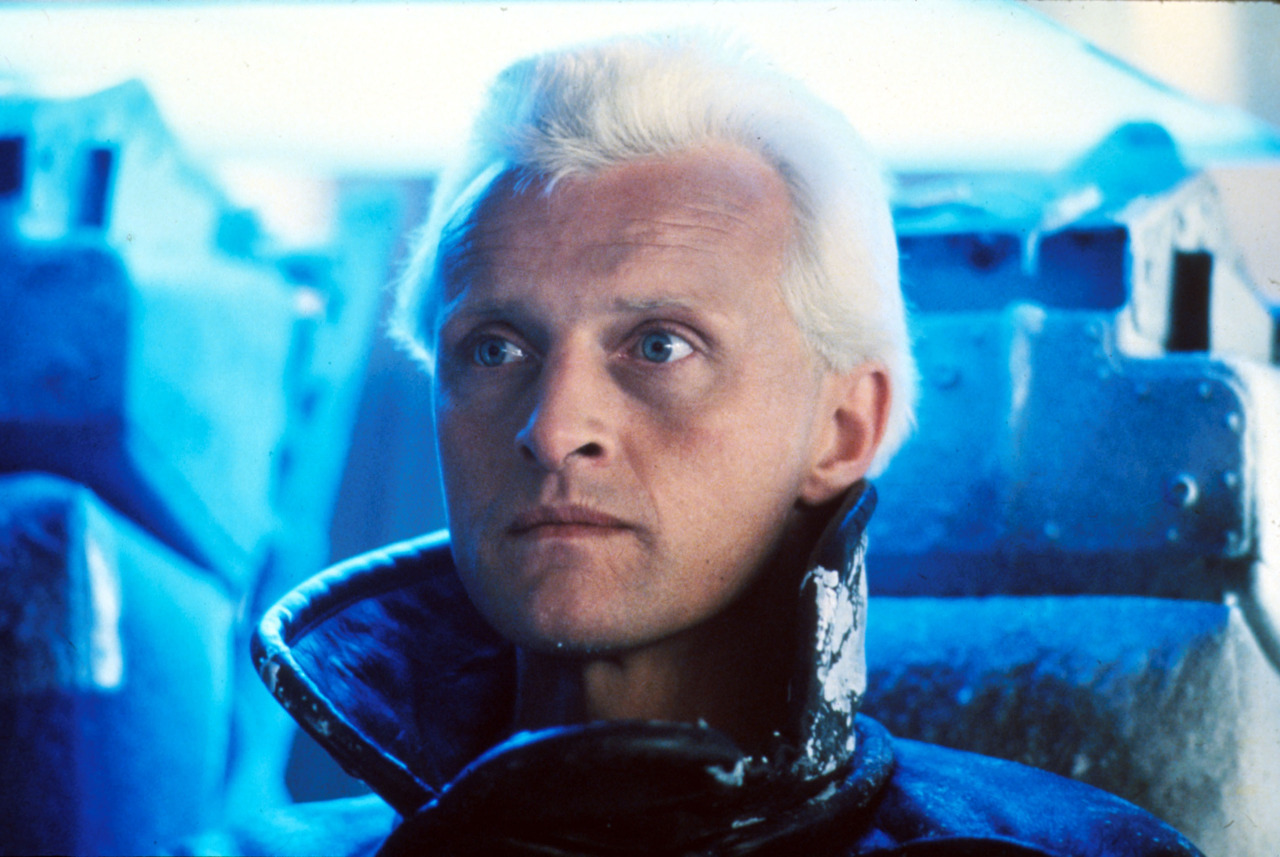
Roy Batty!
Eventually, the final three androids—Roy Batty, Irmgard Batty, and Pris Stratton—worm their way into the confidence, and thence the apartment, of J.R. Isadore, a sterilized, mentally deficient “special” person who lives in a vacant building in the suburbs. They hole up there until Deckard tracks them down and brings on the final showdown.

The book has just about everything: a clever premise, a gripping plot, and a sympathetic main character. It takes place in a creative but still realistic setting that you can picture yourself in, and Dick provides plenty of colorful emotional and physical details to ground you in the book’s world. His writing style itself is clear and straightforward, which is good because his ideas can be pretty twisty.

The movie Blade Runner is really, really, really good also. And the fact is that Blade Runner would probably not have been as great as it is if it had followed the book any more closely. Indeed, in spite of what an ingenious and prolific writer Dick was, there are actually only a couple movies made out of his books that are very good.

Dick’s best writing is about the questions that obsessed him—questions about the nature of reality and humanity that have a lot of potential for cerebral terror: who am I? Is what I perceive real? If someone insists my reality is wrong, should I trust them or my memories? If an android has been given feelings and memories to make it think it is human, is it human? How do I know I’m not an android that has been programmed to think I am human?

These are scary concepts that work well on the page and in the brain but seem to be difficult to translate to the screen. Usually—Total Recall aside—they don’t make for successful popular films.

Blade Runner’s screenwriters were smart to cut out Deckard’s wife, the Penfield mood organ, the Mercerist religion, and the robotic pets. And they were smart to trim down the number of androids and to make them a lot more scary and formidable. All of these changes made the movie into a different, but equally good, animal—a thrilling, gritty, futuristic film noir.

Friday, December 18, 2015

Google vs. the Family of Philip K. Dick

I knew that Google had a phone called the Nexus that uses the Android operating system. But it wasn't until I recently re-read Philip K. Dick's Do Androids Dream of Electric Sheep? that I put the words "Android" and "Nexus" together and they clicked. 

In Dick's novel (and in the movie it spawned, Blade Runner), the most highly sophisticated androids are called Nexus 6s.

When Google first came out with the Nexus 1 for Android in 2010, the Dick family was already onto them. At the time, the Wall Street Journal reported that Dick's daughter, Isa Dick Hackett, sent Google a cease-and-desist letter warning them not to use the "Nexus" brand name, or a lawsuit would follow.

Google did end up using the name "Nexus," but the issue still wasn't settled even as late as 2014, when Google was actually due to launch the Nexus 6. According to several sources, there was suspicion that Google might call the phone the Nexus X instead of the Nexus 6 because of the legal issues (and, of course, because the phone was a highly sophisticated homicidal android virtually indistinguishable from humans without sophisticated empathy testing).

As Chris Matyszczyk wrote in an article for CNET, the name "Nexus" had to be more than a coincidence, and it was legitimate for Dick's family to call Google to account:

Naturally, one wouldn't dream of accusing Google of having some kind of disregard for intellectual property (facetiousness intended). And the word "nexus" has been used in many contexts. Moreover, just because you're a character in a novel, it doesn't mean you immediately get legal protection. It seems to be one of those nuanced problems that lawyers find lucrative.
The word "Droid," however, was deemed different. It was thought to be so characteristic of the "Star Wars" series that Verizon paid Lucasfilm a fee to license the name.
Perhaps "Star Wars" is simply a more famous movie than "Blade Runner." Perhaps Verizon is trying to be honorable in its business dealings. Perhaps, though, in such instances, it sometimes depends on whose pockets and determination are the deepest.
"You have got to be kidding me," says Nexus-6 Roy Batty.

By the end of 2014, the whole issue was eventually settled out of court with a confidential settlement amount, and Google released the Nexus 6. I hope that Hackett got lots and lots of money to let them use the model name her father invented.

Friday, March 20, 2015

Book Review: Mindscan

Robert J. Sawyer
2005
Awards: Campbell
Rating: ★ ★ – –  

Mindscan is another of Sawyer’s forays into the gray area between life and artificial intelligence, and into unanswerable philosophical questions such as: what is consciousness? And how can you prove objectively whether someone or something has it? The book is a quick read, but it is not as fully formed or as well resolved as his earlier novel The Terminal Experiment, which dealt with similar topics.

In the prologue to Mindscan, our protagonist, Jake Sullivan, is a young man in his twenties. Jake is having an argument with his father when his father suddenly drops dead due to what turns out to be a congenital defect in the blood vessels in his brain. Jake then learns that he has the same condition that killed his father, and that, in all likelihood, it will kill him, too, at an early age. Jake is then forced to severely curtail his activities to try to prolong his life.

By the time Jake is in his forties, a private company called Immortex has developed a process by which they can port a complete copy of your brain—including memories, thoughts, and feelings—into an artificial, upgradable robotic body that is durable enough to last virtually forever.

In effect, the process splits you into two identical people: one in your original organic body and one in a new mechanical one. To avoid the potential legal hassles that could come from you having two instantiations of yourself, the artificial version stays on Earth and is given all of your legal rights, and the organic original is sent up to an all-inclusive luxury resort on the dark side of the moon, where it whiles away the rest of its natural life in isolated comfort.

Because of this, and because the whole package is very, very expensive, it is primarily done only by extremely wealthy older people who have at most a year or two to live. Jake is atypically young, but he is the heir of a vast Canadian brewery fortune so he has the money to do it. Frustrated by the way his life is circumscribed by his condition, he opts to get the procedure. Afterwards, we follow the story lines of both the original organic Jake and the new mechanical one.

The new mechanical version—the “Mindscan”—has a hard time adjusting at first. His mother, his dog, and the girl he likes are all creeped out by his new form and don’t accept him as the real Jake. Fortunately, he is eventually able to find acceptance and even love with his fellow Mindscans.

Soon after he starts dating his Mindscan girlfriend Karen, Karen’s original organic version dies. Her son then files suit to have her legally declared dead and her assets distributed to him, even though the mechanical copy of her is still alive. The whole thing then turns into a big legal civil rights battle over whether a mechanical body with a mind-scanned copy of a brain is actually the person it claims to be.

Mindscan Jake stays supportively at Karen’s side through the entire trial. As it drags on, though, he starts hearing voices in his head—specifically, his own voice—which makes him suspect nefarious doings at Immortex, including them possibly making additional copies of him with whom he is somehow mentally connected.

Meanwhile, Jake’s original body—the “shed skin”—wakes up pissed off when he realizes that he is the copy of the consciousness that is going to die. (What did he think was going to happen? Of course one of them has to be the original instantiation of his brain, stuck in his original body.) He goes to the moon to live out the remainder of his life, but he remains cranky and has a hard time settling into his new lunar environment.

And then matters are complicated when a doctor on Earth develops a cure for his brain condition. His corporate caretakers/jailers agree to let the doctor fly up to give him the cure, but afterwards they won’t let organic Jake leave the moon. Too many legal complications, for them and for him, they say.

Organic Jake’s anger builds until he eventually takes drastic action to force the issue. This inevitably results in the two Jakes meeting each other—with disastrous consequences.

This book's subject matter had good solid potential. Unfortunately, its execution was awkward and uninspiring.

  • First and foremost, the legal battle over Karen’s personhood, which takes up a large portion of the book, is unconvincing. The defense reveals surprise information during cross-examination that the judge already knows about but the prosecution doesn’t, which doesn’t seem allowable. Objections are sustained and overruled at weird times for tenuous reasons. And the arguments used by both sides are primarily emotional and philosophical, and practically free of legal content.
  • The Mindscans’ physical construction seems inconsistent. They can feel some things (touch, heat, wind) but not others (air pressure, pain, smell).
Wall-e
  • It’s strange to me that everyone reacts so negatively to the Mindscans. Almost every organic human they come in contact with on Earth is at least uncomfortable with and often overtly hostile to them. I mean, this isn’t 1938; this is the mid-21st century. Is there really no one ready to accept a sentient robot? Has no one read any Asimov? Has no one heard of R2-D2? Data? Wall-E?
  • The story takes place in a North America of the very near future, and the narrative jars badly when the author’s guesses about our current time are wrong. For one thing, in this book, Pat Buchanan is a former U.S. president, when I don’t think he will realistically ever try to run again. In the book, gay marriage is illegal across the U.S., when it looks very much like that tide is moving irrevocably in the opposite direction. And perhaps the saddest non-true historical-future fact in the book is that Christopher Reeve is alive and walking, a testament to advancement in the neurosciences.
  • And, finally, the whole Immortex conspiracy business is wrapped up at the end very abruptly, almost as an afterthought. It turns out to be disappointingly unambitious without any real evil intent behind it, and it is quite dissatisfying.
As I said before, this book does raise big, interesting questions, such as: Can you prove an entity has consciousness? How about a mechanical entity? If an entity of any kind passes the Turing test, and no one can tell that it isn’t conscious and self-aware, is that the same thing as it being conscious and self-aware? Should we consider it to be legally alive?
                                               
These questions deserve a solid story line to explore them. As I was reading this book and feeling frustrated by its inadequacies, I remembered that just such a solid story line did exist—in the form of the Star Trek: The Next Generation episode “The Measure of a Man.” 

In that episode, a scientist wants to take the android Data apart and dissect his brain for research. Data naturally objects, and eventually the controversy leads to a trial in which Data essentially has to prove that he is a sentient being and therefore deserves not be dissected if he doesn’t want to be dissected. 

The episode is wonderfully done, and is a much better presentation of the issues than Mindscan. The Star Trek trial is much more focused than the Mindscan trial on figuring out appropriate criteria for sentience and the legal provability of self-awareness. And the episode's writers are good at exposing arguments that are either red herrings or are too undefined to use as legal proof.

Friday, October 18, 2013

Book Review: Buddy Holly Is Alive and Well on Ganymede

Bradley Denton
1991
Awards: Campbell
Rating: ★ ★ ★ – –

SPOILER ALERT

I’m torn between two reactions to this book. On the one hand, it was funny and, overall, a good read. On the other hand, its boisterous tone sometimes felt slapsticky and forced, and the final climactic confrontation was a bit disappointingly predictable.

I liked the hapless main character, Oliver Vale, and I was moved by his sad backstory, told in flashbacks throughout the novel. Oliver's bad luck started when he was accidentally conceived by his teenage parents on February 3, 1959—the night Buddy Holly, Richie Valens, and the Big Bopper were all killed in a plane crash in Clear Lake, Iowa. Oliver’s father killed himself the next morning when he found out about the crash, and Oliver’s mother began a descent into insanity; she began to believe in aliens and Atlantis and that her son was the reincarnation of Buddy Holly. I sympathized with her, trapped by an unexpected baby at the age of seventeen, even if I didn’t like her very much. Her mental instability reached a sad peak when she, too, killed herselfon February 3, 1984, the twenty-fifth anniversary of the night Buddy was killed.

The book’s narrative starts five years after Oliver’s mother’s death, in 1989. Oliver is in his house in Kansas, watching a John Wayne movie on TV, when the program suddenly switches to a broadcast showing a man who looks very much like Buddy Holly standing on what looks very much like the surface of one of the moons of Jupiter (you can tell it's a moon of Jupiter because Jupiter and its big red spot are hovering in the background). Buddy looks bewildered and is carrying a guitar.

Buddy doesn’t appear to know what else to do, so he starts talking to the air. At one point he says there is a sign hanging on the camera pointed at him that says he should contact an Oliver Vale in Kansas for help.
                                     
It turns out that the Buddy Holly broadcast is preempting programming on all channels all over the entire country. And it goes on and on for hours, with Buddy Holly variously singing songs and talking to the camera and repeating his request for somebody to contact Oliver Vale for help. Eventually Oliver realizes that the disturbance is nationwide, and that everyone will think that he is to blame and will come after him. So he decides to take off for Buddy's grave in Lubbock, Texas, to prove whether or not Buddy is really in fact buried there, or if there is a chance he really is alive. (Oliver hasn’t yet thought about how to prove whether or not Buddy is really on Ganymede, if he turns out not to be in his grave.)

What follows, and takes up most of the rest of the book, is a sometimes funny, sometimes plodding cross-country ride across the plains of Kansas and Oklahoma. It begins on Oliver’s Ariel motorcycle (which may or may not have originally been Buddy Holly’s) and continues on various other modes of transportation as Oliver runs into setbacks. He is chased by a motley collection of pursuers, including his therapist and her boyfriend; a homicidal FCC agent; a hot-headed woman he runs afoul of in a gas station; his irate TV-loving neighbors and their doberman pinscher, Ringo; and numerous followers of preempted and vindictive televangelist Reverend Bill Willard. 

Oliver is also helped out by a few people over the course of his journey, and I liked most of them, especially Boog, a motorcycle salesman; Pete, Oliver’s uncle’s buddy from Vietnam; and Pete’s children. But Ringo was by far my favorite character.

During Oliver’s ride to Lubbock, things get weirder and weirder. For one thing, the FCC determines that the broadcast really is coming from Ganymede. To Oliver, this proves that he is innocent, but to the FCC, it proves that he is something far more dangerous. And after Oliver has Ringo chase him down the highway at 70 miles an hour and chomp off the exhaust pipe of his motorcycle without batting an eye, leaving behind a mechanical tooth (and, later, popping out a robotic eyeball), he realizes that perhaps the dog and its owners aren’t what they seem, and that maybe his mother’s talk about UFOs and aliens might not have been that crazy after all.

It's a Mad, Mad, Mad, Mad World
Sometimes Denton’s humor came close to a good Vonnegut-like dry wit, but in the end he always veered more toward more obvious jokes than Vonnegut would have done. The rollicking chase that takes up most of the book reminded me of Smokey and the Bandit or It’s a Mad, Mad, Mad, Mad World; fun and breathless but maybe a bit over the top for the tone of this novel. About halfway through I began to have a sinking feelingwhich turned out to be well-foundedthat, like those movies, all of the various travelers traveling at breakneck speed across middle America would inevitably have to meet up at the end in one big Great Reveal scene which would tie everything up in a neat but anticlimactic bow.

Friday, May 31, 2013

Book Review: The Snow Queen

Joan D. Vinge
1980
Awards: Hugo, Locus
Nominations: Nebula
Rating: ★ ★ – – –

After having read several disappointing novels by Joan Vinge’s ex-husband Vernor, I have to admit I was kind of dreading The Snow Queen.

The story takes place on the rustic, undeveloped planet Tiamat, where the seasons are centuries long. The people of Tiamat are divided into two populations: “Summers,” unsophisticated, backwards fisher-folk who live in the rural south, and “Winters,” savvy cosmopolitans who live in the urban north. The Summers are deeply religious and their most powerful deity is the goddess of the sea, who they believe speaks to them through a few of their own people who have been called to be “sibyls,” a sort of oracle. Their religion is dismissed as blind superstition by the Winters and the offworlders alike.

As the book opens, the long winter is just ending and summer is about to start. When the seasons change from winter to summer, several things always happen. The areas of the planet where the Summers live become too hot for human habitation and they all migrate north to the cities to jostle for space with their northern Winter brethren. The proximity of the sun makes conditions too unstable for the nearby interstellar transport wormhole to stay open, so all the “offworlders” visiting and working on Tiamat pack up and head home to their own planets, taking all their advanced technology with them. And the Snow Queen, the ruler of the planet during the wintertime and traditionally a native member of the Winter population, is ritually thrown into the ocean to die and is replaced by the Summer Queen.

This winter, however, the people have been ruled by a particularly power-mad and ruthless Snow Queen named Arienrhod. Arienrhod has never wanted to give up power and die in the sea like she is supposed to. So a couple decades ago, she implanted nine embryo clones of herself in nine unsuspecting Summer women visiting her capital city for a festival, hoping that at least one clone turned out okay and she could choose that girl to be the Summer Queen. This doesn’t really prevent her from dying, of course, but at least she’ll have the satisfaction of knowing that she will be the Summer Queen, too, in a way.

Of the nine clones, the only one that survives to the end of winter is a girl named Moon Dawntreader. Moon is a good-natured and unambitious girl raised among fishermen on the seaside, who thinks she’ll be able to continue living indefinitely in blissful happiness with her beloved cousin Sparks. Except that one day, to everyone’s surprise, including Arienrhod's, Moon is called by the sibyls to become a sibyl herself. 

Sparks had wanted to be a sibyl, too, so when Moon is chosen instead, he leaves in a jealous rage for the big city in the north. There he hooks up with Arienrhod and becomes a twisted, Darth-Vader-like, dark side version of his former self.

The rest of the book then follows Moon’s subsequent quest to reunite with Sparks and fulfill her destiny as a sibyl, and Arienrhod’s attempt to find Moon and achieve immortality, both of which affect the lives of a wide assortment of secondary characters and build to a climactic showdown during the end-of-winter celebrations.

In contrast to Vernor’s books, Joan Vinge’s Snow Queen at least kept me generally interested in reading from one chapter to another. She weaves her themes, characters, and technological inventions consistently and intelligently throughout the book, giving them depth and background, so that when they are used, you feel like they are coming to fruition (rather than popping them in for the first time only when they are needed to save the story line).

I also got a bit of a kick out of the matriarchal society Vinge created for Tiamat. Although the foreign offworlders were prejudiced against women in any kind of powerful position, the people of Tiamat were traditionally ruled by queens, rather than kings, and prayed primarily to an all-powerful goddess of the sea.

The matriarchy only goes so far, though. Under the woman-centric overlay, the actions of the two main female characters (and some of the secondary ones) were determined largely by their pursuit of (or escape from) a man. Most of their crushing agonies and triumphant successes revolved around whether they had gotten the male object of their affections (or ire) to do what they wanted. In particular, although Moon’s destiny does have something vaguely to do with bringing better times to her people, at every key decision point she chose her course of action by whether or not it got her closer to Sparks.

It also didn’t take me long to get fed up with the book’s romantic fantasy style. There is advanced technology available in the universe but it is withheld from the planet’s native inhabitants. So, by necessity, they resort to rustic, labor-intensive clothing, food, work, traditions, and religion straight out of the Dark Ages. People do their hair up in various forms of braid, drink ale and eat honeycake, and work as farmers and fisherman and oracles and itinerant healers. They tend to be superstitious, and like to attend large community festivals, and are partial to cries of agony and/or passion when roused in either of those ways.

Every other noun has to be archaically capitalized: the Hunt, the Change, the Transfer, the Street, the Festival, the Death, the Sea.

Otherwise ordinary nouns become romanticized by sticking an adjective onto them:“The [ship] dropped through a flattening arc, like a slingstone skimming an infinite pond.” “I’ll stay here at Street’s-end until you come out of there.” “How do you know what anybody did before the firstships sailed down out of the Great Storm?”

I’m the first one to admit that fantasy can be really fun when it is done well. I like to be carried away by it, unselfconscious of how silly the language and costumes and monsters might be to the uninitiated. But it can be giggle-making if not handled right. And I’m afraid The Snow Queen qualifies a little too often for the latter.

Friday, November 23, 2012

Book Review: The Windup Girl

Paolo Bacigalupi
2009
Awards: Nebula, Hugo, Campbell
Rating: ★ ★ ★ – –
 
The Windup Girl takes place in near-future Bangkok after several environmental nightmares have come true. Worldwide oil supplies are completely depleted, so all machines and vehicles are wind, hydrogen, solar, coil-spring, pressure, human, animal, or coal-powered. Global warming has made temperatures soar and sea levels rise dramatically, so Bangkok has to be protected from complete inundation by a system of pumps and levees. And nearly all plants and animals have been wiped out by diseases and have been replaced with genetically engineered variants.

This last is not an accident. Agribusiness corporations deliberately hoarded stores of seeds and then manufactured the diseases, pests, and plagues that wiped out the naturally-occurring plants and animals, so they could profit by selling the starving world their own genetically-modified, disease-resistant, but sterile products. They now basically rule the world economy.

Thailand has held their own against the agribusiness corporations relatively well because they sealed their borders to imports and hired their own secret, illegal “gene-ripper” to develop new, fertile varieties of their own native plants and distribute them on the black market. One of the major agribusiness companies has sent in a secret agent, a “calorie man,” Anderson Lake, to try to discover who the gene hacker is and where his seed bank is stored. Along the way, he meets and (sort of) falls in love with Emiko, a Japanese windup girl – a genetically modified, semi-robotic human conditioned to obey and to serve.

Thailand is ruled nominally by a child queen, and in reality by her regent, the Somdet Chaopraya. Two of her ministries – Trade and Environment – are led by strong, ambitious men who vie against each other to be the next regent. The story is a little confusing and doesn’t really have any one central plot, but essentially what happens is that Emiko and the calorie man get mixed up in the escalating power struggle and eventually serve as catalysts leading to the death of the Somdet Chaopraya and bringing on an all-out civil war.

After I finished this book, I went back and forth for a long time deciding whether I liked it or not. On balance, I decided on a somewhat lukewarm yes.

The near-future Bangkok that Bacigalupi presents is rich and multi-layered and easily pictured. He has unique inventions – the windup girl herself, the calorie men, the genetically engineered animals that populate the city, and the types of energy and propulsion that people have to use in a petroleum-depleted world.

On the other hand, there are a couple major things that are either too disturbing or too annoying to ignore.

First: language. For one thing, this book is written in the present tense, which I’m realizing I generally don’t like in a novel (although I have to admit that it isn’t nearly as annoying here as it is in the Yiddish Policemen’s Union). But the primary irritant in this one is the use of hyperbole.

Everything is described so dramatically. This over-emphasizes the minor events and makes them seem cataclysmic, so that you get desensitized to the drama, and then the parts that really are cataclysmic have less of an impact than they should.

Also, his hyperbolic phrases are pleasing and catchy at first, but after they are used for the fourth or fifth time, they begin to seem formulaic. After a while, I started writing down the particularly obvious repeats:

- Alleys running thick with blood
- Light spearing eyes
- Scalding skin / skin on fire (with heat)
- Ribs exploding with pain / ribs screaming (after beatings)
- Blossoming (e.g. Blood blossoming red after person is shot; a blossom of pain; legs blossoming with hurt)

Second, and more importantly: there are two major rape scenes, both involving Emiko. I’m not sure how to judge the necessity of a graphic rape scene, but these certainly were very disturbing and seemed to go on well past the point where the point was made. I really started to bridle viscerally at how much Bacigalupi felt he had to do to prove how Emiko’s conditioning made her obey even at the cost of her total shame and extreme physical pain.

I did particularly like one of the first scenes in the book, though, where Anderson Lake has to shoot a megodont (a genetically engineered elephant) who has gone rogue in his factory. It reminded me a lot (perhaps intentionally so) of George Orwell’s great essay Shooting an Elephant.


This review originally appeared on Cheeze Blog.