Showing posts with label Personification of Gods and/or Demons. Show all posts

Friday, January 11, 2019

Book Review: Earthquake Weather

Tim Powers
1996
Awards: Locus (Fantasy) 
Rating: ★ ★ – – – 

Earthquake Weather is the third novel in Tim Powers’ somewhat roughly connected Fault Lines trilogy. It is not really a sequel, but it continues some of the story lines from both of the previous two novels, Last Call and Expiration Date. And it pulls in several of the same characters, although the main characters in this one are new.  

It also takes place in the same world of magic as the other two books. Which is most definitely not the light, floaty, Disney variety; the magic of Powers’ trilogy is a hard-boiled, real-world, practical magic conducted using everyday objects. It is an impressive amalgamation of ancient gods, ghosts, spirits, religions, superstitions, rituals, faiths, totems, and traditions—old and new and east and west.

And it, too, is set against a backdrop of the grittiest parts of America: diners, bars, mental institutions, curanderías, big city streets. The cars are always big, old, beaten-up American models. The characters are people from the edges of society—the poor, insane, criminal, fugitive, orphaned, lost. They tend to drink a lot—mostly Coors, vodka, and cheap red wine. (It can tend to get a little gross.)

At the beginning of Earthquake Weather, Janis Plumtree, a woman with multiple personality disorder, has killed Scott Crane (the man who was crowned as the Fisher King in Last Call). She killed him on a lonely road near Los Angeles by jamming a trident into his throat.

A faction of Crane’s supporters and believers—the Fisher King’s army, if you will—found his body before the police did and are hauling it around with them, trident included, preparing for the day when they can perform the necessary rituals to resurrect him. They are also protecting a pre-teen boy, Koot Hoomie "Kootie" Parganas, who appears to have been spiritually designated as Crane’s successor to the Fisher King’s throne in the event of Crane’s permanent death, as evidenced by the constantly bleeding wound in Kootie’s side, and the fact that he needs to tie his belt in a Mobius strip and drink lots of alcohol to keep himself from being found and possessed by ghosts. 

Into this picture comes Sid Cochran, a man who checked himself into a mental institution because he keeps seeing random people turning into bull-headed gods, and hearing people speak in the voice of his dead wife. Except that he’s not insane; those things actually are happening to him, because he’s been chosen to be one of the vessels of the god Dionysus, after an accident he once had in a vineyard where he almost got his hand cut off trying to protect an old vine stump from being cut down. In the institution Cochran meets Plumtree, who was put there by the police when she came to them claiming to have killed Scott Crane (whose body they can’t find). 

Cochran and Plumtree strike up a friendship (she with him and him with most of her personalities), and eventually they break out of the institution, narrowly escaping the clutches of the evil chief psychiatrist Dr. Armentrout, who “cures” his patients by eating the parts of their souls that are misbehaving. Eating soul parts gives Dr. Armentrout lots of spiritual power, and the fact that it sometimes kills his patients doesn’t really bother him at all. 

Plumtree’s good personalities want to atone for the bad one that killed the Fisher King, so she drags Cochran with her to track down the band of people preparing for the Crane’s resurrection. It isn’t hard, given all the portents pointing to their house in Long Beach, and the people drumming and dancing in front of it twenty-four hours a day. 

Kootie and his adopted parents-cum-spiritual shields, Angelica and Pete Sullivan, and Crane’s old friend Arky Mavranos, take in Cochran and Plumtree as wary allies. They then go on a chaotic journey up to San Francisco filled with pretty random-seeming diversions and plot twists, to perform the king-restoring ritual. 

The whole time they are pursued by Armentrout, who has hooked up with some anti-Fisher-King zealot thugs. Armentrout’s aim is to capture Crane’s body and to keep it alive but in a perpetual coma, so he can feed eternally on the spirit of the Fisher King, making him super powerful in the magical world. He doesn’t mind the idea of kidnaping Kootie as well, holding him coma-hostage in the event Crane dies for good. And if Cochran and Plumtree die along the way as well, so much the better for him. 

The Cochran/Plumtree/Kootie allies race around San Francisco gathering the necessary materials to prepare for the awakening ritual. All kinds of things go wrong to cause them setbacks, not least of which is the fact that one of Plumtree’s personalities is the not-quite-dead ghost of her evil father--the personality that killed Scott Crane--who keeps telling Armentrout where they are. There is also a genuinely exciting car chase scene when a ghost steals the car that has Crane’s body in it, and Angelica and Pete and Arky have to race it down and leap on to it while hurtling down the highway to regain control (over the car and the body). 

It all eventually comes to a climax in a giant turbulent scene at the Sutro Baths, where the final battle for Crane’s life (or death) is fought out with both temporal and fearsomely magical weapons. 

One of the best things about this book is that Powers has a stupefying amount of knowledge of a hugely broad range of spirit world arcana. He brings in ghosts, spells, portents, charms, remedies, and rites from a wide variety of traditions from around the world. This is no American Gods lightweight gimmicky hack job. 

And the magic is cleverly done using practical, real-world objects; for a knowledgeable person in the world of Powers’ books, almost anything can have a magical use. His characters use wind chimes made of chicken bones and radio parts as alarms to warn of incoming malevolent entities. They hook up old television sets and record players to talk to spirits. They use ashtrays as substitutes for fireplaces to send ghosts, literally, up in smoke. They use clove and regular tobacco cigarettes as masking tools, but actual rubber masks (of clowns, in this case) can serve the same purpose, in a pinch. Wine is used for all kinds of purification, masking, and sacramental purposes—although Coors can work, too, sometimes. 

The main problems with this book (which was also true of Last Call) are that it is dense, complex, and seemingly, for the most part, unplanned. Although there was generally an anticipatory build-up, a climactic confrontation, and a resolution (of a sort), the plot trucks along largely haphazardly towards those ends. 

I rarely understood why any of the specific incidents over the course of the book happened; most of them seemed to come out of left field. It felt like the characters were dropped into situation after situation with little or no lead-up or connection to the next. They went from Chinatown to a maze-house to a car chase to a hotel with no apparent logic. 

I also didn’t understand why voices spoke to Cochran when they did, or why he saw the signs he did, or what the bull-headed god meant in any particular situation; it seemed like the god was just saying, “hi, I’m here, be afraid.” I didn’t understand why Plumtree changed personalities when she did, or how they knew to use this or that piece of equipment. 

I tried to go with the flow and let it all just soak into my head naturally. And that worked to some extent, but generally it was so hard to make connections and follow the characters’ non-logic—especially when so much of it was somewhat repellently fueled by Coors and vodka—that I ended up skipping a lot of text. 

And, at the end, it didn’t feel like everything finally connected together and made sense; it felt like it all fell together by accident, in spite of itself, and in spite of the chaotic actions of the characters. All in all, it was just too much reading whiplash.

Friday, August 25, 2017

Book Review: The Hand of Oberon

Roger Zelazny
1976
Rating: ★ ★ ★ – –

SPOILER ALERT (for this and the three earlier installments of The Chronicles of Amber) 

A lot more happens in this fourth episode of The Chronicles of Amber than happened in the previous three. 

Zelazny filled the third episode, The Sign of the Unicorn, with a lot of unspoken flashbacks and character-to-character retellings of what had gone on so far. In The Hand of Oberon, the plot suddenly surges ahead, story lines advance quickly, and several mysteries are unmystified.

At the end of The Sign of the Unicorn, Benedict, Corwin, and Corwin’s trusted aide Ganelon are led by a unicorn to another version of the Pattern. Ganelon, somewhat unusually (and, I may say, suspiciously) perceptively, suggests that this Pattern may actually be the real Pattern, and that the Pattern they know is just a copy.

This version of the Pattern, however, is damaged. Someone has stuck a dagger into the pattern, destroying it where the dagger struck. Impaled on the dagger is a Trump card of a guy who looks a lot like Random, but who none of them have ever seen before. Eventually they figure out that the mystery Trump card is that of Martin, Random’s son, whom he didn’t know existed.

At this point, in the form of a discussion between the siblings, Zelazny gives us a really helpful summary of the cabals that were angling for Oberon’s kingdom in the previous books. There were two—one of Bleys, Fiona, and Brand, and another of Julian, Eric, and Caine—actively working against each other, as well as against their other siblings.

After the cabal recap, Random goes off to find Martin, while Corwin goes to tell Random’s wife, Vialle, about the stabbed card. After telling Vialle, Corwin revisits his old dungeon in Amber, where he uses Dworkin’s old sketch on the cell wall to transport himself to Dworkin’s studio and confronts Dworkin. At this point, he learns two key things:

The first, as he had (somehow) suspected for a while, is that Dworkin is Oberon’s father—Corwin’s grandfather. And the second is that Dworkin and Oberon have a crazily evil plan to destroy the real, broken Pattern—and thus everything in Amber!—to start fresh. This is understandably appalling to Corwin, and he wants to try to repair the Pattern instead. The only way to do that, though, is to walk the pattern while wearing the Jewel of Judgement, and the problem is that if you do that, you might die.

While Corwin is debating this in his head, Dworkin attacks him, and Corwin is only able to escape by picking a Trump at random—which transports him right smack into the Courts of Chaos.

Corwin fights off a bunch of Chaos attackers and escapes again, this time via Gerard’s Trump. Corwin then finds out from Fiona herself that the Brand/Bleys/Fiona cabal was the one that found the primal Pattern and stabbed Random’s son Martin over it in an attempt to open the doors to the Courts of Chaos, with the somewhat misguided idea that they could ally with them to take the throne of Amber. Brand is the one who actually stabbed Martin.

If Corwin is going to use the Jewel of Judgement to repair the primal version of the Pattern, he needs the Jewel of Judgement. Which, as we may remember, he stashed in a compost pile next to his house in upstate New York. He rides through Arden on one of Zelazny’s patented psychedelic hellrides to get it, pursued by a crazy manticora, which is in turn killed by Julian, who tries to ingratiate himself, claiming he was only trying to save Corwin somehow by blinding and imprisoning him for all those years in the dungeon at Amber. 

Corwin shakes Julian off and keeps going. However, when Corwin gets to his house in New York, the compost heap is missing. Brand has been there first, and already has the Jewel!

At this point Fiona joins Corwin and claims that she and Bleys are back on Corwin’s side and aren’t working with the Courts of Chaos anymore, but that Brand is. She says Brand has gone off to walk the primal Pattern to destroy Amber. Corwin is able to stop Brand mid-Pattern-walk, but Brand escapes, still wearing the Jewel of Judgement. 

Ganelon then comes up with a (again, I may say, suspiciously) good plan: to have Benedict go to block Brand instead of Corwin, since Benedict can get there first and has an arm given to him by the Courts of Chaos, so it might be a more even fight. 

And just when we’re starting to get really suspicious about how Ganelon is coming up with all this brilliant planning and analysis all of a sudden, he reveals himself to be something entirely other than a simple faithful friend and servant to Corwin!

Even though this book furthers the plot a lot more than the previous four, and more actual action actually happens, it still also contains plenty of the free-associational impressionistic imagery we expect from a Zelazny Amber offering. Corwin’s ride from Arden back to 20th century Earth is extremely trippy; time and space are distorted, with grass and cobblestones intertwining with meteors. At one point he rides a translucent trail over space, during which he sees multiple moons.

And there is an absolutely beautiful scene when Corwin at last arrives at the Courts of Chaos; half the sky at the Courts is night, with dancing stars, and the other half is full of shimmering, shifting bands of color, and the two halves spin slowly around each other as the sky turns.

The Hand of Oberon also contains plenty of Corwin’s sarcastic attitude and snappy, anachronistic modern analysis of fantasy events. The best example is when he finds out that not only was Dworkin his grandfather, but that the unicorn was his grandmother, and his only reaction is to say that he has “mixed feelings” about being descended from a unicorn.

Friday, July 1, 2016

Book Review: The Innkeeper's Song

Peter S. Beagle
1993
Awards: Locus
Rating: ★ ★ ★ – –

This is one of those fantasy novels set in a medieval-style place and time in which technology has not progressed beyond swords and horses and carts, and there are wizards and strange mythical beasts. And it is well told: very human and accessible, occasionally action-packed, somewhat scary, a little poetic, and a little bit cute.
   
The story starts out with a pair of young lovers: a girl, Lukassa, and a boy, Tikat. The two are billing and cooing on a bridge over a river near their village when the bridge railing suddenly gives way and Lukassa falls into the river and drowns.

The boy, Tikat, is disconsolate, weeping by the river all the next night and day. But then a mysterious warrior woman rides up, raises his dead girlfriend out of the river, brings her back to life, puts her on her horse, and takes off.

Tikat rushes after them and chases them for miles and miles and miles, never catching up. Along the way he encounters a group of bandits who are harassing an old man. He rescues the old man from the bandits and they travel for a while together. The old man turns out, however, not only to be an associate of the warrior woman who raised Tikat’s girlfriend from the dead, but also a mystical beast himself, whose natural form is that of a red fox. Promising to leave a trail that Tikat can follow to find them all, he turns into his fox self and runs off to join the women.

One of the nice techniques Beagle uses is that he switches his narrator every chapter. Each one is narrated by whichever character is most appropriate to tell that part of the story, and every character gets a chance to be the narrator at least once (including the Fox, who has some of the best narration in the whole book).

This means that while we’re following Tikat chasing after the women, we also get to find out what’s going on with the women as they race across the countryside. It turns out the warrior woman, who is named Lal, is the former student of a wizard. On the road, they join up with a woman named Nyateneri, who is another student of the same wizard and who is just as much of a bad-ass warrior as Lal. The two of them are desperately searching for their former teacher; they believe he is somewhere in the area, hiding from a terrible rival wizard who wants to kill him, and they are determined to defend him.

The three women eventually stop at a crossroads inn. The fat, cantankerous innkeeper, Karsh, has been up to now perfectly happy whiling away his days running his inn and beating up his staff, including his teenage stable boy and semi-adopted son Rosseth. But these three women are destined to turn Karsh’s and Rosseth’s lives upside down—and the inn’s staff are destined to help the three women in their goals (albeit mostly unintentionally).

Lal, Nyateneri, and the Fox manage to find the old wizard hiding in the nearby town and they bring him back to the inn to live while trying to gather their strength for the coming confrontation. They have several smaller adventures including the killing of two men sent to kill Nyateneri, a fairly lengthy episode of gender-bending group sex, and an ill-fated journey to find the wizard’s nemesis, until finally it all culminates in an enormous, inn-destroying wizard-on-wizard face-off across both physical and metaphysical planes.

Sometimes I think there are two ways storytelling can be good. If the author does a great job creating and executing a riveting overall story arc, it doesn’t matter so much if the details aren’t perfectly described. And, on the other hand, if the author keeps our interest with entertaining conversations and richly detailed scene-setting, it can be okay to have a relatively basic, less inherently exciting plot.

(If an author can do both, of course, the book has the potential to be truly amazing, rather than just good—but that seems to be relatively rare.)

This book of the second type. The overall plot is simple and not all that exciting in itself. But Beagle keeps us reading along nicely with his colorful and detailed atmospheric, emotional, and scenic descriptions, as well as the interactions between the characters. And the strength of some of the main characters (Lal, Nyateneri, the Fox) helps to distract us from how tiresome some of the supporting characters (Lukassa, Tikat) can be.

He keeps us reading along nicely, that is, until the final showdown—which starts out with a lot of suspenseful promise and then blurs out into an ill-defined and overblown abstract supernatural scene that reflects none of the detailed physical grounding so present in the rest of the book.

Friday, May 1, 2015

Book Review: Kraken

China Miéville
2010
Awards: Locus
Rating: ★ ★ – – –

This book begins as loads of fun. It starts with Miéville at his best: original ideas and a quirky, subtly comic writing style. It reads like a pulp detective novel, with snappy conversations and very short chapters, each one ending in a cliffhanger incident that pulls you into the next.

The book’s hero, Billy Harrow, is a curator in a London museum that has an enormous collection of biologically and/or historically significant dead animals preserved in glass bottles of formaldehyde. Billy is leading an ordinary tour group around the museum on an ordinary day when he finds that the museum’s prize specimen, a giant squid, has disappeared—glass bottle and all.

The police officers that come to investigate the crime are from an odd detective unit that deals with obscure occult religions. The only lead Billy can give them is a description of a man that he noticed on the tour because of the design of his lapel pin: an asterisk with two of the arms elongated and ending in squiggles. But fortunately these detectives know what to do with that information.

What the occult detectives know, and Billy is about to find out, is that London is chock full of obscure gods, ghosts, and other spirit-world powers, and that there are a large number of people in the city who are aware of it and have varying levels of ability to take advantage of it. And that there are also a number of people—including the krakenists, the wearers of the squiggly asterisk pins—who consider the giant bottled squid a kraken, a god. And that there are others who consider the squid to be at the very least a powerful ritual tool—one that can be used to start the chain of events that leads to an apocalypse—and who have the motivation to use it to that end.

At first Billy is an innocent and a pawn in all of this. The police figure he is in danger because of his status as the preparator of the bottled kraken, so they lock him in his apartment to protect him and enjoin him from talking about the incident to anyone. But of course he does, and because of that his apartment is infiltrated and he is almost killed by one set of cultists, and then he kidnapped by another set who think he can find the kraken for them, only to be re-kidnapped by yet another group. Some of the groups and sects and guilds have the world’s (and Billy’s) best interests at heart, and some don’t, and it is hard for him to tell which is which.

Eventually, though, it turns out that Dane, one of the guards at the museum where Billy works, is an elder of the krakenist church, and has secretly been keeping an eye on both the kraken and Billy the whole time. Dane seems to be one of the only people who truly (a) respects the kraken and (b) wants to prevent the world from ending, so Billy throws his lot in with him and goes from being an innocent pawn to being a fugitive believer. The two of them go on the lam, trying to find and save the bottled god kraken before whomever has it can finalize their planned apocalypse.

They are chased the whole time by all sorts of formidable pursuers, including Goss and Subby (terrifying semi-human assassins), the Tattoo (a power who exists solely as a tattoo on another man’s back, who has the power to make people into machines), and the occult police squad. And Billy learns more and more about underworld London, and learns that he has knowledge and powers he never knew he had—powers presumably given to him by his work on the preservation of the kraken.

How could this setup not be fun, eh? The trouble is that after the initial crime and the layout of the various factions, the plot careens from person to person and twist to twist without a sense of a real over-arching plan. We alternately follow Billy, Dane, the detectives, Goss and Subby, and Billy’s best friend’s girlfriend as they race back and forth across London hunting down one person or another. The entire time there are various apocalypses building, none of which is the real apocalypse, but none of which seem all that serious. I also didn’t get to know many of the characters well enough to hate, fear, or like them as I should have. It is a struggle to stay interested in the chaotic chase, and the finale is anticlimactically disappointing.
                                     
None of this is helped any by the choppy, disjointed writing style Miéville adopts more and more in the second half of the book, which is filled with arcane terminology and British-English slang. Reading it requires a vocabulary both deep and locally specialized, not to mention a willingness to overlook sentences with no verb. To wit:
                                                                                               
“Outside in the corridor furniture was tugged skew-whiff by a rubble of piscine bodies. The vivid colours of pelagic dwellers, the drabs and see-through oddities of deep water in hecatomb heaps.”

“Luckily Dr. Harris is a dab hand with Google.”

 “Those rozzers, eh! My name! My name, can you Adam and Eve it?”

“Grisamentum pops his clogs and now we’re all treading a bit softly around the Tat.”

I was predisposed to like a story about a tentacled god, so I was sorry to be so disappointed in this one in the end. I will say, however, that as a book involving personifications of ancient gods and other mythical beings, this is still a much better, less clichéd, and less seemingly self-congratulatory take on it than Neil Gaiman’s American Gods. It uses rarer and more interesting gods than the obvious Egyptian ones, fills in more information about them, and manifests them in ways that are not as trite.

Like, for example, Wati, a relatively obscure Egyptian spirit who has taken it upon himself to be a union organizer for the spirit world, and who can only take earthly form by inhabiting man-made representations of humans such as statues, dolls, and little crucifix Christs. He’s basically on Billy and Dane’s side and tries to help them out, but is constantly distracted by an ongoing strike of familiars that lasts nearly the length of the book.

And some specific bits and pieces of the story are certainly excellent, from a leaf minotaur created by an army of wizards with leaf blowers, to a sorcerer who can read what is going on in the city by pulling up chunks of sidewalk and looking at the entrails underneath. I thought Miéville was particularly clever with a character who has a knack for teleportation, and who has discovered that every time he teleports someone, he isn’t actually teleporting the actual person—he is killing them and copying a brand-new copy of that person into the new location. This man has teleported himself—and thus killed and recreated himself—so many times that he is surrounded and haunted by hundreds of spirits of his own murdered selves.

Friday, April 17, 2015

Book Review: The Dervish House

Ian McDonald
2010
Awards: Campbell
Nominations: Hugo
Rating: ★ ★ ★ – –

The Dervish House is a near-futuristic, somewhat surrealistic tale set in Istanbul in 2027. It follows the concurrent and interconnected stories of several residents of a single apartment building—a converted former home of Sufi ascetics, or dervishes—over the course of several days.

In 2027, Istanbul is, as it is now, a global crossroads. It is a polyglot city, filled with people of many cultures. It is incredibly old and traditional, and yet also jumping breakneck into the future. And the various stories of the main characters reflect this diversity, blending hyper-futuristic technology with ancient spirits and centuries-old city infrastructure.

McDonald’s writing is smoothly-flowing and colorful, almost impressionistic, for the first two-thirds of the book, as he gives life and backstory and motivation to his characters and moves them into the first phases of their respective plots. The writing then becomes harder and more concrete for a time, as the various stories ramp up into faster-paced climactic activity, and then downshifts again as the plot lines approach resolution. Sometimes the swirling imagery and abstractions got to be a little too much for me, but, for the most part, McDonald’s style fits the settings and the pacing nicely.

The book is first set in motion when a suicide bomber blows herself up on a tram in a crowded square. One of the witnesses to the bombing is a boy, Necdet, who has been illegally squatting in a vacant room in the dervish house. Since he is on the questionable side of the law already, he hightails it away from the tram before the police nanobots investigating the accident can arrive and track him down.

Unbeknownst to Necdet, he is followed by nanobots anyway. But these nanobots belong to Can, another boy living in the dervish house. Can has a heart condition that could be set off by loud noises, so he lives all his days trapped in his room, walled off from the outside by noise-cancelling earplugs. But he has outside eyes and ears in the form of a toy, a set of BitBots, nanotech robots that can morph themselves into different animals—a snake, a rat, a bird, a monkey. He uses them to spy on the outside world, monitoring their audio and video feeds on his laptop.

Can is having his BitBots follow Necdet home from the tram bombing when he realizes that both his BitBots and Necdet are being followed by another robot. It is not a police robot; it is a robot of unknown origin. When Can’s BitBots try to evade it, it pursues them, and they lead it a merry chase over the Istanbul rooftops before finally getting it to crash into an alleyway.

Can has his BitBots inspect the robot wreckage and bring pieces home to him. He shows the pieces to his friend, Georgios, a middle-aged former economics professor also living in the dervish house apartments.

Georgios is pretty much the isolated Can’s only friend, and the only person who treats Can with respect (perhaps because, being a Greek man in Turkey, he relates to being estranged from society). It turns out that Georgios is also a former member of a radical activist movement and a current member of a secret anti-terrorist government think-tank. As soon as he sees the robot wreckage Can brings him, he realizes something big and very sinister is afoot.

Georgios’ suspicions are heightened further when, after the bombing, Necdet starts seeing spirits—really seeing them—djinn and karins and the Islamic Green Saint Hızın. This, coincidentally, makes Necdet super-useful to his brother who is trying to become a religious leader of a new tarikat, and gives Necdet a growing reputation as a religious seer.
Meanwhile, while all of this is going on...

Ayşe, the owner of an antiquities shop in the dervish house, is recruited by a mysterious customer to find a legendary treasure: a Mellified Man, a man who was mummified in honey. The honey from such a coffin is reputed to have amazing healing powers. And one such mummy, thousands of years old, is rumored to have made its way to Istanbul. Tracking it down is a treasure hunt that takes Ayşe all over the city, opening her eyes to secret patterns in the original city infrastructure that only the truly alert can see;

And Ayşe’s husband Adnan, an oil trader, is planning a dicey money-making scheme to sell rights to gas pipelines in Iran that are technically illegal because they were irradiated decades earlier in a nuclear explosion;

And Leyla, another resident of the dervish house and a recent business school graduate, is working to get venture capital funding for her cousins’ nanotech startup. They have developed a technology that uses latent, non-coding DNA in the human body to carry information, like a cellular computer. This would let you store and recall every piece of information you amass; it would let you swap in whole new talents and skills instantly; it could enable brain-to-brain telepathy. Needless to say, this could change the world;

And everyone’s movements are observed by a group of older Greek men, friends of Georgios, who hang out at a tea house near the dervish house, and who spend most of every day doing nothing but gossiping about the goings-on of the residents. They seem to be just a group of lazy retired friends, but they really serve as a group narrator—literally, a Greek chorus?—for the reader: interpreting events for us, clarifying, explaining, and at the end, tying everything together in ways we can understand.

There is a lot to like about this book, and a few things to be irritated by. In general, it is a good multi-threaded detective story. It’s a bit like a treasure hunt, in which you gradually put together bits and pieces of the various story lines until they start making sense not only in themselves but also together.

The city itself, the people living in it, and its busy, vibrant, densely-populated atmosphere may be the best parts. I loved learning about Istanbul. And I always like it when I am so immersed in the language and culture of a book that by the end I am totally comfortable with concepts and pronunciations of words that were foreign to me before.

And McDonald exploits Istanbul beautifully. As I said earlier, his writing style is slow, disconnected, and sometimes almost dreamlike. He uses swirling, colorful imagery, and lush but at the same time somehow clear descriptions of locations, buildings, and natural features. Throughout it all you are always conscious of the global-warmed oppressive heat, always making everybody sweaty and itchy. Some of the images were beautiful, like this description of the Grand Bazaar:

Gold with silver; plaster-peeling domes. Yellow-roofed soks refuse to run true; every crossway reveals new alleys and corridors that slope unpredictably between coffin-tight shops and stalls before opening into dome-roofed plazas and bedestens. Tukish flags in all conceivable geometries. Red and white, crescent and star. No home for the starry coronet of the EU here. A painted finger-board points to a tiny mosque, tucked up a twisting flight of stairs. Men hurry high-stacked trolleys along the stone-flagged passages. Water spills down the tiled face of a fountain. Everything is very small, packed, wedged together. The shopkeepers are too big for their tiny stands, oppressed by their piled merchandise. The glare of white neon never changes by day or by night. The Grand Bazaar keeps its own time, which is time not marked by the world’s clocks or calendars. (p. 269)
                                                                                        
Like I said, most of the time it carried me along fine. Much of the time it was beautiful. Sometimes, though, it got to the point where I was frustrated by the incomplete sentences and the ephemerality and itched for something a little more solid.

I would be remiss if I did not mention that The Dervish House reminded me in many ways of Neal Stephenson’s books. For one thing, there’s the exotic location in a cosmopolitan international city, of which we get to see much of the seedy underbelly. There’s McDonald’s wry sense of humor, with his subtle pop culture references to Jack Bauer and Blue Steel, and his affectionately irreverent take on the sacred. And there is the near-futuristic nanotechnology with all kinds of uses: security enforcement, dynamic fabric decoration, smart newspaper pages, and stimulants. And Can’s doggedly loyal BitBots, which took the form of four animals and became his vehicles to wisdom, echoed little Nell’s four stuffed animal friends in The Diamond Age.

Friday, August 15, 2014

Book Review: Last Call

Tim Powers
1992
Awards: Locus
Rating: ★ ★ ★ – –

Last Call by Tim PowersIn general, I enjoyed this book, although I was somewhat hindered in my enjoyment by my lack of poker savvy.

The story revolves mainly around one character, Scott Crane. Scott’s father, Georges Leon, is not only a professional Vegas poker player, but also a master of the black arts of the tarot. When Scott is a little boy, his father uses the magic of the cards to take over Scott’s brother’s body, using it as an alternate vessel for himself. He is planning to do the same to Scott, except that Scott’s mother realizes it in time and sacrifices her own life to set Scott free and hide him in Los Angeles, far from his father.

Scott is adopted (coincidentally?) by another magic-aware card player, albeit a kind-hearted one, who also adopts a baby girl a little bit later under similar circumstances to Scott. Scott and his adoptive father and sister grow up relatively happily after that...

...except that Scott, in his 20s, makes the mistake of playing in one poker-like card game called “Assumption” on a houseboat on Lake Mead, and he doesn’t realize that the game is actually a magical one run by his biological father, who is using it to ritually procure more bodies to inhabit (having lost Scott’s). The deal with Assumption is that if his father “buys” someone’s hand in the game, he’s really bought their physical body, except that it takes twenty years for his power over them to mature and to actually let him take control.

Of course Scott does lose a hand in the game and has it bought by his father, thus putting him in line to have his father assume his body in twenty years’ time.

Unaware of this, Scott goes his merry way after the game. He lives a basically normal (if somewhat alcoholic) life for the next twenty years, until finally fate and the pull of the cards conspire to draw him, and his adoptive father and sister, and a horde of other cosmic hangers-on, back to Vegas where his father is once again preparing to host another game of Assumption in the same houseboat on Lake Mead, and is getting ready to take over the bodies he acquired two decades before, not realizing that his real son is among them.

Scott is slow to realize what is happening to him, and the power of the magic he’s dealing with, so he marches into the situation unprepared. He has to sober up and pull together his wits and defenses, fast, to try to prevent his father from taking over his body.

The premise is definitely clever. And the good guys are mainly likeable, except that the seediness of their lives of gambling and alcohol does stick to them like grease. The bad guys are quite repellant and some are completely bat-crazy insane.

The action drags on a bit too long to be completely riveting. The plot goes slowly in the first half of the book, as you are introduced to the characters and the tarot and the magic, and then the pace picks up considerably in the second half, after everyone converges on Las Vegas and starts getting ready for the big game. But it still seems to take quite a long time to get to the final showdown between Scott and his father—especially when for a frustratingly large amount of that time Scott is barely functional, drunk on beer and whisky.

There is a lot of card playing in Last Call. Mostly it is the standard varieties of poker, but there are also more obscure alternate versions, including Lowball (where the lowest hand wins the pot) and the aforementioned Assumption (which uses antique Tarot cards and is magical). Most of the suspenseful action in the book happens around very tense hands of cards. The play is thick and fast, and I have to admit I got kind of lost in the dust with all the calling and raising and remembering what beats an unsuited flush. And when the ancient suits and major arcana of the tarot were added to the mix, it got even harder to follow. But Powers’ writing explained enough to at least let me follow the generalities of what is happening, even if I didn’t get all the specifics. I got it enough to feel suspense when the game was suspenseful, and to be nervous when the good guys had dicey hands.

What I liked the most about Last Call was how Powers brought the mythical power of the tarot to life in the real gritty world. I liked the manifestations of magic in everyday things—like that you could tell that a particularly cosmically powerful card game was going on when the water in the drinking glasses balanced oddly and the cigarette smoke formed strange patterns in the air. And I liked how mythical characters from the tarot were personified in actual human beings. Sometimes that meant that the god or spirit itself took human form, as with Death and the goddess of the moon. And sometimes that meant that the real human characters took on attributes of the legendary beings, like the joker and the one-eyed jack.

It reminded me of Neil Gaiman’s later book American Gods, in that both books involved the physical embodiment of legendary figures from ancient cultures who were mostly forgotten, but who still held a lot of power for those that did remember them. Except that Last Call did it with more depth and subtlety and didn’t make the technique feel so much like a gimmick.

Friday, May 30, 2014

Book Review: Eye of Cat

Roger Zelazny
1982
Rating: ★ ★ ★ ★ –

I’ve been taking a break from the old award-winner grind, reading books that I just want to read because they look like they’d be fun. I wasn’t planning on writing about any of them, but of course I can’t help it.

Eye of Cat is one of these non-award-winners that did, indeed, turn out to be fun. It has a suspenseful plot, with an appealing hero chased by a scary (and yet also oddly appealing) alien pursuer. The imagery is abstract and surreal, and yet still accessible.

The story takes place in the relatively near future, when space travel is common and humans have made contact with many alien races. The main character is Billy Singer, one of the last remaining Navajo on Earth.

Billy is an outer space hunter. He works as a sort of an independent contractor for a scientific institution (or maybe it’s really just a zoo), using a combination of traditional methods and modern technology to track and capture extraterrestrial life forms, and bringing them back to Earth for observation.
                                                     
Billy didn’t know it at the time he captured it, but one of the extraterrestrials he brought back, a Torglind metamorph, is actually sentient and highly intelligent. And it has been harboring a deep and ever-growing hatred of humans, and of Billy in particular, since he brought it to the zoo forty years ago.

When Eye of Cat opens, Billy is on the edge of retirement, but has been hired by the government for a one-off contract job. They have information that a dangerous alien assassin is somewhere on Earth and is planning to kill an alien ambassador who is visiting our planet on a diplomatic mission. Billy’s job is to track down the assassin and neutralize it. But he quickly learns that the assassin’s abilities to evade detection and capture are way above his head. And he eventually realizes that the only thing on Earth with the ability to catch it is the Torglind metamorph.

So he strikes a deal. If the metamorph helps him to catch the assassin, Billy offers to set it free—and to give it one week to try to hunt him and kill him if it can. The metamorph gladly accepts.

To survive the chase that follows, Billy learns that he must reconnect with Navajo tradition, something he tried to leave behind many years ago. It means that he has to go on not only a tough physical journey but also a trying psychological one. It becomes a semi-supernatural, often hallucinatory experience in which he faces his own life and also the history of his own people while simultaneously trying to outrun and, if possible, turn the tables on the relentless metamorph.

Zelazny is, as always, great at crafting the kind of surrealism necessary for this kind of a story. He sprinkles Navajo poems and songs throughout the book. He writes half-real, half-dream sequences with symbols full of double meaning. He presents the thoughts of both Billy and the metamorph as stream-of-consciousness passages with letters omitted, added, and misplaced. It is often disturbing and disjointed and confusing and yet still strangely understandable at the same time. I don’t know how he manages to come up with these things; I don’t know how he knows what to put where to make it have this effect.

I’ll admit that all this Native American imagery written by a Polish-Irish fellow might come off a little clichéd nowadays. But I thought he did a good job of it.  

A nice postscript to that end is that Zelazny dedicated Eye of Cat to detective writer Tony Hillerman and to his two (fictional) Navajo detectives. According to Wikipedia, Hillerman then "repaid the compliment by having one of his characters reading a Zelazny novel while on a stakeout."

Friday, January 24, 2014

Book Review: American Gods


Neil Gaiman
2001
Awards: Nebula, Hugo, Locus
Rating: ★ ★ – – –

At the beginning of American Gods, the main character, Shadow, is in prison serving the last few days of a multi-year sentence. Shadow is in jail because he allowed himself to be roped into participating in a stupid robbery and ended up taking the full rap for it, but he has a good heart and no intention of getting back into crime. He plans to return to live with his beloved wife and work at a job promised him by his best friend.
                     
The day Shadow gets out of jail, though, he learns that his wife and his friend have both died in a car accident just the day before. Bereft and in need of money, he is lured under the wing of a creepy grifter named Wednesday who offers him a job as his bodyguard/driver/gopher/assistant.

Shadow quickly discovers that Wednesday is no ordinary con man; he is actually the embodiment of the Norse god Odin. And, through Wednesday, he learns that there are gods all over the United States in human (or semi-human) form. They are old gods from the “old countries” (mainly Europe, Africa, and India, with a tiny bit of representation from East Asia), brought over in the heads and hearts of immigrants.

But America is not a fertile country for gods. They tend to wither and die, forgotten in favor of the modern gods of money and technology. Those old gods that do survive subsist by stealing and cheating, clinging thinly to the edges of society.

Wednesday tells Shadow that there is a war coming between the old gods and the new gods. He takes Shadow along with him as he goes around the country trying to get the tired, recalcitrant old gods prepared to fight, as the story progresses (somewhat) inexorably towards that final showdown.
                                                                                                                    
Gaiman’s writing is quite good—up close, on the small scale. He’s a skilled inventor of characters and craftsman of scenery; each setting is well-described and colorful, whether it is peaceful and dreamy or gross and oppressive. A starvation vigil that Shadow has to sit at one point is particularly vivid and pain-filled. And Gaiman sprinkles in several quite entertaining three-or four-page vignettes that tell the mini-histories of particular spirits brought to the new world, like Papa ‘Legba or the piskies from Cornwall.

The problem is that this is a very long book. While individual scenes are often good by themselves, they aren’t well connected to each other. The overall plot meanders, often wandering widely off track, and it had a tendency to lose me. Every time Gaiman kills off one or another main character, I thought that was going to finally be the end of the story, but it just kept going and going.

It almost seems as if he went through the ancient religions section of the encyclopedia and decided to base a book on all of the coolest ones, so he cobbled together some characters and a plot to string them together and dumped it all into the town from Stephen King’s NeedfulThings.

And while the idea of gods in human form is intriguing at first, over the course of the book (especially as I was getting bored with the overall story line) it becomes more and more tiresome and begins to feel like a gimmick. It reminded me a little of a Saturday Night Live skit where the original idea is good but they just work it to death until it’s no longer funny.

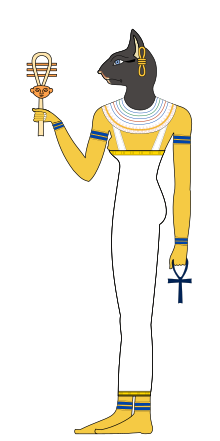
Bastet.svg
Bast (Bastet)
Some of the god representations are more clever than others. I liked Mad Sweeney the Leprechaun and the very cat-like Bast. But I thought the modern gods of Media and financial Intangibles were pretty darned clunky.
And the primary god, Wednesday, is slimy and unethical and mean. He is a grifter with no conscience. I was prepared to cut him a tremendous amount of slack, since he was Odin, after all, but after about a hundred pages I didn’t like him one bit and I didn’t want to hear any more of his slick patter. And I didn’t want to hear any more about his creepy attitude towards women (to wit: they are a dime a dozen, and the best ones to sleep with are naïve, innocent virgins that you can despoil).

Which brings me to my final complaint: by and large, women come out really badly in this book. They are either (a) beautiful, innocent nymphs; (b) horrifying man-eaters; (c) motherly, house-bound caretakers; or (d) priggish, controlling, and sour.

Many of the female gods use their bodies as their primary weapon and their exploits involve titillation, sex, pregnancies, and/or a lot of blood. The male gods have a wide range of attributes—they can be furtive or powerful, showy or gray-suited, efficient and businesslike or sleazy and alcoholic—but are rarely sexualized. Female gods are often shown partially or completely naked as a matter of course; male gods are hardly ever undressed except as part of a specific religious ritual. When female characters are not sexy they are usually crabby, and the male characters commiserate with each other about what joy-killers they are.

Here’s one of my favorite quotes on this topic from the book: “Shadow smiled at the pretty women, because they made him feel pleasantly male, and he smiled at the other women too, because he was having a good time.” (p. 459)

Oh, thank you so much, Shadow.

One woman in the book, Samantha Black Crow, does actually come off as a relatively realistic person. She is snappy, sarcastic, and not averse to telling some tall tales herself. She goes by the name “Sam,” has a face that is described as “slightly mannish” and is leaning decidedly towards the lesbian end of the bisexual scale. Maybe since she isn’t interested in any of the male characters, she can be allowed to have a deeper character development.

If you want a better book about gods who appear in human form to create trouble, I would recommend Roger Zelazny's Lord of Light instead. (Gaimain does acknowledge Zelazny at the end of the book; not as an inspiration but as someone who has tackled this premise before.)

Friday, September 27, 2013

Book Review: Paladin of Souls

Lois McMaster Bujold
2003
Awards: Nebula, Hugo, Locus
Rating: ★ ★ ★ ★ –

Lois McMaster Bujold has won Nebulas and/or Hugos for five books. This is the only one that was not an installment of her long-running Vorkosigan Saga, and (not coincidentally) this one stands head and shoulders above the other four.

It is both a war story and a ghost story, with a relatively strong heroine at its core and an intriguing secret parallel world of gods and demons who influence everyone’s actions. The writing can sometimes get a bit overly romantic, but that is more than made up for by the strength of the tale.

The main character, Ista, is a member of the royal family of her land, Chalion. But her life is not glorious. She had a period of alleged madness several years ago, and although she has quite recovered, her well-meaning family keeps her closely observed and confined in their castle so she won’t go off and do anything crazy again.

To make matters worse, Chalion is on the brink of war with the neighboring country of Jokona. The impending war plus concern for Ista’s supposedly fragile sanity are perfect twin excuses to keep her pent up in her stultifying prison.

Eventually, Ista thinks of escaping by going on a religious pilgrimage, an idea which she knows her family cannot refuse. She quickly gathers a few of her most loyal guardsmen and attendants to go with her, dresses incognito, and packs and leaves before her family can organize the ridiculously huge retinue they think should go with her.

Ista has a fabulous time on her pilgrimage in the beginning: she loves the outdoors, the colors, the people, the freedom. Since she is traveling incognito, no one is overly protective or obsequious.

And you are happy for her. Because, the thing is, Ista is not mad at all, really. Her problem is that she has second sight: the ability to see the gods and demons in the world around her. And this, naturally, makes her feel a responsibility to do something to protect everyone else from the demons. It is a huge burden on her and makes her seem crazy to the 99% of people who cannot see the spirit world.

Ista’s people, the Chalionese, subscribe to a five-way deity system (the deities being the Mother, the Father, the Son, the Daughter, and the Bastard). Every deity has particular strengths and abilities, and every person has a particular deity who they have more of an affinity to than the others, who guides and aides them while they are alive and who will accept their soul when they die.

Unbeknownst to most people, the gods are very active in the real world, observing and interfering and directing things. This is generally a good thing, because there are demons out and about in the world, too. Demons attach themselves to an animal or person, gradually gaining more and more control over it, and jumping to another being when their host dies.

Trouble first comes to Ista's pilgrimage when her party is attacked by a bear occupied by a demon. One of her guardsmen kills the bear, only to have the demon jump into him.

And then, when they are heading to a temple of the Bastard to try to exorcise the bear demon from the soldier, they run afoul of a troop of Jokonans, who overwhelm their party and take them prisoner.

They eventually are rescued and taken to the safety of a Chalionese border castle, and Ista falls in love with one of the two handsome warrior brothers who are the castle's proprietors. But by then the dominoes are tumbling. The incident with the Jokonan troop precipitates an all-out war in which Ista is on the front lines and her second-sight god-seeing and god-speaking abilities turn out to come very handy strategically.

I’m sure that plenty of people would say that this is primarily a romantic love story. But I think it is more about the triumph of a person who is trapped in a suffocating life, empty of love and excitement, until she breaks herself out. In trying to gain her freedom, Ista puts herself in peril and has some very rough and scary times. But she also finally finds true friendship and love, and discovers that her talents give her an important role in her world.