Showing posts with label Religion/Philosophy. Show all posts

Friday, February 7, 2020

Book Review: Project Pope

Clifford D. Simak
1981
Nominations: Hugo
Rating: ★ ★ ★ – –

I like Clifford Simak’s novels a lot, and I think part of the reason might be because he started out as a journalist. His writing is clear and accessible without being simplistic. His main characters tend to be thoughtful loners who still care about other people. And he is able to use his kind, thoughtful little stories to raise big questions about big topics, without being didactic about it.

Project Pope’s big questions all revolve around the reconciliation of faith with science in the search for truth. And as a framework for these questions, Simak invents a paradoxical thing: a society of robots trying to build a religion.

The actual plot is a little peculiar. There are certainly moments of violence, danger, and even at least one murder. But his main characters are generally trying to do the right things even if they mess up sometimes. And even though they face threat, they face it with kindness and an earnest interest in puzzling out the solution.

---

The book starts with a pretty darned exciting scene. On the remote planet of Gutshot, doctor Jason Tennyson has just run afoul of the law for the crime of having his boss, a city bigwig, happen to die on his watch. In a daring escape, he stows away on the next vessel leaving Gutshot’s spaceport, which turns out to be headed to the planet End of Nothing.

As the name would suggest, End of Nothing is the most remote planet in the known galaxy. And, for that reason, it was chosen by a group of cast-off robots from Earth to be the site of their project to create a new robot Vatican, complete with a robot Pope.

On Earth, robots were forbidden from developing their own religion So the ones who founded End of Nothing are extremely skittish about visitors and publicity, and this has piqued the interest of the only other human passenger on Tennyson’s ship, reporter Jill Roberts. Having received no response to her many written requests for information from the new Vatican, she is headed there in person to get some answers.

When they arrive at the End of Nothing, one of the human residents has had a severe accident, and the only human doctor there has recently died. So the robots, who don’t ask too many questions about legality anyway, ask Tennyson to stay and be their new doctor. He assents, not having too many other options. And, in an attempt to make things more palatable for Tennyson and to co-opt Roberts, they offer her a position as Vatican historian.

Roberts and Tennyson learn that the new Vatican employs a select group of semi-telepathic humans as sort of cosmic scouts; these people are able to travel in their minds to other worlds, and they do so, searching one world after another for Heaven.

They do this in service of the new Pope, who is convinced that religion can be derived from science. He believes that if he is able to search wide enough and far enough, he will discover the physical location of Heaven, and then he will be able to have a scientific basis for his faith.

But there is an underground faction of robots that believe that this is the wrong way to approach it; that faith must come first, and science must come after. This is the fundamental tension of Project Pope: the conflict between robots who believe faith must be derived from science, and those who believe science must be derived from faith. And, unbeknownst to our main characters or the Pope, both sides have adherents that are willing to make deadly cases for their beliefs.

While this dispute is simmering, Tennyson strikes up a friendship with Decker, a cabin-dwelling loner who has been on End of Nothing for most of his life, and Decker’s close companion, a sparkly trans-dimensional being named Whisperer that can also itself travel telepathically to other worlds. Whisperer takes Tennyson and Roberts on several journeys to meet the various wacky inhabitants of different worlds, and there they make the acquaintance of a group of aliens that look like giant dice that can print mathematical equations on their surfaces.

Eventually, one of the Vatican’s scouts finds Heaven--or is at least convinced that she has. She suffers a nervous breakdown as a result, but Whisperer is able to read enough of her mind to trace the scout’s journey back to the world she thought was Heaven, and to bring Tennyson and Roberts there.

What they discover there is not actually Heaven but instead a strange city world peopled by a motley group of aliens--including a duplicate of Decker, a furry alien shaped like a haystack, and an octopus-being that constantly plops up and down making a sound like liver being slapped on a countertop. One of these creatures turns out to be one of the faith-firsters, and it is determined to destroy Heaven, and possibly the rest of the universe along with it, by blowing itself up. There is a simultaneously tense and funny climactic scene in which Whisperer, Tennyson, and Roberts are able to avert catastrophe by bringing in their equation-surface-dice friends, and everybody lives, if not happily ever after, at least to see another day, albeit with lingering questions about God, the Devil, Heaven, and the nature of the universe.

---

In the introduction to her novel The Left Hand of Darkness, Ursula LeGuin explained that the great thing about descriptive science fiction is that each piece is a “thought-experiment.” She said:
In reading a novel, any novel, we have to know perfectly well that the whole thing is nonsense, and then, while reading, believe every word of it. Finally, when we're done with it, we may find - if it's a good novel - that we're a bit different from what we were before we read it, that we have been changed a little, as if by having met a new face, crossed a street we never crossed before. But it's very hard to say just what we learned, how we were changed. 
The artist deals with what cannot be said in words. The artist whose medium is fiction does this in words. The novelist says in words what cannot be said in words.
To some extent, Simak does this with Project Pope. It is not the world’s greatest piece of science fiction. But, at the end, if he has done his job for you, you wind up having enjoyed a somewhat quirky story about robots and aliens, while also simultaneously engaging your mind on questions that might not otherwise be easy to conceptualize. Is it better, he asks, to search for universal scientific truths, and to allow religious belief to develop from that? Or to grab hold of a religion--to search for Heaven--first, and then to use that idea of truth to frame your search for scientific knowledge?

Each reader is going to have to answer that question for themselves, of course. Simak provides the framework that enables you to think about it, but does not (and cannot) provide an answer. As Tennyson tells the robot Pope: if you asked a hundred humans whether faith should come out of knowledge or knowledge out of faith, you’d get all sorts of different answers, and any of them may be right.

But, being humans, we still want to ask the question. “We grasp for knowledge;” says Simak, through the thoughts of his main character. “Panting, we cling desperately to what we snare. We work endlessly to arrive at that final answer, or perhaps many final answers which turn out not to be final answers but lead on to some other fact or factor that may not be final, either. And yet we try, we cannot give up trying, for as an intelligence we are committed to the quest.”

Friday, October 18, 2019

Book Review: Radiomen

Eleanor Lerman
2015
Awards: Campbell
Rating: ★ ★ – – –

This novel is...okay. It gives a somewhat new twist to the aliens-are-among-us genre, and kept my interest up a reasonable amount of the time. But it reads a little too much like a young adult novel trying to be grittier and more hard-boiled than it actually is. It’s like Judy Blume trying to be Raymond Chandler. And some of the writing gets a bit sloppy.

The main character, Laurie Perzin, is directionless and isolated. She lives in a down-at-heel part of Queens near warehouses where shady activities go on in the wee hours of the night. Every day she shuttles back and forth from her home to her job as a night-shift bartender at Kennedy airport, keeping her head down, uninvolved in everything around her.

The one interest she has is in ham radio, a hobby borne out of her close childhood relationship with her now-deceased radio enthusiast uncle Avi. But even that hobby is soured by the memory of a vivid dream from that childhood. In the dream, she and Avi were outside the family’s summer vacation rental in Rockaway, trying to listen to signals from Sputnik. Avi lost the signal and went up to the roof to fix the antenna. While he was gone, a gray, fuzzy humanoid form appeared in front of Laurie, telling her not to make a sound while it fixed the radio.

The dream has always disturbed her. So, at the start of the book, without really intending to, Laurie calls in to a psychic appearing on a late-night radio talk show. The psychic, Ravenette, repeats the dream to Laurie unprompted. Laurie hangs up, but the psychic tracks her down and tries to get her to talk about the dream humanoid, and also tries to convert her to a cult-like religion that is almost an exact copy of Scientology called The Blue Awareness.

Ravenette won’t leave Laurie alone. So Laurie turns to the radio show’s host, Jack Shepherd, for help. Jack is sane and sympathetic, but suggests that maybe her “dream” was actually a real incident that she is repressing. Jack thinks that the gray humanoid she saw was an alien, and that there are others on Earth besides the one she saw, and that other people have seen them, and that her uncle might have known about them, too.

In fact, Jack thinks that, Howard Gilmartin, founder of the Blue Awareness, knew about the aliens too, and built his cult around them. Jack’s theory is bolstered when thugs from the Blue Awareness start harassing Laurie, insisting that she submit to “tests” using their “blue box,” which is basically just a box with an electric field in it. She makes the mistake of telling them that she has her own box—one her uncle built to prove that theirs was fake—whereupon they break in and ransack her apartment to steal it.

After the break in, Laurie’s Malian neighbor gives her a watchdog; a very strange but cute and loyal dog that protects her from other incidents and seem to have its own knowledge (and distrust) of the creepos from the Blue Awareness. Jack suspects that the dog is descended from a long line of dogs cared for by the Dogon people of Mali, which may have been given to them originally by the aliens hundreds of years ago as a gift.

Eventually, Laurie is contacted by Raymond Gilmartin, son of Howard and current leader of the Blue Awareness. Raymond thinks she has another piece of her uncle’s radio equipment, a repeater, and he wants it and won’t leave her alone about it. Then there is a weird incident where Ravenette channels an alien who says that it is the aliens who actually need the repeater.

Jack is curious about all of this, so he builds a new repeater when they can’t find Avi’s, and then Jack and Laurie agree to meet Raymond and Ravenette at Laurie’s family’s old vacation rental in Rockaway to give them the repeater, in exchange for them leaving Laurie alone. The Blue Awareness thugs show up and it all threatens to go bad until like a bazillion dogs show up to protect Laurie. And then who should show up but the alien himself, amazing everyone and silencing the Blue Awareness for good.

Lerman’s thesis is an interesting one in principle: that in spite of their superior science, the aliens visiting us are as much in the dark about god and the meaning of life and all that as we are. This could have been turned into a thought-provoking statement about how technology won’t answer those sorts of questions for you, and that no matter how smart you are, you still have to look inside yourself to find meaning in your life. But that does not happen in this novel.

Lerman tries hard to make Laurie tough, but she just doesn’t have the gravitas and attitude to pull off the noir persona it seems that Lerman is going for. She always comes across like a continually disillusioned kid. And many of her movements seem pointless, or at least needlessly slow; like her first visit to her family’s old beach rental on Rockaway, or to her uncle’s grave.

In keeping with a noir atmosphere, Lerman includes huge amounts of gritty scenery description, especially of the seedier parts of New York City, which in a Dashiell Hammett novel would give the story a crucial atmosphere, but which here get, well, boring. Everything is continually soggy, gray, forlorn.

And there are a ton of similes, often combined with comically long run-on sentences, that are pretty hard to read. To wit:
“Dr. Carpenter turned to look toward the window, where a block of dusty summer sunlight seemed to sit on the sill like a package someone had forgotten to bring inside.”
“The structure resembled a pile of dark concrete whose colonnaded facade had been stripped bare and refurbished to emanate a steampunk look that someone must have felt represented the aesthetic of early twentieth-century manufacturing even better than the name of the long-departed box-making firm still chiseled above the entranceway.”
The Blue Awareness is a little too bare-facedly and disappointingly an imitation of Scientology—even down to the Ted Merrill / Tom Cruise star spokesman—without any real significant alteration.

And the ending is awkwardly unsubtle. Characters are supposed to grow and change over the course of a novel, but it is supposed to be self-evident; not proclaimed. At the end of Radiomen, Laurie comes right out and tells the reader that she has changed from a person plodding head down through life to a curious person alive with possibilities. (Which isn’t actually all that apparent.) And, as a bonus, Laurie lists the other key characters and tells us how they have changed, too. It clanks hard.

If anything rescues this novel at all, it is the dogs. They provide the moments of real heart and meaning; they have their own agendas and personalities, and are some of the best characters in the book. If only they were the protagonists as well.

Friday, January 11, 2019

Book Review: Earthquake Weather

Tim Powers
1996
Awards: Locus (Fantasy) 
Rating: ★ ★ – – – 

Earthquake Weather is the third novel in Tim Powers’ somewhat roughly connected Fault Lines trilogy. It is not really a sequel, but it continues some of the story lines from both of the previous two novels, Last Call and Expiration Date. And it pulls in several of the same characters, although the main characters in this one are new.  

It also takes place in the same world of magic as the other two books. Which is most definitely not the light, floaty, Disney variety; the magic of Powers’ trilogy is a hard-boiled, real-world, practical magic conducted using everyday objects. It is an impressive amalgamation of ancient gods, ghosts, spirits, religions, superstitions, rituals, faiths, totems, and traditions—old and new and east and west.

And it, too, is set against a backdrop of the grittiest parts of America: diners, bars, mental institutions, curanderĂ­as, big city streets. The cars are always big, old, beaten-up American models. The characters are people from the edges of society—the poor, insane, criminal, fugitive, orphaned, lost. They tend to drink a lot—mostly Coors, vodka, and cheap red wine. (It can tend to get a little gross.)

At the beginning of Earthquake Weather, Janis Plumtree, a woman with multiple personality disorder, has killed Scott Crane (the man who was crowned as the Fisher King in Last Call). She killed him on a lonely road near Los Angeles by jamming a trident into his throat.

A faction of Crane’s supporters and believers—the Fisher King’s army, if you will—found his body before the police did and are hauling it around with them, trident included, preparing for the day when they can perform the necessary rituals to resurrect him. They are also protecting a pre-teen boy, Koot Hoomie "Kootie" Parganas, who appears to have been spiritually designated as Crane’s successor to the Fisher King’s throne in the event of Crane’s permanent death, as evidenced by the constantly bleeding wound in Kootie’s side, and the fact that he needs to tie his belt in a Mobius strip and drink lots of alcohol to keep himself from being found and possessed by ghosts. 

Into this picture comes Sid Cochran, a man who checked himself into a mental institution because he keeps seeing random people turning into bull-headed gods, and hearing people speak in the voice of his dead wife. Except that he’s not insane; those things actually are happening to him, because he’s been chosen to be one of the vessels of the god Dionysus, after an accident he once had in a vineyard where he almost got his hand cut off trying to protect an old vine stump from being cut down. In the institution Cochran meets Plumtree, who was put there by the police when she came to them claiming to have killed Scott Crane (whose body they can’t find). 

Cochran and Plumtree strike up a friendship (she with him and him with most of her personalities), and eventually they break out of the institution, narrowly escaping the clutches of the evil chief psychiatrist Dr. Armentrout, who “cures” his patients by eating the parts of their souls that are misbehaving. Eating soul parts gives Dr. Armentrout lots of spiritual power, and the fact that it sometimes kills his patients doesn’t really bother him at all. 

Plumtree’s good personalities want to atone for the bad one that killed the Fisher King, so she drags Cochran with her to track down the band of people preparing for the Crane’s resurrection. It isn’t hard, given all the portents pointing to their house in Long Beach, and the people drumming and dancing in front of it twenty-four hours a day. 

Kootie and his adopted parents-cum-spiritual shields, Angelica and Pete Sullivan, and Crane’s old friend Arky Mavranos, take in Cochran and Plumtree as wary allies. They then go on a chaotic journey up to San Francisco filled with pretty random-seeming diversions and plot twists, to perform the king-restoring ritual. 

The whole time they are pursued by Armentrout, who has hooked up with some anti-Fisher-King zealot thugs. Armentrout’s aim is to capture Crane’s body and to keep it alive but in a perpetual coma, so he can feed eternally on the spirit of the Fisher King, making him super powerful in the magical world. He doesn’t mind the idea of kidnaping Kootie as well, holding him coma-hostage in the event Crane dies for good. And if Cochran and Plumtree die along the way as well, so much the better for him. 

The Cochran/Plumtree/Kootie allies race around San Francisco gathering the necessary materials to prepare for the awakening ritual. All kinds of things go wrong to cause them setbacks, not least of which is the fact that one of Plumtree’s personalities is the not-quite-dead ghost of her evil father--the personality that killed Scott Crane--who keeps telling Armentrout where they are. There is also a genuinely exciting car chase scene when a ghost steals the car that has Crane’s body in it, and Angelica and Pete and Arky have to race it down and leap on to it while hurtling down the highway to regain control (over the car and the body). 

It all eventually comes to a climax in a giant turbulent scene at the Sutro Baths, where the final battle for Crane’s life (or death) is fought out with both temporal and fearsomely magical weapons. 

One of the best things about this book is that Powers has a stupefying amount of knowledge of a hugely broad range of spirit world arcana. He brings in ghosts, spells, portents, charms, remedies, and rites from a wide variety of traditions from around the world. This is no American Gods lightweight gimmicky hack job. 

And the magic is cleverly done using practical, real-world objects; for a knowledgeable person in the world of Powers’ books, almost anything can have a magical use. His characters use wind chimes made of chicken bones and radio parts as alarms to warn of incoming malevolent entities. They hook up old television sets and record players to talk to spirits. They use ashtrays as substitutes for fireplaces to send ghosts, literally, up in smoke. They use clove and regular tobacco cigarettes as masking tools, but actual rubber masks (of clowns, in this case) can serve the same purpose, in a pinch. Wine is used for all kinds of purification, masking, and sacramental purposes—although Coors can work, too, sometimes. 

The main problems with this book (which was also true of Last Call) are that it is dense, complex, and seemingly, for the most part, unplanned. Although there was generally an anticipatory build-up, a climactic confrontation, and a resolution (of a sort), the plot trucks along largely haphazardly towards those ends. 

I rarely understood why any of the specific incidents over the course of the book happened; most of them seemed to come out of left field. It felt like the characters were dropped into situation after situation with little or no lead-up or connection to the next. They went from Chinatown to a maze-house to a car chase to a hotel with no apparent logic. 

I also didn’t understand why voices spoke to Cochran when they did, or why he saw the signs he did, or what the bull-headed god meant in any particular situation; it seemed like the god was just saying, “hi, I’m here, be afraid.” I didn’t understand why Plumtree changed personalities when she did, or how they knew to use this or that piece of equipment. 

I tried to go with the flow and let it all just soak into my head naturally. And that worked to some extent, but generally it was so hard to make connections and follow the characters’ non-logic—especially when so much of it was somewhat repellently fueled by Coors and vodka—that I ended up skipping a lot of text. 

And, at the end, it didn’t feel like everything finally connected together and made sense; it felt like it all fell together by accident, in spite of itself, and in spite of the chaotic actions of the characters. All in all, it was just too much reading whiplash.

Friday, December 15, 2017

Book Review: The Alteration

Kingsley Amis
1976
Awards: Campbell
Rating: ★ ★ ★ – –

SPOILER ALERT

The Alteration is a novel of alternate history that makes us think in new ways—as the best speculative fiction does—about our own real-world society. Its subject matter is extremely personal and emotionally intense, which really helps to drive home Amis’s message about the true violence of tyranny and oppression. It can be, on occasion, wryly funny. But the plot takes such unrelentingly cruel and ironic twists that I would find it hard to say that the book is actually enjoyable to read.

~~~~~~~~~~~~~~~

The novel is set in 1976, in an England where the Protestant Reformation never happened. Martin Luther, rather than being a heretic and a rebel, actually served as a pope himself. Since there was no split with the Catholic mother church, the entire English empire—which includes New England and Canada—is ruled by a king who answers directly to the Roman pope.

And the Catholic Church, in the person of the pope, rules with an iron hand. A rigidly hierarchical societal structure keeps everybody in line. High-status men are infallible and unquestionable; low-status men have next to no power, and women have even less. Science is prohibited by the severely conservative church, so people have no electricity, no advanced forms of communication, and only the barest approximation of motorized vehicles. And, to rub salt in everybody’s wounds, novels of science fiction—which Amis calls “time romances”—are banned as a form of entertainment.

Growing up in this world is Hubert Anvil, a ten-year old clerk in a primary seminary school near London. Hubert has the misfortune of having most beautiful singing voice anyone in the Catholic world has ever heard. Visitors come from all over the globe to hear him. And Rome is very interested in him as an exploitable resource.

So the abbot at Hubert’s school, seeing a way to weasel his way into favor with the pope, decides the boy should be castrated, so his voice won’t change and he can be farmed out to sing as long as possible.

The law requires the abbot to ask the permission of Hubert’s father for this to happen. Mr. Anvil is a little torn at first, having a shadow of a feeling that this might be somewhat bad for Hubert, but is won over by the idea that it will prove his faith absolutely to the church hierarchy.

Hubert’s feelings are, of course, irrelevant. And so are those of his mother, who objects strenuously to Hubert’s castration, and campaigns violently against it to her husband, but has no power whatsoever to prevent it. Hubert’s older brother also doesn’t like it, but doesn’t know how to help him.

The only person who really can and does step up to help Hubert is his family priest, who surprises everyone by publicly objecting to the idea, in courageous direct opposition to his superiors. (His squeamishness about it is probably largely due to the fact that he is perhaps a little more in touch with the taste of the carnal than a priest ought to be.) The priest tries to block the permission for the procedure, but is eventually brutally squashed (somewhat literally) by thuggish agents of the church.

Hubert himself is terribly confused. He has no real sense of what he’d be giving up. He is torn between the passionate objections of his beloved mother, brother, and priest on the one side, and, on the other side, the dictates of the church that he has been brought up to respect and obey above everything else. He has only vague feelings of resistance to the idea, which aren’t nearly strong enough to offset the fear that he will be eternally damned if he refuses.

To make the idea more palatable to Hubert and, perhaps, his father, the two of them get invited to Rome to get a glimpse of the cushy, opulent life he could lead. Unfortunately, this glimpse is provided by two aging eunuchs who aren’t very good examples of the long-term results of the procedure, and one of them even ends up begging Hubert’s father to reconsider; his father is freaked out by the whole scene and they flee back to London.

Meanwhile, while all of this is happening, Hubert gives a recital at the house of the New England ambassador, where he is exposed to a whole new possible attitude about the church and established authority. The New Englanders, living a little too far from the reach of the central church, tend to be a bit more irreverent towards authority and less strict about societal mores. They don’t seem all that bothered by the fact that disobeying the pope might endanger their mortal souls. And the ambassador’s young pre-teen daughter is particularly appealing to Hubert, giving him a bit of a glimmer of understanding about what he’d be losing.

At last, Hubert realizes he really doesn’t want this done to him, and that he has no option but to risk soul-damnation and to run away. When he does, he runs afoul of the criminal underworld, but is also helped by responsible strangers and friends, and he almost makes it to freedom—until an ironic turn of fate makes his whole plan fall apart with an awful thud.

~~~~~~~~~~~~~~~

The Alteration is, on the whole, a well-crafted piece of fiction. Amis’s subject matter is certainly courageous. His characters are colorful and believable. And he creates a plausible 20th-century England that has evolved into its current form without almost any advanced science. Its technology is appropriate to his scenario; he does give the residents of this Europe express trains and some alternatively-powered omnibuses and dirigibles, but most people still primarily rely on horses and oxen for transportation.

Amis’s references to celebrities, both past and present, are sometimes smooth, sometimes jarringly cheeky. Alfieri Maserati serves as the pope’s chief inventor; Sir Francis Crick is a sad, mad, marginalized, heretical scientist; Benedict Arnold was not a traitor, but was instead a war hero, with a major town in New England named for him.

And Amis pays homage to alternate history legend Philip K. Dick with a really cheeky device: his most rebellious characters secretly read a banned alternate-history book called The Man in the High Castle, which is about an England where there was a Protestant Reformation, and where invention is allowed, and there are scientists and electricity and airplanes, and where its New England colony—called “America”—fought a revolution to gain its independence and became the world’s superpower. Needless to say, this book gives the rebels who read it much food for thought about how their own society could be.

This book-within-a-book is actually a relatively minor part of The Alteration, but it unfortunately seems to have obsessed William Gibson, who wrote about it in his introduction to my 2013 paperback version to the exclusion of most of the other, probably more important implications of the novel.

The most important implications of this novel being that tyranny and oppression will inevitably rely on a foundation of violence and cruelty, no matter how the subjects of that tyranny want to deny it, and no matter how the perpetrators of it try to sugarcoat it.

Amis’s characters desperately persist in going about their business as if everything was pleasant and idyllic. They are excruciatingly polite and deferential to each other. They use euphemisms to avoid talking directly about unpleasant or overly-personal topics (to the point where after about five people have tried to explain to Hubert exactly what will happen to him, he still has no idea).

But no matter how much the characters want to believe they live in a peaceful, painless society, the truth is that the church’s authority relies on unchecked violence and pain. At any moment, the men in control can strip away their subjects’ lives, liberty, and sensitive body parts. And if an individual resists, they are not just risking their body or their life; they are risking the damnation of their eternal soul.

The distressing truth of this novel is that Hubert never had a chance. I read in continual hope that he would find freedom. But the seeming inevitability of his fate—forced on him in the end, in spite of all his efforts, almost as if by God—casts a depressing, hopeless shadow over the whole book. And maybe that is Amis’s point, and his warning: in a tyrannical state, self-determination is impossible, and hope is pointless.

Friday, November 17, 2017

Book Review: Strange Bodies

Marcel Theroux
2013
Awards: Campbell
Rating: ★ ★ – – –

Theroux’s novel Strange Bodies starts in a tchotchke shop somewhere in Britain. A man comes in to see the shop owner. He claims to be her ex-boyfriend from long ago, Nicholas “Nicky” Slopen, and he can remember all sorts of things only her ex would know. The only problems are that (a) he doesn’t look anything like her ex, and (b) her ex is supposed to have died in a gruesome car accident a couple years before.

Nevertheless, the man claims to really be Nicky Slopen. And he leaves the shop owner with a flash drive that contains a troublingly credible story of what happened to him over the past few years. The rest of the novel tells that story—a story that will reveal whether or not someone has actually invented the technology to resurrect dead souls.

Slopen is a struggling academic, a specialist in the writing of Samuel Johnson. He has a loveless marriage and a strained relationship with his kids.

One day, a rich celebrity collector comes into Slopen’s bleak life to ask him to authenticate some papers that he is thinking about buying that purport to be lost letters of Samuel Johnson.

Slopen finds that the paper the letters are written on are only a couple years old, so he figures the letters must be forgeries. But the writing is absolutely, perfectly, undeniably, bafflingly Johnson’s.

Slopen insists on meeting the person who wrote the forgeries. The man appears to be an autistic savant: a Russian immigrant, Jack, who barely speaks at all, much less any English, but who produces an almost continuous stream of this very authentic Johnsonian material as Slopen watches.

Slopen starts visiting Jack regularly to try to find out more about him, and grows increasingly attached to him and his sister, Vera. Slopen’s attachment grows especially strong after his inevitable divorce.

Eventually Vera has to go back to Russia to see her doctor and leaves Jack in Slopen’s care. It is at this point that Slopen starts to put it together that Jack might actually be Johnson—or that at least his brain might be Johnson’s brain. And the more questions Slopen asks of the sinister people hovering around Jack and Vera—including the celebrity who asked him to verify the documents in the first place, and Vera’s “business associate” and bodyguard, who both live with her and Jack—the more he suspects something really unusual was going on.

Slopen confronts them all, one by one, and eventually learns that they are adherents of the philosophy of the 18th century Russian thinker Nikolai Federov, who theorized of immortality being possible for all humans. And that, following the theory that a person’s soul is present in their writing, they have developed a procedure to use a person’s collected writings to plant that person’s memories into the brain of another person.

There are just two problems with this (besides the fact that the idea that you can recreate a person’s whole personality from their writing is a shaky literary premise at best). The first problem is that they aren’t really giving a person immortality; they are creating a simulation of that person in another body. The original person still dies. (This has been explored to death in many other, better vehicles.)

And, second, in order to do this, they need to use someone else’s body as the vessel for the implanted memories. For all intents and purposes, this essentially kills the person whose body they are using.

Vera and Nicky are, to say the least, disturbed by all of this. And they know they have to stop the practice from becoming a way for wealthy few to perpetuate their personalities on the backs of unsuspecting working-class volunteers. But they know that no one else will believe their story, and that they are in mortal danger from the sinister forces behind the procedure, who will stop at nothing to shut them up.

~~~~~~~~~~~~~~~~~

On the plus side, the story is well written and (mostly) unfolds at a breezy clip. Theroux also does a good job of giving you just enough information that you can guess what’s happening—including the central conceit that not only has Samuel Johnson’s soul been transferred into the body of a working-class Russian man, but so also has that of our main character—but not so much information that you know how it happened, or why. So you want to keep reading to find that out.

Theroux also does a good job of telling the story discontinuously, which seems to be difficult for many writers. The story line jumps back and forth in time between the near past (the story of how Nicky Slopen in his original body met the resurrected Samuel Johnson and got involved with the Russians); the far past (the story of how Slopen and Johnson were resurrected); and the present (the story of the resurrected Slopen in the mental hospital, actually writing the narrative). The discontinuity is a little crazy-making, but completely fits the story, since Nicky himself has been driven a bit crazy by what happened to him and all he has to process to come to terms with it.

Theroux also is able to make his resurrected Samuel Johnson amazingly authentic. It makes me think Theroux must be a Johnson fan himself, well-read enough in Johnson’s papers and steeped enough in Johnson’s style to be able to make his Johnson character speak and write like the real thing.

There are just a couple problems with the book, but they are big ones for me.

For one thing, I’ve never been a big fan of Samuel Johnson’s writing. Far be it from me to use the term “navel-gazing” about the writings of such a philosophical giant. But he does spend quite a bit of time agonizing over the meaning of life, and the universe, and the nature of the soul, to the point where, if one were so inclined, one conceivably could describe it as unproductive noodling for noodling’s sake.

And, perhaps as is natural with this subject matter, his writing tends to get depressing. Which brings us to the second issue I have with the book: the tone. Samuel Johnson always leaves me feeling unproductively melancholy and pessimistic.

In several places in the novel, Slopen raves about how great it is that Johnson is able to look unblinkingly at reality, recognizing that all the things we do on Earth are most likely completely meaningless, and that the ways we try to make ourselves feel better about that fact are just Band-Aids. In a passage near the beginning of the book, Slopen writes:
I’m poor in everything but ironies, and to be truthful, I’ve forgotten what’s so good about irony in the first place. It’s just the resting state of the universe. Johnson puts it best in a section I can recall from memory. “The real state of sublunary nature,” he calls it, “in which, at the same time, the reveler is hastening to his wine, and the mourner burying his friend; in which the malignity of one is sometimes defeated by the frolic of another; and many mischiefs and many benefits are done and hindered without design or purpose.”
But the truth is that the irony he describes in those easy pairings—revelers sharing the world with mourners, Wile E. Coyote foiled by the Road Runner’s cheery energy—is simply the last available meaning before the significance of anything decays to random chance. Many mischiefs and many benefits are done and hindered without design or purpose. Good becomes bad, bad good; love degenerates to dullness and senseless animosity. Irony is not order, but it gives a shape to things. We can’t believe that a rational God had a hand in this chaos, but we’re not quite ready to sign up to the devastating truth of Johnson’s last line. Our faith in irony is a sticking plaster to restore our loss of Faith in its larger sense. (Pp. 77-78)
Slopen and his idol Johnson both also have an ever-present feeling that our reality is fragile, and based simply on consensus. They are hyper-aware that the “facts” we take for granted—“the state of a marriage, artistic merit, a person’s true nature”—are liable to fall apart at any moment, simply because those involved might stop believing in them.

And, because they are aware of this, they stand ever poised on the precipice of oppressive gloom and insanity. They are just this side of mental breakdown. Slopen describes Johnson as the master of “keeping it real in spite of the danger of melancholy and losing your grip on sanity.” As Slopen says,
To me, Johnson’s recognition of that is part of his acute modernity as a moralist. I think he saw the relation between individual and collective delusion: the threat of madness to the human mind and the body politic. He knew that it was a small step from religious mania to religious wars. Madness is part of that turn away from the real that Johnson was so vigilant in confronting wherever he found it—not because of his confidence in reason, but because he knew from his own experience how fragile the rule of reason is.
No one more embodies the illuminating potency of reason. Johnson was devastating in his capacity to sniff out the fake in its different guises… But this very power was riddled with its opposites: melancholy and uncertainty; fear of his own loosening grip on the nature of reality.” (P. 148)
Years ago, I used to find this kind of thinking appealing. It seemed to cut through pretense and offer an unvarnished, honest view of the world. But I find that I have grown weary of it, and now it seems pretentious itself. I don’t have the patience any longer for maudlin, self-absorbed noodling about reality and the soul. I don’t necessarily think that reality is that fragile. I think it is possible to look at the world and be cynical and skeptical and honest without falling into a pit of despair. I want to find joy where I can, and to be able to acknowledge pain without being overcome by ennui and pessimism.

But Johnson doesn’t seem to be able to do that, and neither does Slopen. They remain stubbornly forlorn and depressed.

Friday, November 11, 2016

Educational Snippits from Kurt Vonnegut’s Slaughterhouse Five


On Americans and The Poor (page 164)

While the British colonel set Lazzaro’s broken arm and mixed plaster for the cast, the German major translated out loud passages from Howard W. Campbell, Jr.’s monograph. Campbell had been a fairly well-known playwright at one time. His opening line was this one:

America is the wealthiest nation on Earth, but its people are mainly poor, and poor Americans are urged to hate themselves. To quote the American humorist Kim Hubbard, “It ain’t no disgrace to be poor, but it might as well be.” It is in fact a crime for an American to be poor, even though America is a nation of poor. Every other nation has folk traditions of men who were poor but extremely wise and virtuous, and therefore more estimable than anyone with power and gold. No such tales are told by the American poor. They mock themselves and glorify their betters. The meanest eating or drinking establishment, owned by a man who is himself poor, is very likely to have a sign on its wall asking this cruel question: “If you’re so smart, why ain’t you rich?” There will also be an American flag no larger than a child’s hand—glued to a lollipop stick and flying from the cash register.
                                                                                   
On Christian Gospel (page 138)

Rosewater was on the next bed, reading, and Billy drew him into the conversation, asked him what he was reading this time.

So Rosewater told him. It was The Gospel from Outer Space, by Kilgore Trout. It was about a visitor from outer space, shaped very much like a Tralfamadorian, by the way. The visitor from outer space made a serious study of Christianity, to learn, if he could, why Christians found it so easy to be cruel. He concluded that at least part of the trouble was slipshod storytelling in the New Testament. He supposed that the intent of the Gospels was to teach people, among other things, to be merciful, even to the lowest of the low.

But the Gospels actually taught this:
                                                                            
Before you kill somebody, make absolutely sure he isn’t well connected. So it goes.

A Fourth-Dimensional Tralfamadorian Explains to His Peers What Time Looks Like to a Three-Dimensional Human Using a Two-Dimensional Analogy (pp. 146-147)

The guide invited the crowd to imagine that they were looking across a desert at a mountain range on a day that was twinkling bright and clear. They could look at a peak or a bird or a cloud, at a stone right in front of them, or even down into a canyon behind them. But among them was this poor Earthling, and his head was encased in a steel sphere which he could never take off. There was only one eyehole through which he could look, and welded to that eyehole were six feet of pipe.

This was only the beginning of Billy’s miseries in the metaphor. He was also strapped to a steel lattice which was bolted to a flatcar on rails, and there was no way he could turn his head or touch the pipe. The far end of the pipe rested on a bi-pod which was also bolted to the flatcar. All Billy could see was the little dot at the end of the pipe. He didn’t know he was on a flatcar, didn’t even know there was anything peculiar about his situation.

The flatcar sometimes crept, sometimes went extremely fast, often stopped—went uphill, downhill, around curves, along straightaways. Whatever poor Billy saw through the pipe, he had no choice but to say to himself, “That’s life.”

Friday, October 14, 2016

Book Review: Slaughterhouse Five


Kurt Vonnegut
1969
Nominations: Nebula, Hugo
Rating: ★ ★ ★ ★ –

In my review of Cat’s Cradle, I already talked a lot about Kurt Vonnegut’s life, the themes in his work, and the power of his writing. Everything that I said there all goes, for the most part, for Slaughterhouse Five as well.

Cat’s Cradle is a more straightforward novel, though. It is written in a chronologically linear narrative, with a more standard type of dramatic tension and a definitive ending. Slaughterhouse Five is radically structured, even more existential, and even more of an anti-war statement. It is also much more personal and autobiographical—if it is possible to say that about a novel whose main character who lives discontinuously in time and is abducted by aliens.

Vonnegut wrote Slaughterhouse as a way to deal with his experiences in World War II and, in particular, the firebombing of Dresden. 60,000 people were killed in that attack—more than at Hiroshima—and Vonnegut, as a German prisoner of war, worked to clear away the bodies in the aftermath. It is no wonder that it took him more than twenty years to write this book.

The main character, Billy Pilgrim, grows up as a relatively ordinary boy with a relatively uneventful boyhood in upstate New York. When World War II breaks out, he joins the army, is sent to Europe, and is stranded behind enemy lines in Luxembourg after the Battle of the Bulge. Shoeless and stupefied, he wanders in the snow with other survivors until they are captured by the Germans and put in a prisoner of war camp. He is sent to Dresden, Germany, just before its complete destruction by Allied forces and, like Vonnegut himself, Billy is put to work cleaning up corpses by day and housed in a former pig slaughterhouse by night.

After the war, Billy stays in a mental hospital for a long time and then goes home to Ilium (to a family that thought he was dead), marries basically the one woman who will have him, becomes an optometrist, has two children, and lives a pretty commonplace life into middle age.

Occasionally, during his commonplace middle age, others try to force him to be nostalgic about the war, or to think of it wistfully and romantically, when he doesn’t give a damn about it one way or another. When one history aficionado is lecturing him about how valorous and virtuous the war was, Vonnegut says that it “made the inside of poor Billy’s skull echo with balderdash.” And you can completely picture Vonnegut experiencing exactly the same thing.

There are just two exceptions to the banality of Billy's existence. The first is that during his early years he becomes “unstuck in time,” meaning that he has the unfortunate tendency to travel through time at random, living the moments of his life discontinuously. The other is that later in life he is abducted by aliens from the planet Tralfamadore, and is installed in a residence in a sort of a zoo on the planet Tralfamadore, together with Montana Wildhack, a former Hollywood starlet.

If this all sounds a bit disjointed and surreal, it is. But if you let any need for chronological sensibility go, and follow the story where Vonnegut wants to take you, the book is powerful, mind-opening, and oddly optimistic.

One of Vonnegut’s tried-and-true reader-jarring techniques is to set up direct juxtapositions of banality with horror. Since we are following the narrative through Billy’s eyes, we jump from time to time (and planet to planet) as he does, switching from the middle of wartime Europe, to a rather boring optometrists’ cocktail party, to Billy’s cage on Tralfamador. One of the most poignant of these juxtapositions happens when, first, Billy is traveling across Europe in a P.O.W. box car, the roof of which is painted with distinctive black and orange stripes... and then the very next scene he jumps to is his own wedding, years later, where the wedding tent's roof is painted with exactly the same black and orange stripes. 

In Slaughterhouse Five, these juxtapositions not only make the horror more horrible and set up a nice dose of irony, but also give us a slanted, challenging perspective on ordinary life that is probably very good for us to have. It means that what could have been either a relatively banal story of a relatively banal man, or possibly an overwhelmingly depressing story of a soldier experiencing one of the most awful things a soldier can experience, is turned into a mind-twisting, funny, surreal, and occasionally gut-wrenching story about finding ways to make it through life when there seems to be only pain and pointlessness all around.

Vonnegut also occasionally, sparingly, inserts himself into the story, showing up in places where he actually was in real life and glimpses into his real experience. He appears, for example, in Billy’s the prisoner of war camp, suffering from food poisoning and wailing in the latrine (which did happen). He also is spilled out of the P.O.W. box cars in Dresden at the same time as Billy, standing near him as they look at Dresden for the first time, marveling at how it is the most beautiful city he has ever seen (which also did happen). These moments also have the effect of bringing you right back to earth: if you were in danger of thinking you were just reading a piece of pure fiction, Vonnegut’s appearances remind you that many of these moments happened to a real person (and that a beautiful city and its people really were pulverized by Allied forces).

Oddly, it is the Trafalmadorians that give the book what incongruous optimism it has. The Tralfamadorians live in four dimensions. Which means that they see all of time, from beginning to end, at once. When looking at a person, they see that person’s entire life, from birth to death, all at the same time. To a Tralfamadorian, therefore, when a person dies, they aren’t really dead; they are still alive somewhere else in their life timeline. When a person dies, then, the custom on Tralfamadore is to say, “so it goes.”

So every single time Vonnegut mentions someone dying in his book, he follows it with “so it goes.” This has the weird effect of making it seem like he’s taking the fact that someone died less seriously, when he's actually calling extra attention to it. After he has said “so it goes” ten or twenty or thirty times, it makes you realize just how many people have died, and in what awful and sometimes pointless ways. It also makes you realize how often we talk about people dying and we don’t stop and acknowledge what has happened, even with a silly little ritual like saying “so it goes.”

And the thing is that the idea that a person has not really died, but is still alive somewhere along their cosmic timeline, makes it easier for Billy—and presumably, Vonnegut himself—to live with the memories of what he has been through and what so many others have suffered. The wider perspective of the Tralfamadorians gives him a way to see his own life, and the lives of others, in a less painful way.

Fittingly, there is no real end to Slaughterhouse Five. The novel’s coda is set in the corpse mines of Dresden, and is told from Vonnegut’s real-life point of view. Vonnegut uses the coda to lay out a sometimes overwhelming existential dichotomy:

       There is no meaning behind the horrible things that happen to people.
       But, hopefully, on balance, most of the moments in life are nice ones.

And, hopefully, the nice moments in life are all the meaning you need—because I’m afraid that’s all you’re going to get here.

Friday, April 8, 2016

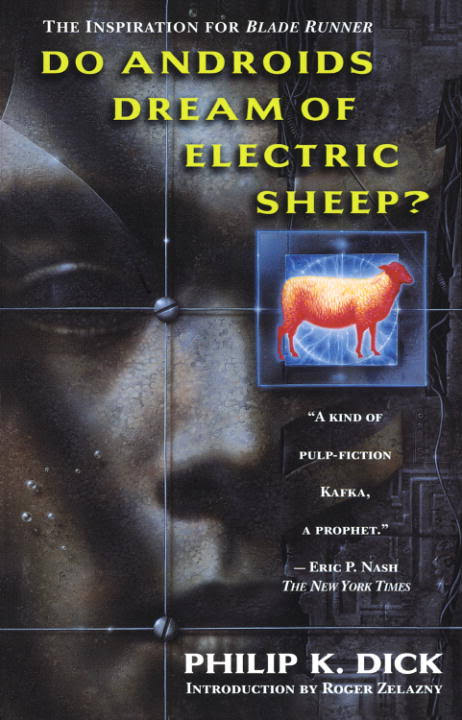
Book Review: Do Androids Dream of Electric Sheep?

Philip K. Dick
1968
Nominations: Nebula
Rating: ★ ★ ★ ★ –

It is truly a pleasure to be able to review another book by the brain-twisting, reality-suspending Philip K. Dick.

This novel is probably one of his most famous since it was, as the front cover of my 1996 paperback version says, “the inspiration for the movie Blade Runner.” The book was really just that, however—an inspiration. No one should read Dick’s novel expecting it to be a direct parallel to Ridley Scott’s 1982 movie.
   
Both share the same basic plot skeleton: in a technologically advanced Los Angeles of the near future, protagonist Rick Deckard is hired by the L.A. police department to hunt down a group of dangerous androids who have escaped from an off-world colony.
   
However, the meat covering the book’s and movie’s respective skeletons is almost completely different. Which, as I will explain later, is not necessarily a bad thing; both are superb in their own ways.

The novel is set in the 2020s (which would have been pretty far in the future for Dick in 1968). A nuclear war has killed off most of the world’s animals and the radioactive dust that remains is slowly killing everything that was able to survive the war itself. Most of the planet is vacant, desolate desert. All of the humans who could afford to have fled to off-Earth colonies elsewhere in the Solar System; the people who remain eke out their livings while trying to avoid sterilization and death.
   
To cope with the pervasive atmosphere of despair, most people own Penfield mood organs, which offer hundreds of different settings. The machines allow them to be in complete control of their feelings at all times, whether they want to feel happy, or calm, or raunchy, or even profoundly depressed.

Most people also subscribe to Mercerism, the new masochistic religion of the times. Special devices let them connect their brains into the brain of the religion’s founder, Wilbur Mercer. They stay connected to him and to each other for hours, seeing what he sees, which mainly involves him trudging steadily uphill on a path in a desert, often being pelted with rocks by from unseen persecutors.

On an Earth with hardly any animals, owning a pet is the ultimate status symbol. But because the scarcity of real flesh-and-blood animals has driven their prices through the roof, most people can only afford mechanical copies. No one wants their neighbors to know they can’t afford a real animal, so corporations are making money hand over fist by building increasingly realistic robotic animals that can usually pass for the real thing.

Robot technology has not stopped at animals, however. Corporations are now also able to build incredibly highly-functioning androids as well. In fact, the latest models, the Nexus-6s, are indistinguishable from humans without sophisticated empathy testing. Androids are used as slave labor on off-Earth colonies, but they are illegal on Earth. Every once in a while a slave android will escape, make it to Earth, and try to blend in.

This is where our main character, Rick Deckard, comes in. At the beginning of the book, Deckard gets an emergency assignment: find and kill six escaped Nexus-6s who are believed to be hiding out in L.A. They are clever and very dangerous; one of them has already put his superior in the hospital.

Deckard and his wife Iran have so far only been able to afford a mechanical sheep. Bounty hunting is an extremely risky job, but he thinks that with the staggering reward he’d get from bagging six androids—which would be an industry record—he’ll be able to afford a much higher-status animal—maybe even a real one. Maybe even a Percheron. His wife, who is so depressed that she actually regularly sets her mood organ for more depression, urges him on.

The police chief suggests that Deckard first fly to Seattle to talk to Rosen Associates, the company that makes the Nexus-6s, so he can see a sample before he goes after them. There, he meets Rachael Rosen, a staffer who at first is presented as a relative of the company’s founder but who he learns through testing is actually one of the Nexus-6s herself.

This throws him for a loop, because he would have sworn she was human; and it’s even more disturbing to him because she didn’t know she was a robot either.

Back in L.A., Deckard methodically finds and kills the first three of his six androids. Each one is a different challenge, but the most difficult are the ones who try to befuddle him by making him doubt his entire sense of reality. They set up their own false, staffed, police station and they try to convince him that all his memories are fake, that he’s not working for the police at all, that they are the real police, and that perhaps he is an android himself. They are very convincing and he just about believes them (as do you). It is very anxiety producing—and classic Philip K. Dick.

Rachael Rosen, who is very upset upon learning she is an android, begs Deckard for help and they end up sleeping together. This makes him falter and start having doubts about his ability to kill androids and even to see them as non-people. It turns out, though, that Rosen was just trying to distract him in the hopes that he won’t go after one of the remaining androids—the one named Pris—who is the same model as her.

Roy Batty!
Eventually, the final three androids—Roy Batty, Irmgard Batty, and Pris Stratton—worm their way into the confidence, and thence the apartment, of J.R. Isadore, a sterilized, mentally deficient “special” person who lives in a vacant building in the suburbs. They hole up there until Deckard tracks them down and brings on the final showdown.

The book has just about everything: a clever premise, a gripping plot, and a sympathetic main character. It takes place in a creative but still realistic setting that you can picture yourself in, and Dick provides plenty of colorful emotional and physical details to ground you in the book’s world. His writing style itself is clear and straightforward, which is good because his ideas can be pretty twisty.

The movie Blade Runner is really, really, really good also. And the fact is that Blade Runner would probably not have been as great as it is if it had followed the book any more closely. Indeed, in spite of what an ingenious and prolific writer Dick was, there are actually only a couple movies made out of his books that are very good.

Dick’s best writing is about the questions that obsessed him—questions about the nature of reality and humanity that have a lot of potential for cerebral terror: who am I? Is what I perceive real? If someone insists my reality is wrong, should I trust them or my memories? If an android has been given feelings and memories to make it think it is human, is it human? How do I know I’m not an android that has been programmed to think I am human?

These are scary concepts that work well on the page and in the brain but seem to be difficult to translate to the screen. Usually—Total Recall aside—they don’t make for successful popular films.

Blade Runner’s screenwriters were smart to cut out Deckard’s wife, the Penfield mood organ, the Mercerist religion, and the robotic pets. And they were smart to trim down the number of androids and to make them a lot more scary and formidable. All of these changes made the movie into a different, but equally good, animal—a thrilling, gritty, futuristic film noir.

Friday, January 15, 2016

Book Review: Permutation City

Greg Egan
1994
Awards: Campbell
Rating: ★ ★ – – – 

What Egan is trying to do in Permutation City is to examine a large and diverse array of issues related to the virtualization of human life. He uses his various characters to explore whether you can achieve immortality as a virtual copy of yourself and what that would be like; whether it would be possible to create life forms that could actually evolve in a virtual environment; the mental adjustments that you might go through upon waking up and discovering that you are a virtual copy of your former self; how economic inequality might affect your virtual existence; and even what a virtual hell might be like. 

All of this is pretty ambitious. And some of the specific scenes are certainly thought-provoking and vividly written. But the main story line is not at all compelling, leaves many more promising smaller story lines unfinished, and is based on a vaguely explained metaphysical theory with feeble conceptual underpinnings. It seems as if Egan first brainstormed all of the virtual reality theories he could think of, and then just connected them all together with the thinnest and stretchiest of story skins. 

In the world of Permutation City, in 2045, people can create fully sentient electronic copies of themselves, with memories intact. These “Copies” live in virtual environments but can interact with flesh-and-blood humans through immersive interfaces. People can extend their lives a long time this way; for example, many major companies are still being run by virtual Copies of their founders, many years after the originals have died.

There is a catch, though: creating a Copy of yourself is expensive. And the processors required to run your Copy and its virtual environment are expensive too, and usually require a trust be set up to fund them in perpetuity. So self-virtualization is really only available to the wealthy. And less wealthy Copies running on cheaper processors can be stuck living at speeds many times slower than real time, making it hard for them to interact with other, faster Copies, and next to impossible to interact with the outside world.

The economic inequality of processor speed for virtual humans could be an interesting plot in itself. Egan creates, for example, a radical separatist movement among Copies, “Solipsist Nation,” which advocates turning entirely inward to your virtual self and cutting yourself off completely from the “real” outside world. And some equality-minded faster Copies, particularly those in Solipsist Nation, like to go “slumming” at slow-down bars, where all of the Copies in the bar sync themselves down to the speed of the lowest person there. But these are only incidental topics, dealt with only briefly; in fact, the only two characters in the book who talk about these issues are dead ends with almost no bearing on the main story line whatsoever.

No, the main narrative instead centers on the crackpot theories of main character #1: Paul Durham, insurance salesman by profession and virtual reality experimentalist by passion, who claims to have been reincarnated from dust twenty-three times.

Durham likes to create Copies of himself to experiment with, to analyze his reactions to being virtualized. The book opens, in fact, with a scene of one of his Copies waking up and realizing that he is virtual, not a flesh-and-blood human. The Copy goes through shock, depression, panic, and then anger as he realizes that the fail-safes in his environment won’t allow him to commit virtual suicide.
[Note here to the editor of Permutation City: the term that Egan uses to describe committing virtual suicide—when Copies can’t cope with being virtual and turn themselves off permanently—is “baling out.” He uses this term repeatedly. Unless he is making some clever pun on the word “bale,” as in “baleful,” I think he meant to use the term “bailing out,” which means to remove yourself from a harmful situation. If it is indeed not a pun, then it is misspelled in the text, over and over and over.]
Durham’s Copy’s frustration is understandable. The thought processes he goes through and the feelings he has, when he thinks about how he can no longer touch his girlfriend or walk beyond the borders of his virtual world, ring very true. He knows he could simulate those things, but they wouldn’t be real, and that is tremendously depressing to him at first. He knows that the simulation of his virtual world disappears when it is out of his eyesight, that none of the visuals are generated by the computer until they need to be generated to protect his illusions; he wishes he could turn his head fast enough to see the parts that aren’t there.

This scene is one of the best in the book, and the issues it raises might have been enough to hang the entire plot on. It brings up good questions, such as: if everything feels real around me, but I know it isn’t real, does it make a difference? Should it? What kind of life could I build for myself in a virtual world? Does it make me less of a person to be virtual? How do I go about accepting who I am?

But rather than musing over these questions for long, Durham’s Copy quickly starts to accept his situation. And, sitting there in his unique environment, he comes up with a theory, which he calls the “dust theory,” that goes like this:
Everything is made of tiny cosmic particles, or what Durham’s Copy calls “dust.” If there are sentient beings in that dust, their very beingness—or, as he says, “the internal logic of their experience”—is strong enough that if they are somehow destroyed, that the particles that made them up will still combine in an infinite set of permutations that eventually will result in them coming into existence again.

Durham theorizes further that he can use this wackjob theory to create a virtual refuge for Copies that is completely unconnected and protected from the real world. He thinks that if he builds the seed of this environment correctly, loads a bunch of Copies into it, launches it into the void, and then cuts it off from the outside world, that it will continue functioning, and even growing, forever. It won’t need any physical presence in our universe at all, so it won’t be subject to real-world competition for power or processors, or the potential of being shut down.

To provide ethically questionable entertainment that could last potentially forever for the residents of his refuge, Paul then enlists the help of main character #2, Maria Deluca. Deluca is a hobbyist who spends much of her free time playing with virtual bacteria in a bacterium-modelling virtual universe, and she has recently become the first person ever to develop a virtual bacterium that actually evolves and adapts to its environment.

On what I might uncharitably say is the thinnest of premises to include another not-fully-realized virtual-reality-related thought experiment in the book, Durham hires Deluca to build the seed of an entirely new planetary system, running separate from but parallel to the human Copies’ refuge. This alien environment will be packed with the building blocks of virtual life, designed to grow and evolve into a fully diverse ecosystem of its own, for the Copies to observe. (This is another subplot that might have been good as the fully-developed center of a novel of its own: following the alien ecology’s evolution in detail, interacting with the inhabitants, answering their questions about their creation, coping with the moral issues it raises. But this was not to be.)

Durham then goes out and recruits a bunch of wealthy Copies to fund the project. One of these is Thomas Riemann, who, unbeknownst to anyone living today, long ago in his dark youthful past, semi-accidentally killed his girlfriend. The murder continually weighs on his conscience, and he runs through the incident in his mind over and over again. (Riemann’s agony, too, might have been good explored as a story by itself: how prolonging your life through virtualization doesn’t rid you of your past mistakes, and how it can even turn an infinite lifespan into a sort of hell. Egan deals with this a bit, but then lets it fizzle out.)

Durham and Deluca set up the seed for the standalone environment, which they are calling Elysium, pack it full of billionaire client Copies and the seed of Deluca’s virtual alien planet, and launch it out into the ether. 

And it turns out that the dust theory works, that the Copies survive, that Elysium works, that Deluca’s alien world works, and that it all keeps growing and expanding and evolving, unconnected from the real world they left behind. 

And then, thousands of years later, Elysium is faced with a new crisis, when the alien planet has developed sentient life forms and the two environments appear to be affecting each other, encroaching on each other. 

Permutation City certainly has some bright spots: isolated subplots with potential, isolated sections with interesting narratives. But the main story is flat and almost emotionless with the barest excuse for a rationale, and the subplots are stuck into it haphazardly. In general, it does a lot of metaphysical navel-gazing about esoteric virtual reality theories without blending them into a coherent whole—much less an exciting story.

Arnold Schwarzenegger in Total Recall


I should say here that it is possible to incorporate questions about perception and virtual reality into riveting stories. Take, for example, maybe half of the works of Philip K. Dick. Dick may have done such a good job of it because he was genuinely afraid of not being able to distinguish between reality and artificial memories, and he let his real fear come through into his writing.

Friday, December 11, 2015

Book Review: Cat’s Cradle (Part II: Writing & Themes)

Kurt Vonnegut
1963
Nominations: Hugo
Rating: ★ ★ ★ ★ –

This post talks about Kurt Vonnegut’s writing and general themes in his work, particularly as used in Cat’s Cradle. For my synopsis of the plot of Cat’s Cradle, please see my last post.

Vonnegut's Style

Vonnegut’s style was very different from what most other authors were doing when he first started publishing novels in the 1950s and early 1960s.

His chapters are tiny—sometimes just a page or two. (Cat’s Cradle, for example, is less than 200 pages long and has 127 chapters.) The chapters also have a tendency to break right in the middle of a conversation or anecdote.

His writing is rapid-fire, hurtling through plot and character development at high speed. And he frequently punctuates his main narrative with side references and little bits of added information that seem totally out of left field but often come up later in unexpected ways. They are always funny without being overly clever. He constantly makes you wonder: how the hell did he think of that?

A clever writing style does not by itself make a person a great author, however. What made Kurt Vonnegut great were the subjects he dealt with, his willingness to lay himself on the line emotionally, and his drive to get to the truth, however painful. And how he tied it all together with a brilliantly dark sense of humor.

Vonnegut's History

Vonnegut did not have an easy early life, and much of his largely pessimistic and cynical outlook was undoubtedly formed by major traumas he experienced in his teens and twenties. He was born in 1922 and when he was still a young child, his parents were all but destroyed, economically and psychologically, by the Great Depression. His mother eventually ended up committing suicide shortly before he was sent off to World War II.

And the war itself was horrific for him, as the Kurt Vonnegut Memorial Library’s biography of the author describes:
When World War II broke out, Vonnegut was 16; at 20, he entered the army and was shipped off to Europe, where he almost immediately was captured by the Germans in the Battle of the Bulge.
He was sent as a POW to Dresden. On February 13, 1945, British and American bombers destroyed the city by dropping high explosives followed by incendiary bombs. The resulting firestorm turned the non-militarized city into an inferno that killed up to 60,000 civilians. Vonnegut and his fellow POWs survived by accident only because they were housed some 60 feet underground in a former meat locker and slaughterhouse.
Vonnegut’s job for weeks after the bombing was to gather up and burn the remains of the dead.
Dresden after the 1945 Firebombing
It is no wonder that Vonnegut wrote so much about the pain of war and the pointlessness of religion, business, and patriotic fervor. And it is no wonder that he was so sensitive to falseness, both large- and small-scale. Vonnegut spent much of his time in his writing trying to strip away artifice and to get to the truth.

Vonnegut's War

War is less of a central theme in Cat’s Cradle than in some of Vonnegut’s other novels, but it still rears its head in significant places.

First, of course, the narrator gets sucked into the San Lorenzan/ice-nine mess in the first place because he is writing a book about the day the atomic bomb was dropped on Hiroshima. He—along with Vonnegut, presumably—wants to know how the intelligentsia of America coped psychologically with what they had done to the people of Japan.

And the ceremony honoring San Lorenzo’s Hundred Martyrs to Democracy is a cynical and, at the same time, heartbreaking take on the hero-worship of soldiers who die in war.

The story of the Hundred Martyrs is that when World War II broke out, one hundred San Lorenzan men volunteered to fight. They all got onto a ship and took off for the war, but a U-boat sunk the ship and all one hundred soldiers died before it even got out of the harbor. Every year since then, San Lorenzo has held a ceremony to honor these heroes in which cardboard cutouts of world dictators are floated in the harbor and shot at by San Lorenzo’s six war planes.

After learning about the ridiculousness of both the martyrs’ deaths and the ceremony honoring them, we are prepared for total buffoonery at the ceremony itself. But instead we are forced to come face to face with the true awfulness of it all by the U.S. Ambassador to San Lorenzo, who says in his speech:
    “We are gathered here, friends,” to honor…children dead, all dead, all murdered in war. It is customary on days like this to call such lost children men. I am unable to call them men for this simple reason: that in the same war in which [these martyrs] died, my own son died.”
    “My soul insists that I mourn not a man but a child.”
    “I do not say that children at war do not die like men, if they have to die. To their everlasting honor and our everlasting shame they do die like men, thus making possible the manly jubilation of patriotic holidays.”
    “But they are murdered children all the same.”
    “And I propose to you that if we are to pay our sincere respects to the hundred lost children of San Lorenzo, that we might best spend the day despising what killed them; which is to say, the stupidity and viciousness of all mankind.”
Vonnegut's Religion 

Religion is much more prevalent than war as a theme throughout Cat’s Cradle. Vonnegut’s vehicle for talking about it is Bokonon, San Lorenzo’s local holy man, a former sailor and somewhat questionable figure who, after being marooned on the island, created his own irreverent and unholy religion.
   
The Books of Bokonon, which Vonnegut’s narrator John learns about on the flight to San Lorenzo, are a series of parables and lessons in the form of calypso songs. They tend to reflect on the ridiculousness of life and to send the message that the only thing that is really holy is humankind itself.

The General Electric Company Board
Bokonon teaches that everyone belongs to a karass: a group of people with whom you are cosmically connected and are fatalistically destined to do God’s will, whether you want to or not. He also teaches that people often try to create artificial karasses, which he calls granfalloons, which are groups that people think are significant but which really have zero meaning on a cosmic scale. Examples of granfalloons, groups that appear to be meaningful but which are not, are: the General Electric Company, Cornell alumni, and any country at all. 

Vonnegut's Truth

Vonnegut had a real distaste for falsehoodfrom the big lies told by churches, corporations, and countries to get people to do what they want, to the little white lies told by individual people to make themselves look and feel better.

On the large scale, Vonnegut's shredding of both war heroism and religion is an expression of his general struggle to cut through these lies. Through the stories of the Hundred Martyrs and the Books of Bokonon, Vonnegut shows us that much of what we revere is self-deception; we are desperate to feel like we are part of something big and important, so we construct institutions to convince ourselves that we are.

And on the small scale, his characters usually seem pretty normal at first but then, through seemingly innocuous conversations and throw-away remarks, piece by piece, he reveals their odd and often depressingly sad backstories. Supposedly happy marriages turn out to be shams; supposedly successful people turn out to feel like tremendous failures; supposedly tight-knit families turn out to be full of tension.

In fact, the people who openly admit from the start that they are liars—like Bokonon and Newton Hoenikker—end up being the only truly honest people in the book. Bokonon admits that everything he says is a lie—and therefore Bokononism is the only religion John feels he can believe in. And Newton illustrates the destructiveness of untruth with a story about how his father at one point became obsessed with cat’s cradle, the string game. His father kept waving the cat’s cradle in Newton's face and demanding that he pay show some interest. Newton explains how confusing this was for him as a child, and how this kind of thing would teach a kid to doubt what he sees:
    “One of the oldest games there is, cat’s cradle. Even the Eskimos know it.”
    “You don’t say.”
    “For maybe a hundred thousand years or more, grown-ups have been waving tangles of string in their children’s faces.”
    “Um.”
    Newt remained curled in the chair. He held out his painty hands as though a cat’s cradle were strung between them. “No wonder kids grow up crazy. A cat’s cradle is nothing but a bunch of X’s between somebody’s hands, and little kids look and look at all those X’s…”
    “And?”
    “No damn cat, and no damn cradle.”
And, indeed, for Vonnegut himself, the more blatant and ridiculous he is with his lies in his writing, the more believable he is. It is his mission to peel the onion, to strip away the false fronts his characters put on until we are left with the bare and painful but also honest and funny truth.

Cat's Cradle String Game
It is distressing, but it also feels right. It feels better to come to grips with the truth, however depressing, than to carry on the ridiculous and always even more pathetic lies people tell to cover it up.

Vonnegut's Humor

All of this is pretty heavy stuff, of course. But Vonnegut’s books are never too heavy to read because of his biting, sarcastic, cynical wit. His dark humor is present throughout all of his writing, from silly acronyms and funny names to the embarrassing ways people die and the tremendous effort people put into pointless tasks.

On the surface, his humor might make it seem like he is being flippant about really serious subjects. But his flippancy and his deadpan delivery actually make the serious issues even more horrifying than if he had tried to present them seriously.

Vonnegut could not look at life in anything other than a clear-headed, unvarnished way. This was a blessing for his readers but was probably a curse for him. Given the overwhelming depression that he experienced at times, it is amazing that he was able to create stories with such humor in addition to such insight. It is a measure of his genius that he was able to make us look directly at such difficult topics, and make us question our own assumptions and actions, and make us laugh while he was doing it.

From The First Book of Bokonon:

     In the beginning, God created the earth, and he looked upon it in His cosmic loneliness.
     And God said, “Let Us make living creatures out of mud, so the mud can see what We have done.” And God created every living creature that now moveth, and one was man. Mud as man alone could speak. God leaned close as mud as man sat up, looked around, and spoke. Man blinked. “What is the purpose of all this?” he asked politely.
     “Everything must have a purpose?” asked God.                                 
     “Certainly,” said man.
     “Then I leave it to you to think of one for all this,” said God. And He went away.