Showing posts with label Voluntary Body Modification. Show all posts

Friday, November 17, 2017

Book Review: Strange Bodies

Marcel Theroux
2013
Awards: Campbell
Rating: ★ ★ – – –

Theroux’s novel Strange Bodies starts in a tchotchke shop somewhere in Britain. A man comes in to see the shop owner. He claims to be her ex-boyfriend from long ago, Nicholas “Nicky” Slopen, and he can remember all sorts of things only her ex would know. The only problems are that (a) he doesn’t look anything like her ex, and (b) her ex is supposed to have died in a gruesome car accident a couple years before.

Nevertheless, the man claims to really be Nicky Slopen. And he leaves the shop owner with a flash drive that contains a troublingly credible story of what happened to him over the past few years. The rest of the novel tells that story—a story that will reveal whether or not someone has actually invented the technology to resurrect dead souls.

Slopen is a struggling academic, a specialist in the writing of Samuel Johnson. He has a loveless marriage and a strained relationship with his kids.

One day, a rich celebrity collector comes into Slopen’s bleak life to ask him to authenticate some papers that he is thinking about buying that purport to be lost letters of Samuel Johnson.

Slopen finds that the paper the letters are written on are only a couple years old, so he figures the letters must be forgeries. But the writing is absolutely, perfectly, undeniably, bafflingly Johnson’s.

Slopen insists on meeting the person who wrote the forgeries. The man appears to be an autistic savant: a Russian immigrant, Jack, who barely speaks at all, much less any English, but who produces an almost continuous stream of this very authentic Johnsonian material as Slopen watches.

Slopen starts visiting Jack regularly to try to find out more about him, and grows increasingly attached to him and his sister, Vera. Slopen’s attachment grows especially strong after his inevitable divorce.

Eventually Vera has to go back to Russia to see her doctor and leaves Jack in Slopen’s care. It is at this point that Slopen starts to put it together that Jack might actually be Johnson—or that at least his brain might be Johnson’s brain. And the more questions Slopen asks of the sinister people hovering around Jack and Vera—including the celebrity who asked him to verify the documents in the first place, and Vera’s “business associate” and bodyguard, who both live with her and Jack—the more he suspects something really unusual was going on.

Slopen confronts them all, one by one, and eventually learns that they are adherents of the philosophy of the 18th century Russian thinker Nikolai Federov, who theorized of immortality being possible for all humans. And that, following the theory that a person’s soul is present in their writing, they have developed a procedure to use a person’s collected writings to plant that person’s memories into the brain of another person.

There are just two problems with this (besides the fact that the idea that you can recreate a person’s whole personality from their writing is a shaky literary premise at best). The first problem is that they aren’t really giving a person immortality; they are creating a simulation of that person in another body. The original person still dies. (This has been explored to death in many other, better vehicles.)

And, second, in order to do this, they need to use someone else’s body as the vessel for the implanted memories. For all intents and purposes, this essentially kills the person whose body they are using.

Vera and Nicky are, to say the least, disturbed by all of this. And they know they have to stop the practice from becoming a way for wealthy few to perpetuate their personalities on the backs of unsuspecting working-class volunteers. But they know that no one else will believe their story, and that they are in mortal danger from the sinister forces behind the procedure, who will stop at nothing to shut them up.

~~~~~~~~~~~~~~~~~

On the plus side, the story is well written and (mostly) unfolds at a breezy clip. Theroux also does a good job of giving you just enough information that you can guess what’s happening—including the central conceit that not only has Samuel Johnson’s soul been transferred into the body of a working-class Russian man, but so also has that of our main character—but not so much information that you know how it happened, or why. So you want to keep reading to find that out.

Theroux also does a good job of telling the story discontinuously, which seems to be difficult for many writers. The story line jumps back and forth in time between the near past (the story of how Nicky Slopen in his original body met the resurrected Samuel Johnson and got involved with the Russians); the far past (the story of how Slopen and Johnson were resurrected); and the present (the story of the resurrected Slopen in the mental hospital, actually writing the narrative). The discontinuity is a little crazy-making, but completely fits the story, since Nicky himself has been driven a bit crazy by what happened to him and all he has to process to come to terms with it.

Theroux also is able to make his resurrected Samuel Johnson amazingly authentic. It makes me think Theroux must be a Johnson fan himself, well-read enough in Johnson’s papers and steeped enough in Johnson’s style to be able to make his Johnson character speak and write like the real thing.

There are just a couple problems with the book, but they are big ones for me.

For one thing, I’ve never been a big fan of Samuel Johnson’s writing. Far be it from me to use the term “navel-gazing” about the writings of such a philosophical giant. But he does spend quite a bit of time agonizing over the meaning of life, and the universe, and the nature of the soul, to the point where, if one were so inclined, one conceivably could describe it as unproductive noodling for noodling’s sake.

And, perhaps as is natural with this subject matter, his writing tends to get depressing. Which brings us to the second issue I have with the book: the tone. Samuel Johnson always leaves me feeling unproductively melancholy and pessimistic.

In several places in the novel, Slopen raves about how great it is that Johnson is able to look unblinkingly at reality, recognizing that all the things we do on Earth are most likely completely meaningless, and that the ways we try to make ourselves feel better about that fact are just Band-Aids. In a passage near the beginning of the book, Slopen writes:
I’m poor in everything but ironies, and to be truthful, I’ve forgotten what’s so good about irony in the first place. It’s just the resting state of the universe. Johnson puts it best in a section I can recall from memory. “The real state of sublunary nature,” he calls it, “in which, at the same time, the reveler is hastening to his wine, and the mourner burying his friend; in which the malignity of one is sometimes defeated by the frolic of another; and many mischiefs and many benefits are done and hindered without design or purpose.”
But the truth is that the irony he describes in those easy pairings—revelers sharing the world with mourners, Wile E. Coyote foiled by the Road Runner’s cheery energy—is simply the last available meaning before the significance of anything decays to random chance. Many mischiefs and many benefits are done and hindered without design or purpose. Good becomes bad, bad good; love degenerates to dullness and senseless animosity. Irony is not order, but it gives a shape to things. We can’t believe that a rational God had a hand in this chaos, but we’re not quite ready to sign up to the devastating truth of Johnson’s last line. Our faith in irony is a sticking plaster to restore our loss of Faith in its larger sense. (Pp. 77-78)
Slopen and his idol Johnson both also have an ever-present feeling that our reality is fragile, and based simply on consensus. They are hyper-aware that the “facts” we take for granted—“the state of a marriage, artistic merit, a person’s true nature”—are liable to fall apart at any moment, simply because those involved might stop believing in them.

And, because they are aware of this, they stand ever poised on the precipice of oppressive gloom and insanity. They are just this side of mental breakdown. Slopen describes Johnson as the master of “keeping it real in spite of the danger of melancholy and losing your grip on sanity.” As Slopen says,
To me, Johnson’s recognition of that is part of his acute modernity as a moralist. I think he saw the relation between individual and collective delusion: the threat of madness to the human mind and the body politic. He knew that it was a small step from religious mania to religious wars. Madness is part of that turn away from the real that Johnson was so vigilant in confronting wherever he found it—not because of his confidence in reason, but because he knew from his own experience how fragile the rule of reason is.
No one more embodies the illuminating potency of reason. Johnson was devastating in his capacity to sniff out the fake in its different guises… But this very power was riddled with its opposites: melancholy and uncertainty; fear of his own loosening grip on the nature of reality.” (P. 148)
Years ago, I used to find this kind of thinking appealing. It seemed to cut through pretense and offer an unvarnished, honest view of the world. But I find that I have grown weary of it, and now it seems pretentious itself. I don’t have the patience any longer for maudlin, self-absorbed noodling about reality and the soul. I don’t necessarily think that reality is that fragile. I think it is possible to look at the world and be cynical and skeptical and honest without falling into a pit of despair. I want to find joy where I can, and to be able to acknowledge pain without being overcome by ennui and pessimism.

But Johnson doesn’t seem to be able to do that, and neither does Slopen. They remain stubbornly forlorn and depressed.

Friday, May 6, 2016

Book Review: Bellwether

Connie Willis
1996
Nominations: Nebula
Rating: ★ ★ ★ ★ –

I never thought I would say this about a book and mean it in a good way:

Bellwether is an adorable romance story.

It’s also a tremendously cute send-up of people slavishly following popular trends.

The main character, Dr. Sandra Foster, is a statistical researcher at a corporation called HiTek. Her area of research—her obsession—is to discover how fads start.
   
HiTek has several floors of researchers all engaged in different types of research, from stats to biology to physics. It is a sort of Dilbertian company in that it does not appear to actually create any products, but does spend tons of money and time holding trendy sensitivity exercises and producing reams of bureaucratic paperwork.
   
HiTek is interested in Foster’s research because they’d like to use it to create fads of their own. But Foster is doing it because she is simply fascinated by trends: the phenomenon of people blindly following the crowd’s lead in completely silly fashions, food, and entertainment. She wants to know what makes otherwise rational people subscribe to the pointless and idiotic just because it’s popular.
   
Foster is surrounded by people who subscribe to the latest fads and try to enforce them on her—not only HiTek’s management, but also her friends, her friends’ kids, her maybe-boyfriend, the baristas at her favorite cafĂ©, and the assistant librarians at her local library. Foster’s life is additionally complicated by Flip, the company’s twenty-something administrative assistant (later re-titled by management the “interdepartmental communications liaison”). Flip is on the bleeding edge of fashion, with blue hair and duct tape jewelry, but cannot make copies or correctly deliver inter-office mail to save her life. She invariably ends up making more work for Foster than if Foster had just done the administrative tasks herself.

Foster’s current project is to find the source of the hair-bobbing fad of the 1920s. She has methodically eliminated all of her most promising potential sources, and feels like she’s not getting anywhere. Then, one day, Flip mis-delivers a package to Foster that is supposed to go to a Dr. Turnbull down in Biology. Foster takes it upon herself to deliver it since it is marked “perishable.” Turnbull is not in her lab at the time, but her lab mate, Dr. Bennett O’Reilly, is there. And in O’Reilly, Foster meets the first and only person she has ever met who seems to be completely immune to fads.

O’Reilly is a complete fashion disaster. He wears clashing colors and patterns and has no idea whether tiramisu or bread pudding is in or out. And not only does he not care about fads, he seems to be unaware that they even exist. This is, of course, fascinating to Foster.

O’Reilly is working on chaos theory. He is trying to observe how chaotic systems behave and understand how they can sometimes reach such a point of total chaos that they will actually spontaneously organize themselves into a new, organized-seeming equilibrium. He and Foster quickly recognize the similarities in their goals, and decide to work together on a single project to find out how cohesive trends arise out of chaos and disorganization. They launch their project—which involves borrowing a flock of sheep from Foster’s rancher maybe-boyfriend—but their progress is hampered on all sides by friends and colleagues who want them instead to help them ban smoking from the parking lot, find a Romantic Bride Barbie, and win the elusive million-dollar Niebnitz research grant.
   
O’Reilly and Foster are as cute as buttons. Really. They’re the only people at HiTek—or even apparently in the greater Denver-Boulder area—who seem to have a dose of common sense. And they’re ideal for each other, but they don’t see it at all, of course.

There’s not actually all that much that goes on as far as plot in this book. It’s like Willis’ longer books in that most of the activity involves the main characters trying to get something done—like copying a bunch of clippings on hair-bobbing—and having it take weeks because it is interrupted by management all-hands meetings, administrative assistants (or interdepartmental communications liaisons) losing the clippings, and people wanting advice about filling out the incomprehensible new simplified funding forms.

As long as you don’t need a lot of actual plot or action, and you are okay sitting back and enjoying the ride through the chaos, you’ll get a lot of funny information about trends and entertaining character studies of impossible people, and a very sweet love story between two likeable characters fighting against all odds to follow their own stars.

Friday, July 24, 2015

Book Review: Queen of Angels

Greg Bear
1990
Nominations: Hugo, Campbell, Locus
Rating: ★ ★ – – –

SPOILER ALERT

I am normally a Greg Bear fan, but Queen of Angels did not do it for me. It seemed like a writing experiment that failed. The post-cyberpunk style seemed half-hearted; the multi-threaded plot lines were plodding and uninteresting; and several thematic elements that were initially intriguing and seemed to be being set up to be important turned out to be disappointing dead ends.

The first of these thematic dead ends is the date. The book is set in Los Angeles in December of 2047, on the eve of the binary millennium. This means that on January 1st the year, when expressed in binary form, will flip from 11111111111 to 100000000000. For most of the book it seems like this might be a big deal, but in the end it doesn’t make any difference to anything, and winds up feeling like a piece of geeky trivia that Bear tossed in just to be clever.

In Bear’s 2047, the world is full of automated highways, nanotech, and biogenetic transformation. It is also divided into the haves, who live in luxurious, secure high-rises, and the have-nots, who live in the “jags,” or what used to be the regular old city. And it is also split into people who have been “therapied” and the maladjusted unfortunates who have not—another thematic element which there is a great stir about at first, but which ends up leading nowhere, especially since you can’t really tell who is what, and the supposed anti-untherapied discrimination doesn’t really amount to much.
   
Anyway. The plot starts out gamely enough, with a mass murder: eight students are found dead in the apartment of their professor, famed poet Emmanuel Goldsmith. Police detective Mary Choy is assigned to the case.

(Choy, incidentally, is a full-body “transform” who has had her entire skin replaced with a jet-black, slick seal-skin-like material. It’s cool, but we never learn exactly why she chose that, and what its significance is, if anything.)

At first, Choy thinks that solving these murders is going to be a breeze, but it turns out to be much more complicated than she expects. One problem is that Goldsmith, the prime suspect, is missing and is suspected to have escaped to the banana republic of Hispaniola, where his best friend is the semi-benevolent dictator. Another problem is that she can’t find any hard evidence proving that he is the culprit.

In addition, there is a rogue group of “selectors,” people who appoint themselves to be judge, jury, and executioner of justice against perpetrators of fraud and abuse who haven’t yet been caught by the police. They target powerful mafia bosses and white-collar criminals and put them through mind torture harsh enough to turn many of them into vegetables. Choy figures (correctly) that the selectors are after Goldsmith and that she has to find him before they do, and this sets up a nice bit of suspense.

If Bear had focused more on the murder investigation, he probably would have had himself a pretty good novel. He could have fashioned himself into a sort of post-cyberpunk Raymond Chandler. But, instead, he splits the story into four separate, frustratingly slow-moving plot lines with only light (or, in one case, zero) connections to each other.

In addition to Choy, he follows the story of Richard Fettle, a failed writer who was a friend of Goldsmith’s and who is suffering not only from shock at the crimes but also severe writer’s block and a dysfunctional relationship with a really annoying girlfriend. He gets more and more frustratingly aimless and pitiful over the course of the book.

We also follow brilliant psychological researcher Dr. Martin Burke, one of the only people on earth with the technology and expertise to enter another person’s brain and probe around inside what he calls “the Country of the Mind.” Burke likes to expound at length on his half-baked theories about how our personalities are actually made up of separate segments of personality that all come together in our brains to get reconciled into a whole, and that where psychological problems happen is when these segments can’t get reconciled with each other. Burke is hired by the father of one of the murder victims to probe Goldsmith’s mind and to find out why he committed the murders (if he did). Because, oh yeah, Goldsmith is not actually in Hispaniola, he is still in Los Angeles, hiding out at the house of his publisher, which makes Choy’s later trip to Hispaniola to find him feel incredibly pointless.

And finally, to add a totally random, ridiculously unconnected plot line to all of this, because clearly that is what is most needed, we also follow the adventures of a robotic probe, AXIS, that is out in the Alpha Centauri system investigating the possibility of life on planet Alpha Centauri B-2. AXIS finds mysterious structures on the planet and we are strung along for dozens of pages thinking that maybe they are artificial constructs built by intelligent life, and that something cool is going to come of this story line, only to discover that the structures are just natural byproducts of the tides and algae-like protozoans.
   
Meanwhile, because of the time lag in messages to and from Alpha Centauri, there is a clone of AXIS on earth that the scientists are using to analyze and predict what the real AXIS is doing, and yet another clone called “Jill” which analyzes the other two, and which they are watching on tenterhooks to see if she develops consciousness. Meanwhile, the real AXIS does develop consciousness and then goes into a mental breakdown upon realizing there is no intelligent life on B-2 and it is totally alone.
   
One additional issue is that the speech and thoughts of some of the characters (Choy and Fettle) are in a type of futurespeak (or futurethink) that Bear invented for this book. I’m generally game for learning new forms of speech if it is in keeping with the story, but this is a particularly annoying brand that doubles up on adjectives and leaves out most of the punctuation. For example:
“The metro-federal interface supervisor had the look of the oft therapied a man with guts stamina and manifold problems that he had spent years and hundreds of thousands of dollars to smooth.”
Bear himself doesn’t seem thrilled with it either, since he starts off using it frequently in the early chapters and then seems to allow it to fade away to almost nothing later in the book.

It seems like Bear had five or six different ideas for what he wanted to write about, and decided to use them all in one story. The result is a big disjointed mess, and I had no investment in any of it. The plot(s) and characters were not interesting enough to hold my attention and to make it worth the slog it took to get through the narrative. It was a disappointment, since Bear’s writing is usually so greedily consumable.

Friday, February 7, 2014

Book Review: 2312

Kim Stanley Robinson
2012
Awards: Nebula
Nominations: Hugo
Rating: ★ ★ ★ ★ –

Kim Stanley Robinson writes long books. While there are, from time to time, exciting sections, you cannot count on them for constant page-turning action. They are not taut, fast-paced thrillers. And his central characters tend to be opinionated, idiosyncratic, aloof people who have difficulty getting along with others.

But what Robinson lacks in breathless plot pacing and likeable characters he makes up for—in spades—with his imaginative, vivid, and realistic descriptions of other moons and planets, the colonies we humans build in those places, and the remarkable but completely conceivable technology it takes to create and maintain those colonies. No one does a better job at this than him.

2312 is true to Robinson form in all of these ways. It is a good story—not fast moving, generally, but it keeps you interested enough, and there are several parts that are actually quite exhilarating. There are loads of excellent, realistic off-Earth locations and ingenious, not-so-out-of-reach machinery. And the love story is surprisingly touching.

~

The year 2312 comes almost two hundred years after our successful colonization and terraformation of Mars. During that time, human exploration has spread; there are colonies and, in some cases, the beginnings of terraformation on Mercury, Venus, and several of the moons of Jupiter, Saturn, and Neptune. We have also hollowed out the insides of thousands of asteroids and turned them into mobile, steerable, life-supporting terrariums, which we use simultaneously as space transport vehicles and as biomes for preserving extinct and endangered Earth flora and fauna.

For, sadly, in spite of our success in greening and animating much of the rest of the solar system, we have just about destroyed our home planet. By 2312, global warming, in combination with massive overpopulation, has had catastrophic effects, which Robinson depicts with depressing realism. Earth’s ice caps have completely melted except for two small, carefully tended glaciers in Greenland and Antarctica. Sea levels have risen more than thirty feet, so that Florida and all of the South Pacific islands and the bottom several floors of all of Manhattan’s skyscrapers are under water. Forests have turned to grasslands, grasslands to deserts. Earth is full of poverty, disease, and sharply divided classes of haves and have-nots.

Ironically, the geoengineering that we are doing everywhere else in the solar system won’t work on Earth—the ecosystem is too complex. The bombardments, sunshields, and gas emissions that we’re using in other places would upset the delicate balance of life that is left.

And the incredible political bickering on Earth leads only to indecision. Earth needs an ecological revolution, but the people of Earth variously can’t see it, can’t accept it, and can’t agree on what is needed. So nothing gets done, and the situation gets worse.

~

The first person we meet in 2312 is Swan Er Hong, currently residing in Terminator, a domed colony city on Mercury. At a spry 137 years old, Swan has been a designer of asteroid terrariums, an architect of cities and landscapes, a terraformer, and a visual artist.

Swan is also kind of a mess as a person. She is brash, whiny, cranky, and impatient. She has a tendency towards depression, self-mortification, and self-punishment. She berates herself about early biome designs that seem misguided to her now. She has a cantankerous personal Artificial Intelligence computer (or “qube”) implanted in her head; she once injected herself with alien microbes from Europa for a high without knowing what the consequences might be; she had treatments to implant animal genes into herself so she can sing like a lark and purr like a cat.

But what prevents her from being completely unappealing is that, at the heart of it all, she loves life. She appreciates everything: the croaking of frogs, the wind, the sun, the soil. She can be happy living for days out in the wild of a terrarium, following a pack of wolves. She likes risky sports and other activities that drive her to the limits of her endurance, because they make her feel fully human and alive.

At the beginning of the book, Swan’s beloved grandmother Alex has just died. While Swan is trying to grieve, her grandmother’s associates come to Terminator from across the solar system to pull her into the project that her grandmother had been working on.
                       
Which, Swan learns, wasn’t just ordinary terraformation research. It turns out that Swan’s grandmother had an all-encompassing, Seldon-esque theory of power in the solar system, which predicted that the instability on Earth would eventually lead to a crash, which would in turn mean disaster for the entire Earth-dependent solar system. And her grandmother had enlisted others across the space colonies to help her with an ultra-secret project to save Earth—“to help Earth cope with its problems by ecological means.”

Swan isn’t actually all that thrilled about being sucked into this project until catastrophe hits her personally. The city of Terminator, which Swan helped to design, is built on rails that circle the entire circumference of Mercury at a single latitude. As the planet rotates through its extremely slow day, the tracks in the daylight behind the city heat up and expand, pushing the entire city down the rails towards the night side, where the tracks are cooling and narrowing. In this way, the city is constantly moving, constantly staying slightly ahead of the deadly radiation of the Mercurial sunrise.

One night Swan and Fitz Wahram, a big lumbering co-worker/co-conspirator of her grandmother’s from Titan, go outside the city, farther ahead into the night side, to a concert. As they are returning, a meteor hits the tracks in front of the city, destroying the rails and forcing the city to stop. Terminator’s human residents are all able to evacuate in emergency shuttles, but when the sunrise finally hits the stalled city, everything else—buildings, gardens, forests, animals—burns to the ground.

Swan & Wahram are able to get to an underground conduit and walk for over a month to the nearest shelter where they can be rescued. During the time they are in the conduit, the Interplanetary Police discover that it was not a meteor at all, but a very cleverly disguised missile attack by someone who wants to subvert their project.

The rest of the book is a combination of intense cross-solar-system geoengineering and crime-solving challenges for Swan. She and Wahram and the rest of her grandmother’s allies struggle to get past sabotage, terrorism, and interplanetary politics to reverse the damage to Earth’s ecosystem, while at the same time trying to track down the forces against them and prevent them from doing even more harm. It starts getting particularly sinister when it appears that the relatively new AI “qubes” may be involved in the sabotage—because, of course, Swan has one of them implanted in her brain.

Eventually Swan and her cohorts decide that the time has come to force her grandmother’s revolution on Earth, whether it wants it or not.

I won’t describe what that revolution is here, but I will say that it is a beautiful thing. And that, in contrast to the ideal Hollywood narrative, but in keeping with both Robinson’s style and the way things really work, it is hard to definitively call it either a complete success or a complete failure.

Friday, January 10, 2014

Book Review: Camouflage

Joe Haldeman
2004
Awards: Nebula
Rating: ★ ★ ★ – –

SPOILER ALERT

Camouflage is not a deep or complex book, but it is a real treat to read. It’s a fast-paced, excellently-written story with an interesting central character, and it’s funny.

The plot is this: millions of years ago, two aliens landed on earth. They don’t know about each other, having come from different planets and having landed at different times and different places. One came in a spaceship that crashed on the floor of the Pacific Ocean. We’re not sure where or how the other one arrived.

Both aliens are shape-shifters and can take the shape of any one or any thing they want. The body chemistry that allows them to do this also makes them invulnerable to any germ or weapon or predator so they can, theoretically, live forever.

The alien that arrived in the spaceship, “the changeling,” is primarily interested in gaining knowledge of the world around it. The other alien, “the chameleon,” is primarily interested in eliminating competition and staying at the top of the food chain.

The two aliens take the form of various animate or inanimate objects as necessary to best pursue their respective goals. Over the centuries, the memory of who they are and where they came from becomes hazier and hazier, but they both know they are not like the rest of life on earth and both are constantly searching for others like themselves (for different reasons, in keeping with their different aims).

Being drawn to intra-species violence, the chameleon makes the transition to human form quite early, several millennia B.C. The changeling, on the other hand, finds itself drawn to the Pacific Ocean and spends a lot of time as sharks and whales and only takes human form for the first time in 1931.

Eventually, in 2020, the changeling’s crashed spaceship is discovered and hauled up on land to be analyzed. This gets a lot of press which immediately attracts the attention of both aliens, who then wangle their respective ways into the closely-guarded spaceship analysis project where they inevitably meet other.
 

At first the changeling, like the chameleon, is only concerned with survival; it has no concept of human emotions and makes several terrible mistakes which hurt people around it. But little by little it gains understanding and sympathy. The chameleon gains no such understanding.

Both the changeling and the chameleon experience war but have opposite reactions to it. The chameleon feeds off of the violence and joins in as often as possible. The changeling, who in one incarnation does a stint as an American prisoner of war in the Bataan Death March, is confused by atrocities and our inconsistent behavior and eventually becomes repulsed by the killing.

The only real gripes I had with the book were that (a) the chameleon’s pre-Earth background was so undefined, (b) the suspense about the inevitable confrontation between the two aliens builds through the entire book and then at the end everything is wrapped up in a nice bow in just a couple pages, and (c) I didn't really like the human characters all that much.

But that’s okay. It is all made up for by Haldeman’s terrific writing, which, to me, is the best thing about the whole book. He is succinct, matter-of-fact, and funny. He writes the way I’d hope I could write if I wrote a novel.

I know that individual paragraphs will not do him justice, because, out of context, they lose much of the book’s overall flavor. Nevertheless, here are a couple examples from Camouflage.

Describing the changeling’s experiences as a Marine at boot camp in 1941:

“For the first week they did little other than run, march, and suffer through calisthenics, from five in the morning until chow call at night – and sometimes a few more miles’ run after dinner, just to settle their stomachs. The changeling found it all fairly restful, but observed other people’s responses to the stress and did an exactly average amount of sweating and groaning. At the rifle range, it aimed to miss the bull’s eye most of the time, without being conspicuously bad.”
On how the changeling spent much of the ‘80s and ‘90s:
“It was an exotic dancer and part-time prostitute in Baltimore for a while, then a short-order cook back in Iowa City. As an old lady, it read palms on the county-fair circuit in the Midwest, and returned to California in its old Jimmy body to be a surf bum for a couple of seasons.

Sacrificing half its mass, it became a juggling dwarf with the Barnum & Bailey Circus, making contacts in the freak world. It met some interesting people, but they all seemed to be from Earth, no matter what they claimed.

It married the Bearded Lady, an even-tempered and sardonic hermaphrodite, and they lived together until 1996. The changeling left behind a hundred ounces of gold and no explanation, and became a student again.”
When the scientists studying the alien spaceship realize that there is likely at least one alien on earth, and that the alien will likely have taken human form and could be anyone, and that the way to identify the alien is that it will not have human DNA:
“In fact, by the time Jack said this, every employee at the CIA had donated a few cheek cells to the agency, as had employees of NSA and Homeland Security. A ‘suggestion’ had come down from the White House that all of the country’s leaders be tested. …

The tests proved that every member of the American intelligence community was human, at least in a nominal sense, and so were all prominent politicians, including the president, which surprised a few people.”

An earlier version of this review originally appeared on Cheeze Blog.

Friday, December 6, 2013

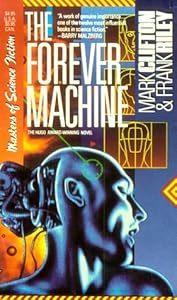
Book Review: The Forever Machine

Also published as They'd Rather Be Right
Mark Clifton & Frank Riley
1954
Awards: Hugo
Rating: ★ ★ ★ – –

I have read several reviews of this book that call it trite and clichéd. But I generally enjoyed it.

The main character is a telepathic man, Joe Carter, who grows up ostracized and isolated because of his abilities; people are freaked out by the fact that he can tell what they are thinking. He doesn’t like being so lonely, so he becomes a brilliant scientist and invents a machine that can make other people into telepaths.

Everyone on earth theoretically has the potential to be turned into a telepath by Joe's machine. But it is next to impossible to be telepathic and to retain the judgmental natures most people have. Since telepaths know what everyone else is thinking, they have to be able to handle all the varied thoughts, good and bad, intentional and unintentional, that come into their heads, without prejudice. They have to be the most understanding, least judgmental people on earth.

Before it makes you telepathic, therefore, the machine strips out all your preconceived ideas about what is right and wrong and rebuilds you, cell by cell, from the ground up…

…and it turns out that this has the nice side effect of making old people young again. Which means that once the machine has been run on its first person, an elderly woman, and she is transformed back into a beautiful twenty-year-old, everybody else on earth wants to do it.

The catch is that the machine won’t work on anybody who is convinced that they are absolutely right about something. If you are not flexible enough to be removed of all your assumptions and prejudices, then you will come out of the machine physically and mentally unchanged.

The first third of this book, which I liked the most, tells the story of Joe's childhood. As a young boy, he instinctively reacts not to what people are saying but to what they are really thinking--which, of course, makes everyone think he is crazy. He learns, painfully, that it is best to disguise the fact that he can read minds.

In the second third of the book, which was still okay, Joe grows up and goes to college and teams up with two professors to create the telepath-making machine. Throughout the project the three of them are alternately reviled and revered by the public, because the public is both terrified of what the machine means and also greedy for it. Eventually popular opinion turns totally against them; they become the target of a witch hunt and have to go into hiding.

In the last third of the book, however, after the machine has actually been built and its three creators start doing demonstrations of the machine for the public, the book loses its way. It becomes far too heavy-handed in its lesson about how we all need to be more flexible and realize that we’re not always right. I was also very dissatisfied with their solution for what to do with the machine in the end.


An earlier version of this review originally appeared on Cheeze Blog.

Friday, November 1, 2013

Book Review: Stations of the Tide

Michael Swanwick
1991
Awards: Nebula
Nominations: Hugo
Rating: ★ – – – –

I started out excited to read this book because of the setting. It takes place on a planet called Miranda, which has a very long annual cycle around its sun lasting several of our years. Miranda has one large dry-land continent (named “Continent”) and one ocean (named “Ocean”) surrounding the continent. During half of the year, the polar ice caps melt and the tides come in and Ocean rises to cover half of Continent. Any creature living on the land who is not prepared for the annual tides gets swept into Ocean and drowns.

The indigenous animals of Miranda, collectively called the “haunts” by the colonizing humans, have evolved to be able to change to either land-suitable or water-suitable form, as necessary. Miranda’s native mice, for example, change into sort of swimming mini-otters when the tides come in.

Unfortunately, although the setting has great potential, the plot is confusing and ill-defined, and the characters are all either annoying or just plain boring. I don’t know how William Gibson and Kim Stanley Robinson could have given it the stunning reviews they did.

Basically, the story is about a bureaucrat (“the bureaucrat”) visiting Miranda from its governing worlds, which are many light years away. A mysterious Mirandan wizard named Gregorian is rumored to be in possession of proscribed technology, and the bureaucrat has been sent to find him and get him to give it back. Over the course of completing his mission, the bureaucrat has life-threatening adventures, learns Gregorian’s true identity, experiments with mind-altering drugs, and has pretty kinky, very explicit sex with a witch. It all takes place on the coast in the last days before the tides are scheduled to come rushing in, adding a certain urgency to his task.

My major problem with the book is that Swanwick has a Vernor Vinge-like habit of continually bringing in new ideas and plot lines and technology, and then never carrying them through. From the Mirandans’ vaguely restrictive census bracelets, to the feverdancers that affect your brain when you’re on drugs, to the weird TV drama that everyone is always watching, many of the early details you think hold promise and are going to be explored further are just left amorphous and hanging. And some elements essential to the ending are brought up for the first time in the last five pages.

To make matters worse, many of the ideas in this book are painfully derivative of better earlier work by other people. For example, one of the characters has to go through a test of strength and character that involves sticking their hand in a pain-box in a scene that could have been copied directly from Dune. And the dual nature of Miranda’s haunts seems similar to, although not as well developed as, the local fauna and flora in Speaker for the Dead. (Note: I did appreciate the overt homage in which the massive, multi-towered granite government buildings the bureaucrat works in are called “the Mountains of Madness” by the employees.)

Swanwick sprinkles references to The Tempest throughout the book, undoubtedly inspired by the ocean forces that hover in the background, threatening inundation at any moment. Celestial bodies are all named for characters in Shakespeare's play – the sun is Prospero, one moon is Caliban and the other is Ariel, and then of course there is the planet Miranda itself.

None of the references are carried through with any meaning, though. He throws them out but feels no need to incorporate any deeper parallels to The Tempest into the story. That would have been quite possible; after all, one of the main characters is a powerful magician, and it takes place on what is essentially an island whose inhabitants feel constrained by their colonial government (although they are also kind of colonizers themselves). (I have to admit, though, I never really liked The Tempest either. I don’t like Shakespeare’s plays about fairies and romances nearly as much as the ones about despotic rulers.)

Our lives may be such stuff as dreams are made on, but this book definitely is not.


An earlier version of this review originally appeared on Cheeze Blog.

Friday, October 11, 2013

Book Review: Forever Peace

Joe Haldeman
1997
Awards: Nebula, Hugo, Campbell
Rating: ★ ★ ★ - -

SPOILER ALERT

In the preface to Forever Peace, Joe Haldeman explains that it is not a sequel to his earlier novel, The Forever War. But the two books are related to each other, in that they both deal with similar issues of war, and peace, and human beings’ apparently inherent and inescapable violence towards other human beings. 

I didn’t enjoy Forever Peace as much as I did The Forever War. The emotions are not quite as raw and the plot is a bit more goofily over-idealistic. It is also less of a complete whole; the first and second halves of the book are two almost completely separate stories stuck together with the most slender of links.

The first half of Forever Peace—the better half—tells the story of a war between richer and poorer nations, in which the richer nations are able to do most of their fighting by remote control. The U.S. and its allies are at war against the Ngumi, an alliance of various Asian, African, and South American countries. The Ngumi, who generally come from poorer nations, use human beings to do their fighting. For the U.S., the war is primarily fought remotely by “soldierboys,” which are giant heavily-armored humanoid semi-robotic machines.

Each soldierboy is controlled by a “mechanic,” an individual human soldier who, from a chair in a U.S. military base, is “jacked in” to his or her soldierboy’s command matrix through a neural plug at the base of his or her skull. The sensory connection is powerful enough that the mechanics feel what happens to their soldierboys as if they were inside them physically.

The mechanics are used in platoons of ten for rotations of ten days. While platoon members are all jacked together they can see, feel, and think what the others are seeing, feeling, and thinking. This makes for extremely rapid and effective communication but it also means there is basically no privacy, and it also means a lot of deep trauma when one of their soldierboys is wounded or killed in the line of duty.

The main character, Julian Chase, is a sergeant leading one of these mechanic platoons in a remote war in the jungles of Costa Rica. He has been trained and conditioned both physically and mentally to be able to do his job, but the carnage and destruction still get to him; he wages a continual battle with depression and suicidal thoughts. Eventually this reaches a crisis point and Julian has a breakdown. This is where the first story stops and the second (weaker) story takes over.

In addition to being a soldierboy mechanic, Julian is also a physics post-doc at a university in Houston. He’s dating one of his co-professors, Amelia Harding, who is working on a project to create the universe’s largest particle accelerator around the planet Jupiter.

After Julian has his breakdown, he is put on leave from the military and joins Amelia in her work. They do a bunch of calculations and discover, to their chagrin, that when the Jupiter Project is finally finished and turned on, the accelerator will replicate the conditions of the Big Bang and will thereby cause the destruction of the entire universe, starting with our solar system.

Simultaneously, some of their researcher friends find out that if you leave soldierboy mechanics jacked in to each other for two weeks or longer, they become completely empathic and can no longer bring themselves to harm any other person.

The rest of the book becomes a race against time in which Julian, Amelia, and a small group of their friends fight to get the Jupiter Project stopped. Faced with powerful sinister and lethal interests who either don’t believe them or want the project to continue anyway, their plan is to install jacks in everyone on earth’s head and turn them all into involuntary pacifists, starting with the army, before the accelerator can go live.

I always like the clarity of Haldeman’s writing and thinking. I also appreciate the questions Forever Peace raises about why we fight our wars in the first place, and the fairness of a drastically unbalanced battle between the world’s haves and the have-nots. His drawing on his own experiences as a soldier in Vietnam give a hefty weight to his clear desire for peace.

The first half of the book explores these issues with a lot of potential, but the second half seems to lose its way. We exit the jungle battlefield, which is the most interesting part of the book, and enter a world of academic theory and political sniping. The universal jacking plan seems contrived and tenuous, and everyone seems a little too eager to jump right in and implement it. And I’m also not a hundred percent sure I actually would want a world in which everyone on earth was forcibly made into a pacifist.

Friday, August 30, 2013

Book Review: Embassytown

China Miéville
2011
Awards: Locus
Nominations: Nebula, Hugo
Rating: ★ ★ ★ – –
               
China Miéville has the ability to do the best of what science fiction authors can do: to set up unique, alien environments that allow us to become conscious of, and think differently about, what we take for granted.
                          
Embassytown does this. It makes you think about language, and what words represent, and how what you say can determine what you think and believe, and vice versa. I only wish that the plot and characters had been better able to keep up with the creativity of the concepts.

The story is set in a far-flung corner of the populated galaxy on the planet Areika. The human colony on Areika is limited to a small enclave called Embassytown, which is enclosed in an oxygen bubble to protect the colonists from the planet’s toxic air.

The Areikei, the indigenous sentient beings that populate the rest of the planet outside of Embassytown’s bubble, are big, tree-like creatures with two mouths, multiple eye stalks, and spindly spider-like hooved legs.

Humans have found it difficult to communicate with the Areikei for a number of reasons. For one thing, the Areikei are poly-vocal, which means that their language requires them to speak one part of each word out of each mouth at the same time.

The other, more imposing challenge is that for the Areikei, language is directly and inextricably connected to thought. This means that the Areikei cannot speak anything that they cannot think. Their language is explicit and concrete, short on theoretical concepts, and completely bereft of lies.

This also means that they can only understand words when they are spoken by a conscious, thinking mind. The sounds of the words themselves mean nothing to them; the meaning is produced by the thoughts coming from the mind speaking the words. Because of this, the humans’ recordings and linguistic tools like auto-translators don’t work with the Areikei. They are able to record and generate poly-vocal speech, but the Areikei don’t understand it when it is played back to them on a mindless device.

To solve this problem, humans have developed a new breed of person: an Ambassador. An Ambassador is made up of two identical clones raised from birth to think of themselves as one person; their mental connection is strengthened as they grow up with training and drugs and technology. These two people must not only say the word parts at the same time, but also must be thinking the same thing at the same time as well. If it all works, they are able to speak to the Areikei, functioning as one person with two voices. All of these Ambassadors live in Embassytown, along with police, merchants, pilots, and other staff needed to support the town’s infrastructure.

Everything is peaceable and civil on Areika between the humans and the natives for a long time, with the two races establishing beneficial trade relations. The Areikei start to use the humans to grow linguistically; they ask humans to act out scenarios in front of them, turning the human actors into similes which they can use to say something that hasn’t ever happened before. And from the humans they also learn, theoretically at least, the concept of lying.

Trouble begins in a small way with a growing group of Areikei who get a charge, a real physical high, out of the cognitive dissonance that arises when they attempt to tell a lie. Discord is whipped up even more with the arrival of a new Ambassador named EzRa, who is not made up of two identical clones, but of two distinct, very physically different individuals who have an unusually strong mental connection to each other. EzRa’s ever-so-slightly mentally misaligned speech has powerful, damaging consequences for the Areikei, eventually leading to a huge planet-wide crisis for humans and natives alike, which the two races must join together to solve or die.

This is one of those books where you acclimatize to it by immersion. It plunks you down in the middle of a strange landscape with alien technology, concepts, language, and slang, and starts using them in context with little explanation. But it’s not jarringly fakey, and everything is used consistently, so you quickly learn words like automs, turingware, and biorigging as you need to.

I liked the way the book made me think about my own language. While reading it, I found myself thinking in stilted similes like, “I am like the frog that was put in cool water which was then raised to the boiling point.” I became conscious of my sentence structures and how I am able to use words to signify something that has no relationship to how the word sounds. It was like dipping back into a college semiotics class (without having to write the papers).

And I enjoyed Embassytown, overall. But I did not get as carried away by it as some of MiĂ©ville’s other work. The plot limped to catch up with the ideas and didn’t always keep my interest; much of the time it seemed like it was only a tool to explore the premise of the poly-vocal Areikei, rather than being a good story on its own merits.

And, maybe more importantly, there were times when the premise didn’t stand up to all circumstances. The City & the City worked because the whole time, you knew that everyone really did physically have the ability to see the other city, but that they forced themselves not to see it by common agreement. In Embassytown, it sometimes seemed that the Areikei really physically couldn’t hear or speak untruths, and other times it seemed like it was just a shared illusion that could be changed with effort and willpower.

Friday, July 12, 2013

Book Review: Man Plus

Frederik Pohl
1976
Awards: Nebula
Nominations: Hugo
Rating: ★ ★ ★ ★ –

Good story ideas come in all sizes. Some are so big they need to have trilogies (or even ennealogies) written to fully flesh them out. For others, one 200-page book is fine. And others are better off as short stories.


Frederik Pohl seems to have an instinct for writing up his original ideas (or original takes on old ideas) into appropriately sized books. He fully explores his premise but doesn’t beat it to death. This means that his books usually end up being relatively short but efficient Cool Idea Delivery Systems. I think this is the best book by Pohl that I have read so far. 

Many people have written stories about the colonization of Mars by humans. Usually the premise is that we will terraform Mars to support human life. In Man Plus, instead, the U.S. has a top-secret project to physically modify a human being – a man named Roger Torraway – so that he can survive on the surface of Mars.
 

Scientists replace his skin with a super-tough, rhinocerous-like hide that can withstand high solar radiation and temperatures hundreds of degrees below freezing. They replace his lungs and most of his circulatory and digestive systems with machinery so that he needs hardly any oxygen or food. They give him new eyes that can see into the infrared and ultraviolet bands of the spectrum. And they put big solar panels on his back to power the parts of him that are now mechanical.
 

Naturally, there are forces at work conspiring to make the project difficult. One is internal; Roger’s wife Dorrie is a bit of an unsupportive whiner and is also having an affair with one of the project’s scientists. This is pretty upsetting to Roger, especially at a time when he’s being turned into an unrecognizable monster and preparing to spend two years alone in space.
 

The other problem is external. According to all the most reliable governmental models, the world will soon descend into nuclear war. The only thing that will turn the projections around, apparently, is a successful manned mission to Mars (to rally and inspire humanity, I presume). The pressure on the Man Plus scientists to succeed in an unrealistically short time is therefore immense, so much so that their only other Mars-altered human subject died in the lab from too much aggressive testing.
 

It’s a good premise and the story is suspenseful in its own subtle way. You want to find out if Roger can survive all the operations and the mental and physical stress and make it to Mars, and you really want to find out what it’s like through his eyes when he gets there. For most of the book, Pohl keeps dangling the promise of the upcoming mission just out of reach (of both you and Roger) like a tasty carrot.
 

There is also a quiet, almost incidental mystery running through the book about who the narrator is. Most of the time I forgot to wonder about it, as I was absorbed in the rest of the story, but it does add a nice additional piece of intrigue and allows the book to end with a bit of an extra flourish.


This review originally appeared on Cheeze Blog.

Friday, January 4, 2013

Book Review: Neuromancer

William Gibson
1984
Awards: Nebula, Hugo, Philip K. Dick
Rating: ★ ★ ★ – –

I am of two minds about this book.

On the one hand, I very much appreciate it. It is the very best in cyberpunk writing. It was groundbreaking and radical when it came out in 1984, and it still reads like a fresh, contemporary story today.

Gibson is great at taking abstract technical concepts like computer viruses, hacking, ROM constructs, and artificial intelligence and describing them so that you can picture them; so that they seem physically real. He does this for many things that were brand-new and almost inconceivable to most people at the time.

He also coined the term “cyberspace” and used the word “matrix” to describe the virtual environment of the internet, even though the internet didn’t really exist fully yet for most people.

Neuromancer is fast-paced and slick. People go swinging around the matrix at the speed of light and also zip around physical space very quickly as well; it’s no big deal to go from one end of the BAMA (Boston-Atlanta Metropolitan Axis) to the other, even just for dinner.

Its characters have talents and body modifications adapted to this new environment. The protagonist, Case, is a cyber cowboy with an enhanced nervous system whose trade involves jacking into the matrix and hacking around stealing information. Case meets up with a number of colorful people, including Molly, a sort of mercenary who has retractable razor blades implanted under her fingernails (like Wolverine, although Wolverine actually came first) and high-tech mirrored lenses embedded over her eyes that give her access to all kinds of real-time information.

On the other hand, I don’t really like this world. It’s hostile. Everyone seems high on something most of the time. No one can trust anyone else and no one is sure if they’re on the right side. You can't ever be sure if what you’re looking at is real or a hologram. No one has a home; Case just rents various “coffins” (cheap tiny hotel spaces) to spend the night.

I don’t like Case or Molly or any of the people they run into (with the possible exception of Wintermute, who is actually an artificial intelligence and not a person).

I also don’t understand anyone’s motivation for doing what they’re doing (with, again, the exception of Wintermute).

The premise of the story is that Case used to be one of the best cyber cowboys out there, but he made the mistake of stealing a piece of information from an employer, who then fried his nervous system so he couldn’t jack into the matrix anymore. When a mysterious new employer needs someone to do the most dangerous, complex hacking job ever, they hire him to do it and are willing to pay for the extremely expensive operations required to fix him. Yet I didn’t think that Case ever really proved why he was so good (like, for example, Ender Wiggin proved over and over).

Case develops a romantic relationship with Molly, who has been hired by the same mysterious employer to be the muscle on the hack job. But they seem to get together just because they’re in the same place at the same time, not because they really are interested in each other.

Neil Stephenson’s novel Snow Crash, which came out in 1992, draws a lot from Neuromancer, both in its atmosphere and in its story line. But I liked the characters and the world of Snow Crash much more. 


An earlier version of this review originally appeared on Cheeze Blog.