Friday, September 28, 2012

Book Review: The Speed of Dark

Elizabeth Moon
2003
Awards: Nebula
Rating: ★ ★ ★ ★ –

This story is told almost entirely from the point of view of an autistic man, Lou Arrendale.

Lou is one of several autistic savants working for a big corporation that hires them for their abilities in math and pattern recognition. Lou also takes fencing classes outside of work. He is very good at fencing, since it also requires good pattern recognition, and he has a crush on one of his fellow fencing students. Lou’s work and his fencing occupy pretty much all of his life, and he likes it that way.

Lou works with a number of other autistic savants. They have a tight bond through their work and also their mutual understanding of each other’s particular fears and routines. They go out for pizza regularly, sitting at the same seats at the same table in the same restaurant where they know they will always get the same waitress and where the interactions are comfortingly predictable. It is a calming refuge when other parts of their lives are in turmoil and these scenes are some of the best parts of the book. I loved all the conversations and non-conversations they have, how they have learned what makes each other nervous, and how they accept it and make accommodations for it.

Lou’s company offers all its autistic workers a new experimental treatment which might cure their autism. He has to decide if he is going to have the treatment or not; it would make him “normal,” which is something he very much wants in the abstract, but it could also fundamentally change who he is as a person and there is a possibility that he could lose the talents that make him useful. To make things more stressful, the company claims it is offering it as an “optional” benefit, but they make it clear that if you do not volunteer for it, you are jeopardizing your job.

I really wasn’t sure until the end of the story whether Lou would decide to take the experimental treatment that his company was trying to force on him. And I worried along with him what would happen to his advantages in pattern recognition if he was cured.

Seeing the world through Lou’s eyes gives you a remarkable perspective on us “normal” people. For example, Lou cannot instinctively understand facial expressions. You follow his thought processes as he sees someone’s expression and consciously deconstructs it, painfully slowly, in order to understand what the person is trying to convey. It makes you think about how much we take for granted about what our faces convey and also how much we can lie with them.

Lou’s co-workers, the people in his fencing class, and the waitresses, policemen, and shopkeepers he comes into contact with every day relate to him with varying and sometimes surprising degrees of understanding, sensitivity, impatience, and cruelty. You really feel good about the people who do their best to overcome their own fears to try to understand Lou and to relate to him with integrity. And you are repelled by the people who take advantage of his naiveté and who are harmful.

Because of the subject matter and plot, this book is often compared to Flowers for Algernon. But I thought The Speed of Dark was a far better book. 


This review originally appeared on Cheeze Blog.

Wednesday, September 26, 2012

Snow Crash: The Movie?

Neal Stephenson was recently interviewed by Tim Maughan on Tor.com here. Most of the interview focuses on a video game that Stephenson is developing, but at the end they talk about whether there really will finally be a Snow Crash movie in the future. 

Please o please do it! Relevant excerpts below:
So there’s talk of a Snow Crash movie again. Do you know much about that, do they keep you in the loop? Joe Cornish is meant to be involved.
Oh yeah. I’ve met with Joe. The story is that its been for a long time in the custodianship of the Kennedy/Marshall Company, and I’ve always felt comfortable with that because I knew they wouldn’t just screw it up. They can afford to wait until the time is right. Which is kind of what’s been happening. It’s good that we took our time, because if we’d done it in the 90s there would be this crushing expository burden of "There’s this thing called the internet! This is what it is! Lots of people can be logged on to it at the the same time!" It would have been excruciating and taken up half the movie. And a few years later it would have seemed sadly dated and wrong. Now we don’t have to do that. We don’t need to explain what an avatar is...none of that has to be explained. And the graphics can be whatever we want them to be. The graphics won’t look stupid and old and dated....
Y.T. by Mitsuki Tachiba
They don’t even have to look like graphics.
Right. Exactly. We can just film it. And so I think there’s huge benefits going to be reaped by having waited 20 years. And Joe so far has come into it with a great attitude...
...I mean one way to go with this would be to make it bombastic - and he’s not going to do that. He’s more subtle.
Is there a timescale for it yet? Are you involved in the writing?
No, Joe’s the writer. The only schedule that matters is that the big production houses have got their key release dates. It’s like landing slots at Heathrow, right? You know what plane is going to be at what gate two years in advance. It’s the same with movies. That’s the only thing that matters, and I doubt that’s been decided yet. It’s exciting. I’ve got no reservations about it.

Friday, September 21, 2012

Book Review: Speaker for the Dead

Orson Scott Card
1986
Awards: Nebula, Hugo, Locus
Rating: ★ ★ ★ ★ –

SPOILER ALERT (for Ender’s Game)

In the introduction to my edition of Speaker for the Dead, Orson Scott Card said that he never meant to write Ender’s Game. He had intended to make Ender’s childhood a relatively small part of the beginning of Speaker. But when he got into it, he realized that Ender’s war-gaming backstory was involved enough to deserve its own novel, so he split that part off into Ender’s Game, making that book a prequel to this one, which was the book he really wanted to write in the first place.

I think Card’s priorities were right on. I liked Ender’s Game quite a bit but this is an even better book. Not many people are able to write something so touching and sensitive without being trite or cloying, but Card was up to the task.

Before getting into the plot of Speaker, a brief review of the events detailed in Ender’s Game are in order: Thinking he is only running a computer simulation, a teenage military prodigy named Ender Wiggin brilliantly wipes out the “buggers,” the only other known sentient species in the universe, with whom we are at war.

Ender defeated the buggers due less to his tactical genius than to his ability to understand others. He grew to know his enemy well enough to intimately understand their weaknesses. This insight allowed him to learn how to kill the buggers, but it also meant that he could no longer bring himself to hate them.

Ender’s victory over the buggers makes him a hero. But when he finds out what he has done to them, his guilt wrecks him inside. He goes to the buggers’ home world and finds a cocoon containing the very last remaining bugger hive queen. He secretly takes the cocoon with him, hoping to place it on a hospitable planet one day, once all the humans have finally gotten over their fear and hatred of the buggers.

In the meantime, the hive queen in her cocoon is able to communicate telepathically with Ender. In an act of contrition, Ender writes a history of the queen and her species. This book, The Hive Queen, is published anonymously – the author is listed as “Speaker for the Dead” – and it is distributed across the populated universe. It makes humans understand the buggers so fully that they undergo a guilt-fueled reversal of opinion. The formerly-revered Ender Wiggin, Savior of Humanity, becomes reviled and hated as Ender Wiggin, Xenocide. Nobody has any idea that the Xenocide and Speaker for the Dead are actually the same person.

Speaker for the Dead becomes a model for many people. The anonymous author even inspires the growth of a sort of new religion, in which Speakers are called by the living to research and report – warts and all – on the life of someone who has died, in the hope that it will increase understanding all around.

Ender goes underground to escape the celebrity, both the good and the bad. By traveling at light speed from planet to planet, he ages only a few years while human society ages hundreds of years. By the time Ender is 35 years old, 3,000 years have passed in real time. He ends up on Trondheim, a planet of snow and ice, where he goes by his given name (Andrew) and starts teaching at an institute that trains Speakers of the Dead.

This is the point where Speaker of the Dead begins. The action is centered on the planet Lusitania. In colonizing Lusitania, a group of humans have discovered the third known sentient species in the universe, the “piggies.” The piggies appear quite primitive, so the humans establish strict rules, limiting contact to avoid influencing their development. Unfortunately, however, Pipo, one of the xenologers whose job it is to study the piggies, ends up getting killed by them in a horribly gruesome manner – dissected, with his stomach opened up and his organs strung out from his body across a hillside.

Pipo's young daughter Novinha sends out a call for a Speaker to "speak," or report on, her father's life and death. Ender takes the call himself, but he is several light years away. By the time he arrives on Lusitania, only two weeks have passed for him but 22 years have passed for everyone on the planet. In the meantime, not only has Novinha’s abusive husband Marcão died, but her friend Libo, the new xenologer, has been killed by the piggies in the same way as his father Pipo – and Novinha’s children have called for someone to speak the deaths of both of them too.

Ender researches the three men’s lives and deaths and uncovers a lot of painful and/or really cool truths not only about them but also about the colony, the piggies, and the planet’s strange biology. When he speaks the deaths, it is like a root canal to the colonists, exposing all their secrets and faults. But it is also a release and a relief for them – especially Novinha and her children, who had been living with lies and guilt their whole lives.

Although I enjoyed the story of the colony and the piggies a lot, the real strength of the book is the character of Ender, his tremendous capacity to understand those who are different from himself, and the message he carries about seeing the shades of gray in everyone.

This understanding is what made him want to be a Speaker. He knows that no one is as all-good or all-bad as people want them to be. He doesn’t glorify anyone when he speaks, and he doesn’t vilify them either; he tells the truth so the living will know them as they really were. He shows everyone that Marcão is not 100% bad, and that Pipo and Libo are not 100% good, even though that is what most people wanted to hear.

The great thing, though, is that Card doesn’t make Ender into some drippy, self-righteous spiritualist. Ender knows that sometimes it’s necessary to be threatening or cruel or to use physical force. And he makes mistakes and has doubts, just like everybody else. Almost everyone in the universe regards Ender as an extreme: genius, hero, devil, Xenocide. But he knows that he is just a human being trying to do what he thinks is right.

The one part of the story that makes me a little impatient concerns Valentine, Ender’s sister and his only real companion on his galactic travels. I know Valentine is important to Ender, as the only person who has really loved him all his life, but I never got interested in her or the political machinations she pursues. 


This review originally appeared on Cheeze Blog.

Friday, September 14, 2012

Book Review: Flowers for Algernon

Daniel Keyes
1966
Awards: Nebula
Nominations: Hugo
Rating: ★ ★ – – –

SPOILER ALERT

Flowers for Algernon is a seminal work, not only of science fiction but of fiction in general. It is written in the form of the diary of a mentally retarded man, Charlie Gordon, who starts out with an IQ of 70 and then goes through an experimental procedure which temporarily raises his IQ to a genius level of over 180.

This is a great premise and Keyes tells the story well. The book allows you to look into the mind of someone you wouldn’t normally understand and see him as an equal.

Charlie originally works as a janitor in a bakery and thinks everyone there is his friend. As he grows more intelligent, he realizes that his co-workers have actually been ridiculing him and making him the butt of their jokes the whole time.

And he realizes that the scientists experimenting with him see him only as an object, as something they’ve created. “It’s frightening to realize,” he says, “that my fate is in the hands of men who are not the giants I once thought them to be, men who don’t know all the answers.”

Not only is this extremely upsetting to him, but it is also threatening to the people around him. His relationship with his experimenters becomes increasingly hostile. His co-workers turn against him and petition to have him fired. He realizes that:
“It had been alright as long as they could laugh at me and appear clever at my expense, but now they were feeling inferior to the moron. I began to see that by my astonishing growth I had made them shrink and emphasized their inadequacies. I had betrayed them, and they hated me for it.”
He has had to grow up and learn, as we all do, that our revered authority figures are only human. And he’s had to compress that whole process into just a few months.

I quite appreciate the pain of this disillusionment. Unfortunately, however, there were two major things that turned me off about this book.

The first was that I didn’t like the characters very much. Not Charlie Gordon, or the scientists experimenting on him, or his sympathetic teacher Miss Kinnian, or his co-workers in the bakery. They seemed (respectively) cold and arrogant, self-centered, dippy, and mean.

The second was the omnipresent, kitschy 1950s-era psychology. Charlie’s post-experimental monitoring is full of Rorschach tests, dream therapy, and the use of free association to “remove mental barriers.” During key moments of change, instead of explaining what is happening to him in any accessible way, Charlie tends to go into trippy meditative trances complete with shimmering flowers and balls of light and mental voyages into the universe.

The Speed of Dark, which came out in 2003, was consciously modeled after Flowers for Algernon but I liked it much more. The autistic man who was The Speed of Dark’s main character had compatriots, autistic co-workers coping with their own challenges in their own ways. The key non-autistic people in his life were more interesting. The interactions he had with minor characters – a policeman, his landlady, his mechanic, people in his fencing class – were human and subtle. And his inner thoughts were always comprehensible, even as panicky as they sometimes were.

Algernon was originally published as a short story in 1959 and I actually think that the shorter version is better. Perhaps because it necessarily has to focus on the central plot and doesn’t have as much time to expose the characters or to get into wacky psycho-pop. 


This review originally appeared on Cheeze Blog.

Tuesday, September 11, 2012

Do You Bite Your Lip at Us, Sir?

A writer of my acquaintance has a particular pet peeve about authors who have a character bite his or her lip when that character is nervous, angry, or deep in thought. She says—and I agree whole-heartedly—that it almost always seems contrived.                                                  

I provide the following analysis for her benefit.

The book Cyteen contains, by my count, twenty-two instances where someone's lip is bitten, gnawed, chewed, or caught between their teeth. Sometimes the lip is just bitten; sometimes it is bitten until it hurts; other times it is bitten until it bleeds.
                                      
With 680 pages in the book, this is an average of one lip-biting every 31 pages. Usually lip-biting is an isolated occurrence, but there is at least one time that two lip-biting incidents appear on the same page, and one time where lip-biting occurs on three consecutive pages.
  
Lip-biting incidents in Cyteen break down across characters as follows:

Ariane:  12
Justin:  5
Mikhail:  3
Yanni:  1

Friday, September 7, 2012

Book Review: Cyteen

C. J. Cherryh
1988
Awards: Hugo, Locus
Rating: ★ – – – –

Cyteen is one of the central books in C. J. Cherryh’s enormous Alliance-Union universe series. It is billed as a masterwork of colorful characters and multi-layered political intrigue.

It is, indeed, a complex tale of intergalactic politics. Unfortunately, it is also incredibly boring. And massive. I found myself less and less motivated to finish it with the turn of each one of its 680 pages. I didn’t care about the politics or the intrigue. I thought the writing was overwrought. The characters were all unappealing and I was troubled by the abusive treatment of those who were clones.

The story takes place on the planet Cyteen, primarily in the city of Reseune, the home of giant labs that churn out genetically engineered clones. Many of these are “azi” clones, which are people not only designed with a specific genetic makeup but also neurally programmed from birth to have particular personalities and skill sets.

There are factions within factions in Cherryh’s universe, most of which have unmemorable names with similar connotations even though they are opponents (e.g. “Alliance” versus “Union”). Cyteen is a Union planet, so the relevant opposing parties in this book are both sub-factions of the Union faction: Expansionists, who support cloning and colonizing as many habitable worlds as possible, and Centrists, who don’t like either cloning or colonization. The Expansionists hold the majority on the governing council of Cyteen and its colony worlds but the Centrists are a powerful and angry minority.

At the beginning of the book, a brilliant scientist and powerful Expansionist politician, Ariane Emory, repeatedly sexually abuses a younger brilliant scientist, Justin Warrick, who works under her in the Reseune labs. Ariane is then found dead. Justin’s father, Jordan Warrick, a brilliant scientist backed by the Centrists, is accused of Emory’s murder and banished to a remote outpost.

The Expansionists then create a clone of Ariane using her stored DNA, in hopes of recreating someone with her scientific brilliance and leadership abilities to pick up where she left off. Justin, who is actually a clone of Jordan in addition to being his son, is left in Reseune to cope with debilitating flashbacks while watching the young clone of his abuser growing up close by.

Along the way there are endless interest groups that want various things out of Ariane, Justin, and/or Jordan, and which play excruciatingly subtle intergalactic politics with the three of them, their projects, and their funding.

I didn’t like the mealy-mouthed Justin or his insipid azi servant/lover Grant; I didn’t like the cruel Ariane or her goody-goody azi assistant/lover Florian or her impersonal azi guard Catlin; I couldn’t keep any of the governing council members straight; and all the other characters were either uninteresting or sneaky and conniving.

The political maneuverings were incredibly hard to keep track of, partly because the positions of the different sides seemed way too abstract to be really motivational. The Expansionists are supposedly driven by the “fear of loss of momentum” and abstract economic collapse at some point far in the future. The Centrists are supposedly driven by fear of clones, expansion, “peripheralization,” and “diffusion of human cultures.” Those don’t seem like the kind of things you’d bomb your opponents for, much less risk war over. For people to sacrifice their lives, it seems like the cause has to be closer and personal, like the fear of immediate physical danger or deprivation. I couldn’t bring myself to care about any of the abstract scheming and I didn’t see how any of the characters could, either.

And none of it seemed to have any impact on the story in the end, anyway, making reading it feel like a complete waste of time. The main characters spent interminable hours agonizing over the minutiae of politics, and speculating intensely on the meaning of people’s tiniest actions, but very little actually happened. On the rare occasions when something did happen, we often had to hear the event described again and again from multiple participants’ only slightly different points of view.

The most troubling aspect of the book, though, was the role of the azi clones. Azi are designed to be dutiful subordinates such as servants, assistants, or guards. Each azi is programmed from birth to obey their single Supervisor unconditionally, to feel bad when they are displeasing naturally-produced humans, and not to let too much free will or complicated emotion get in the way of their actions. They don’t have the same rights as other people: they can be legally mind-probed, punished or rewarded with drugs and behavior modification programs, and “terminated” with sufficient cause.

Needless to say, this creates some very weird relationships. Azi are expected to behave on the one hand like servants and on the other hand as lovers and emotional supports, even though the relationship is never one of equals. At one point, one of the Expansionists justifies the azi program by explaining that their primary purpose is to ensure genetic diversity as humans expand to new colony planets. But it is hard to see that an azi is anything but a slave (albeit often in a gilded cage).

And the azi are so well programmed that they never seem to bridle at this. In fact, Cherryh has a way of soft-pedaling and almost, it seems, reveling in all the abuse. Not only was this a bit upsetting, but it also made me think that perhaps Cherryh herself was not fully aware of the implications of what she had created.

Friday, August 31, 2012

Book Review: The Dispossessed (Part 2 of 2)

Ursula K. Le Guin
1974
Awards: Nebula, Hugo, Locus
Rating: ★ ★ ★ ★ –

SPOILER ALERT

This is a continuation of an earlier review. For a description of the back story and plot of this book, see my post from last week.

I think that the real power of The Dispossessed is that it gives you a chance to explore both a libertarian anarchy and a capitalist government - populated by very similar people - through the eyes of someone with a very open mind. And in a more subtle way than either Le Guin's own earlier work or Heinlein’s polemics.

The main character, Shevek, was born and raised on the moon Anarres, in a society founded as an experiment in nonauthoritarian communism. For him, this is the comfortable default; he has been raised to think of governmental structure as inherently corrupt and of the drive for profit as an unjust and ineffective motive.

In many ways, the Anarresti system is a good one and Shevek is justifiably proud of it. People trust each other (there is no reason not to, since nothing is private). People do, for the most part, work together. No one is left to starve while others have extra food. No one is forced to take an illegal, oppressive, or dangerous job just to survive. Everyone is of equal status – men and women alike.

The problem is that, in spite of itself, Anarres has started to develop a government-like bureaucracy. The Anarresti structure is meant to foster choice and open-mindedness. But every crisis requires the imposition of a little more process which never really goes away when the crisis is over. 

It doesn’t help that the moon is so inhospitable. A five-year famine tests the Anarresti social commitment to the breaking point, with mobs coming awfully close to hijacking food shipments designated for somewhere else. So the bureaucracy, such as it is, clamps down tighter to make sure everyone gets fed. This, plus Shevek’s own experiences with close-mindedness and even censorship at work, make him realize that their system may not be as infallible as he was raised to believe. More and more, norms and regulations are putting the needs of society as a whole before individual freedom.

Urras opens Shevek’s eyes even more - and confuses him.

Some aspects of Urrasti capitalism are indeed as bad as he was taught. When he meets the elite, they all seem anxious, and he wonders if it is worry because someone always has more, or guilt because someone always has less. Women, servants, and laborers are second-class citizens, and they are by no means all happy about it. Large groups of sometimes violent Urrasti people want a change and want him to be their spokesman.

But he also sees things that show him that a profit-driven system might not necessarily be all bad:
“He had been taught as a child that Urras was a festering mass of inequity, iniquity, and waste. But all the people he met, and all the people he saw, in the smallest country village, were well dressed, well fed, and, contrary to his expectations, industrious. They did not stand about sullenly waiting to be ordered to do things. Just like Anarresti, they were simply busy getting things done. It puzzled him. He had assumed that if you removed a human being’s natural incentive to work – his initiative, his spontaneous creative energy – and replaced it with external motivation and coercion, he would become a lazy and careless worker. But no careless workers kept those lovely farmlands, or made the superb cars and comfortable trains. The lure and compulsion of profit was evidently a much more effective replacement of the natural initiative than he had been led to believe.”
What Shevek is learning is that neither type of society is inherently, self-consciously evil. Both kinds of incentive can be used to get people to do things. Both can be effective, to a point and in the right context. And both have dangers.

He also realizes that the mental and physical walls between the worlds hide a big lie: Anarres needs Urras. Although Anarres is anti-capitalist, it is essentially a mining colony of Urras. The Anarresti receive manufactured goods, machinery, and new strains of plants in exchange for their ores. And, although no one seems to acknowledge it, it is largely the fear and hatred of Urras that keeps the Anarresti social bond strong.

In addition, it may be mainly Anarres’ isolation that allows the system to persist. As one of Shevek’s new Urrasti friends points out, it’s easy to be anarchists when your population is small and you have no neighbor states. If Anarres was threatened by an aggressive nation, they’d have to change (like by developing a military) or be wiped out.

By the end, you find yourself feeling that it is impossible to be an ideological purist about any one system. Every system, no matter the theoretical underpinnings, requires vigilance and creativity to avoid either tyranny or stultification.

In describing the theoretical physics he works on, Shevek explains that he thinks in terms of two types of time. One is “arrow time,” in which time is linear, progressing from past to future. The other is “circle time,” in which time goes in predictable, repeatable cycles like the seasons; where past and future exist simultaneously and our "now" is just us experiencing a sliver of what always has been and always will be.

Shevek says that in order for his theories to work, we must exist in both types of time simultaneously. Arrow time enables us to have progress; without it there is no change. Circle time enables predictability and constancy; without it there is chaos.

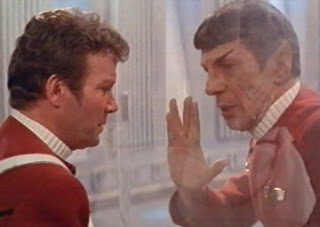
The needs of the many outweigh the needs of the few... or the one.
Sometimes the needs of the many
do outweigh the needs of the few...
or the one.
I think Le Guin is drawing a parallel between Shevek’s physics and society. We need to make sure that fulfilling the needs of a few individuals doesn’t mean that the needs of the many go largely unmet. But we also need to make sure that the needs and drives of the individual don’t get entirely submerged by the needs of the whole.

The best solution lies in a balance. And achieving a balance, in turn, depends on open communication between people with different ideas, each constantly providing feedback and challenge for the other.

All of this makes me think of the words of the wise and articulate poet Jello Biafra, when he wondered: Where Do Ya Draw the Line?


An earlier version of this review originally appeared on Cheeze Blog.

Friday, August 24, 2012

Book Review: The Dispossessed (Part 1 of 2)

Ursula K. Le Guin
1974
Awards: Nebula, Hugo, Locus
Rating: ★ ★ ★ ★ –

SPOILER ALERT

So far, this is my favorite of Le Guin’s novels.

I have criticized some of her other books for having too obvious a message. This one is obvious about its real subject matter – different governmental philosophies – but it is subtle about delivering any simple message or judgment about them.

I also liked the main character very much. He is a smart guy going through a difficult time, learning hard truths about the way he was brought up.

And her writing, as always, is clear and flowing - if maybe a little dreamy.

This book is about two worlds: the planet Urras and its moon Anarres. Urras is a densely-populated analogue for Earth; its main superpower nation is a prosperous capitalist country with a comfortable upper class and struggling lower classes. Anarres is a dusty, barren, barely hospitable mining colony.

Several centuries ago, a small group of Urrasti anarchists were banished to the moon Anarres. After the freighters brought the last group of them up, the exiles built a wall around the spaceport. They kept the port operating for a handful of cargo shipments each year, but resolved that no one else from Urras would ever be allowed up. Then they set about building a non-authoritarian communist utopia based on the teachings of their philosopher Odo.

As a result, today, on Anarres, there are no governments, no bosses, and no wages. Clothes and other necessary goods are available free to anyone at communal depositories. Food is served for free at communal refectories.

Jobs are dispensed by a central computer. You feed in your skills and your requests for location and the computer comes back with a suggested placement. You do not have to accept the placement, although pretty much everyone does.

You have no obligation to do anything in particular. You have the freedom to learn or work at whatever you want at any time. You are owned and governed by no one.

The catch, of course, is that no individual can own or govern anything. No one can become rich or powerful. If you are found to be “egoizing” – keeping goods for yourself or doing things solely for your own aggrandizement, you are isolated and ostracized.

Anarresti children are brought up to see themselves as part of a whole; as a single cell in the body of society. Their role is to find their own best individual cellular function and do that – the idea being that if they do what they do best, that is the greatest contribution they can make to society.

The plot centers around an Anarresti physicist named Shevek. Shevek is happy; he has a loving partner, children, and friends. He is always willing to do his part. He grows up trusting his countrymen and assuming unquestioningly that everyone is working together. He grows up distrusting and fearing the profit-driven people of Urras.

But as Shevek gets closer to developing a General Temporal Theory, which will enable faster-than-light space travel, he discovers that instead of being freely exchanged, his ideas are being stifled.

For one thing, his work is threatening to his advising professor, Sabul. Sabul has been discouraging the publication of those ideas of Shevek’s that he doesn’t understand and, contrary to Odonian teaching, has been publishing the ideas that he does understand under his own name.

Shevek’s work is also a threat to his society; it threatens to break down the walls that protect Anarres from Urras. His university will only permit him to teach basic courses, claiming that not enough students are interested in the more complex ones. The job-posting computer starts to send him to godforsaken places to do mining or agricultural jobs that have nothing to do with physics and separate him from his family for long periods.

An Odonian society is supposed to be in a state of permanent revolution, encouraging of initiative and freedom of thought. But Shevek starts to realize that, little by little, in spite of itself, Anarres is developing a bureaucracy that functions very much like a government and serves to limit radical thinking.

So Shevek reaches out to physicists on Urras, sending them letters via cargo shipments. His correspondence often gets “lost” in transit but the few responses that come back show him that the Urrasti physicists are intensely interested. Thinking that this could be a way to reunify the two worlds, he smuggles himself off to Urras.

The Urrasti receive him with open arms. At first, he is astonished by how luxurious everything is and how happy the people are. But he gradually realizes (mainly through clandestine little notes slipped into his pockets by servants) that he is being coddled by the elite, who hope that they will profit from his General Temporal Theory. They have carefully prevented him from seeing any slums or poverty or other downsides of Urrasti capitalism.

Shevek eventually goes on the lam, gets caught up in a street protest, and is almost shot by the police, before coming up with a solution that serves his needs – and almost everyone else’s, whether they realize it right away or not.

But here I’ve gone on and on about the plot and I’ve hardly talked at all about the real reason to read the book, which is the subtlety and thoughtfulness with which Le Guin, through Shevek’s eyes, compares the Anarresti and Urrasti systems. Any review of The Dispossessed should really include an insightful, complex discourse on capitalism versus socialism, on anarchy versus government, and on how it is impossible to be an ideological purist about any one system.

I feel that this is, alas, beyond my analytical abilities but, to at least show my appreciation for what Le Guin has done, I will try to address it in a small way in my next post, here.


This review originally appeared on Cheeze Blog.

Tuesday, August 21, 2012

Princess Leia: Role Model

Although on the surface it might appear that Princess Leia is merely a helpless princess needing to be rescued, she is actually a bad-ass. This is a great post on Tor.com by Emily Asher-Perrin about why Leia always ends up on--and deserves to end up on--any list of strong female characters in SF.

http://www.tor.com/blogs/2012/08/can-we-talk-about-why-we-really-love-princess-leia