Friday, December 27, 2013

Book Review: The Big Time

Fritz Leiber
1957
Awards: Hugo
Rating: ★ ★ ★ ★ –

This book is really abstract and way out there. I think much of it was beyond me. But what I did get I really enjoyed.

The Big Time’s main premise is that the time in which we live is actually an enclosed environment, and that there is a zone surrounding us, a gray misty space outside of and separate from our time, where other beings live. These other beings can come and go into and out of our time at will, plopping onto our world at any time in our past or future that they choose.

Two groups of these beings, which we never actually see but which are called “Spiders” and “Snakes” by the main characters, are fighting a massive war against each other, using our time as their battlefield. This war involves them: (a) recruiting recently-dead people to be soldiers and support staff for their side, (b) resurrecting the ones who agree to sign up, and (c) sending the resurrected soldiers into different eras of our time to fight the forces of the other side.

Through this process, the Spider and Snake soldiers have managed to screw up history in all kinds of ways, like by changing the outcomes of important battles in ancient Rome and assassinating key people during World War II who had never been assassinated before.

The entire book takes place in the misty realm outside of our time, in a sort of behind-the-lines R&R spot for Spider soldiers. The spot is populated by resurrected formerly-dead people who serve as entertainers, prostitutes, counselors, and doctors for the troops. These “ghosts” are pretty satisfied with how things are going until one visiting soldier decides to mutiny against the Spiders, breaks the connection to real time so they’re floating lost in the timeless zone, and then starts the countdown on a portable atomic bomb.

The main character who narrates the story is one of the prostitute/counselor/entertainers. She is very appealing; she has a laid-back attitude and uses a lot of slang, and, although she is our guide to this weird world, she doesn’t feel the need to explain a heck of a lot. I also really liked the variety of the other characters. Since the Spiders can recruit from any place and time they want to, their support staff and soldiers are necessarily from all different countries and all different eras, including the future.


An earlier version of this review originally appeared on Cheeze Blog.

Friday, December 20, 2013

Book Review: Foundation's Edge

Isaac Asimov
1983
Awards: Hugo, Locus
Nominations: Nebula
Rating: ★ ★ ★ – –

SPOILER ALERT…
…for all of Isaac Asimov’s other Foundation novels.

This is one of the last books in Asimov’s Foundation series (one of the most excellent and seminal bodies of work in science fiction), and builds on the characters and themes developed over the course of that series. It is therefore hard to describe this book without giving away a lot about the previous books in the set.

This book also incorporates elements of Asimov’s Robot series (yet another excellent and seminal work).

And, because the Foundation series deals with thousands of years of galactic history, it is hard to describe this book without going into a ridiculous amount of back story, which I’m not going to do here.

Clearly, then, the only thing for you to do is to read all the Robot and other Foundation books, in the correct order, and then to read this review, and then to read Foundation’s Edge. (To help you in this pursuit, a complete chronology of Asimov’s books can be found here.)

In the 1950s, Asimov began writing a series of books telling the story of the development of humanoid robots in our near future (the Robot series). He simultaneously began a separate series of books about the rise and fall and rise again of a galaxy-wide empire ruling millions of inhabited worlds in our very far future (the Foundation series). He wrote Foundation’s Edge about thirty years after finishing the last of the original Foundation and Robot novels, but he intertwines elements of both multi-ologies in this book in his same familiar, clear style as if there had been no break at all. This is a testament to the solidity and endurance of the characters, worlds, and concepts he created.

The Foundation novels are built around one primary character, Hari Seldon, the developer of the science of psychohistory. Psychohistory is sort of a combination of mass psychology, sociology, statistical modeling, and complex mathematics. Seldon is able to use it predict the future of all of galactic society.

What he forecasts is the inevitable decline of the decadent galactic empire (which is in its heyday while Seldon is alive), followed by a painful, chaotic period of several thousand years of division and war, and then the rise of a second (more benevolent) empire bringing peace and stability back to the galaxy. 

The violent interregnum has the potential to last from one thousand years to thirty thousand years, depending on which of several courses of action people take. So Seldon sets up a secret foundation of scholars and directs them to guide humanity towards the choices that will shorten the period of chaos as much as possible. He also records a series of holographic animations of himself to be played at key times in the future so he can help guide humanity himself even after he is dead. The Foundation series plays out this “Seldon plan” across hundreds of years of ups and downs and danger and turmoil.

One strange thing about the Foundation series is that it keeps your attention even though there is usually very little action. Often the major crisis in each book involves the characters working to prevent something from happening, rather than to make something happen. These crises usually center on a single skeptic who challenges the assumptions of the majority and who has to use logic and persistence to turn the others around. But it is Asimov’s particular genius that he makes this kind of story interesting and keeps the pages turning.

It helps that the whole concept of psychohistory is awesome and the character of Hari Seldon is enduring and appealing*. And, because Asimov covers thousands of years of history in his various novels, he has to invent a ton of other characters, not to mention worlds and governments and advances in technology, and he always does it with extraordinary clarity, believability, creativity, and humor.

This book, Foundation’s Edge, takes place 500 years into the chaotic interregnum. The original First Foundation (of regular people) and the Second Foundation (of telepaths) both appear to have things well in hand. Things are going perfectly in accordance with the Seldon Plan. Maybe a little too perfectly. People in both foundations grow suspicious that someone is manipulating all of them to align with the Plan, depriving them of independent action. Eventually, their investigations center on a mysterious lost planet, Gaia, which may or may not be the original Earth, and which may or may not be controlling them all without their knowledge, and which may or may not be able to control and/or destroy the entire universe.

Foundation's Edge was a mixed bag. It exhibits all the good characteristics of Asimov’s work. It also exhibits his annoying tendencies to give his characters silly names and to include a number of pert, very young women who are attracted to much older, professorial-type men.

I liked the First and Second Foundationers, their slow realization that they are being manipulated, and their search for the source of that manipulation in the first half of the book. But the second half was unsatisfactory. I didn’t really like what Gaia turned out to be. And I didn’t buy the climax of the plot, where there was a multiple-choice decision that had to be made to determine the fate of the galaxy and only one guy in the universe could make it. I didn't feel that this book necessarily deserved the Hugo Award, and it made me think that perhaps this book won it as a sentimental choice--a win to make up for all the other Foundation series novels that came out before the award was invented.

-----------

* Nobel-Prize-winning New York Times columnist Paul Krugman admits here that part of the reason he went into economics is because it is the closest thing we have to psychohistory.


An earlier version of this review originally appeared on Cheeze Blog.

Friday, December 13, 2013

Book Review: Powers

Ursula K. Le Guin
2007
Awards: Nebula
Rating: ★ ★ – – –

SPOILER ALERT

This book was only available in the Young Adult section of my library. And, after reading it, I can see why; this is definitely a book for teenagers.

I have really enjoyed some of Le Guin’s books, and others not so much. The books that I don’t like usually fall into one of two groups: those that are too dreamy and those that have too heavy-handed a Message. This book fell too far into both of these negative categories for me. (The Message in this particular book is that slavery is evil.) (Which, of course, it is.)

The story is about a young slave boy, Gavir, who has been brought up in a relatively benevolent household. He is able to be in denial, at first, that it is bad to be a slave, because his life seems to be pretty good. His masters are not overtly cruel; he is able to live with his beloved sister, Sallo; and he gets to go to school with the master’s children because he is being trained to be a teacher.

But eventually his little world starts falling apart and he starts to question the system. He is bullied by some of the less benevolent members of the household. His home is invaded by people from another country. And finally his sister is murdered, which is the last straw and makes him run away.

After he runs away, he lives in several different types of societies, including a city of freed men; a camp of runaway slaves in the heart of the forest run by a misogynistic megalomaniac; and the poor marshland settlements of his own people from whom he was stolen as a baby. This all conveniently exposes him to alternative governments and different attitudes towards women, work, war, and cooperation.

The Message, which, of course, Gavir eventually learns, is that a cage is still a cage no matter how gilded it is. That slavery is an evil institution, however disguised it may be, and a limited freedom is no freedom at all.

This is all very well and good a Message, but so obviously delivered.

And the characters are so black and white. Gavir and his sister are one hundred percent good, eager naïfs. They have unquestioning obedience to and reverence for their masters. They are hard-working and earnest. And the bad guys are uniformly awful bullies.

The story is also not all that exciting. Gavir’s story is the classic monomyth: he is born under mysterious circumstances, shows early evidence of supernatural abilities (he can see visions of the future), goes on a long journey or quest, encounters several father figures from whom he has to become independent, and has to have a showdown with an arch enemy to finally prove himself. But Gavir's life really isn’t all that difficult most of the time. He is in physical danger maybe twice, and in an actual physical conflict a couple more times, but these situations are all generally over in about a minute. Even his escape from slavery is easy.

And all of the pivotal events in the book are instigated and resolved by external forces without any action on Gavir's part. He is swept along by events, not directing of them. Even his final showdown is won essentially passively, by natural forces, not by anything special he does.


An earlier version of this review originally appeared on Cheeze Blog.

Friday, December 6, 2013

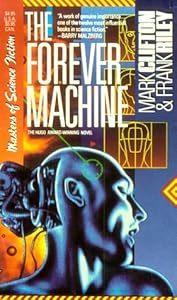
Book Review: The Forever Machine

Also published as They'd Rather Be Right
Mark Clifton & Frank Riley
1954
Awards: Hugo
Rating: ★ ★ ★ – –

I have read several reviews of this book that call it trite and clichéd. But I generally enjoyed it.

The main character is a telepathic man, Joe Carter, who grows up ostracized and isolated because of his abilities; people are freaked out by the fact that he can tell what they are thinking. He doesn’t like being so lonely, so he becomes a brilliant scientist and invents a machine that can make other people into telepaths.

Everyone on earth theoretically has the potential to be turned into a telepath by Joe's machine. But it is next to impossible to be telepathic and to retain the judgmental natures most people have. Since telepaths know what everyone else is thinking, they have to be able to handle all the varied thoughts, good and bad, intentional and unintentional, that come into their heads, without prejudice. They have to be the most understanding, least judgmental people on earth.

Before it makes you telepathic, therefore, the machine strips out all your preconceived ideas about what is right and wrong and rebuilds you, cell by cell, from the ground up…

…and it turns out that this has the nice side effect of making old people young again. Which means that once the machine has been run on its first person, an elderly woman, and she is transformed back into a beautiful twenty-year-old, everybody else on earth wants to do it.

The catch is that the machine won’t work on anybody who is convinced that they are absolutely right about something. If you are not flexible enough to be removed of all your assumptions and prejudices, then you will come out of the machine physically and mentally unchanged.

The first third of this book, which I liked the most, tells the story of Joe's childhood. As a young boy, he instinctively reacts not to what people are saying but to what they are really thinking--which, of course, makes everyone think he is crazy. He learns, painfully, that it is best to disguise the fact that he can read minds.

In the second third of the book, which was still okay, Joe grows up and goes to college and teams up with two professors to create the telepath-making machine. Throughout the project the three of them are alternately reviled and revered by the public, because the public is both terrified of what the machine means and also greedy for it. Eventually popular opinion turns totally against them; they become the target of a witch hunt and have to go into hiding.

In the last third of the book, however, after the machine has actually been built and its three creators start doing demonstrations of the machine for the public, the book loses its way. It becomes far too heavy-handed in its lesson about how we all need to be more flexible and realize that we’re not always right. I was also very dissatisfied with their solution for what to do with the machine in the end.


An earlier version of this review originally appeared on Cheeze Blog.

Friday, November 29, 2013

Book Review: Seeker

Jack McDevitt
2005
Awards: Nebula
Rating: ★ ★ ★ ★ –

This book is great in many ways. It is an exciting detective story with appealing central characters, plenty of outer-space travel, and a satisfying ending.

The story takes place many centuries in the future, after humans have developed faster-than-light travel and colonized several worlds. It is narrated by Chase Kolpath, an interstellar pilot. Kolpath and her boss, Alex Benedict, make up the staff of Rainbow Enterprises, a company that explores remote sections of space, finds ancient artifacts from abandoned space stations and failed colonies, and sells the artifacts to collectors.

It is lucrative. But Kolpath and Benedict are always running afoul of academic archaeologists and historians who view their business as theft, and this tension pervades the entire book.

The book’s adventure begins when a woman asks Rainbow Enterprises to appraise an antique cup with the seal of the starship Seeker on it. The cup turns out to be 9,000 years old and to be, just possibly, a relic of an ancient lost colony.

In researching the cup, Kolpath and Benedict find out that back in the 25th century, Earth was poor, overpopulated, plague-stricken, and ruled by a series of harsh authoritarian regimes. A small group of idealists, the Margolians, fled Earth in two rickety starships, one of which was named Seeker. They may have successfully established a new Eden for themselves or they may have died in the attempt, but, either way, they were never heard from again.

Their fate at first became the subject of novels and films but gradually their memory faded to the point where most people in Kolpath & Benedict’s time now think they are merely a legend and never existed at all.

If the cup can be proven to be from this lost colony, and if it can be used to trace the colony’s location, it could be Rainbow Enterprises’ greatest find ever.

Together, Benedict and Kolpath unravel the secrets of the ancient emigrants. They do library research; they talk to avatars of the long-lost Margolians; they explore remote sections of outer space; they have daring adventures and evade several attempts on their life.

This was the first time I had read anything by Jack McDevitt. I liked it so much I immediately read the prequel, Polaris, which was just as good and which suffered not at all from being read out of order.

Stephen King has called McDevitt “the logical heir to Isaac Asimov and Arthur C. Clarke.” That is a pretty high bar, but King may just be right. McDevitt’s writing is straightforward and the process of putting together the pieces of the puzzle keeps your attention the whole time.

One of the things I liked best about this book (and about Polaris, too) was Chase Kolpath. She is matter-of-fact and thrives under pressure. People naturally call her by her last name. She is a great pilot and her boss respects her as such. Benedict is a better sleuth, but when his investigations repeatedly put their lives in immediate physical danger, she’s always the one who keeps her head clear and gets them out of it. She has a private life and keeps it private, from both her boss and largely from the reader, too. She likes a party and goes out with guys but doesn’t get attached to any one of them.

As a side project, Kolpath decides to watch all the films based on the Margolian legend. Her summaries of the plots of the movies she watches are really quite funny.

I also liked the ways that McDevitt layers fiction within fiction. He puts a quote at the beginning of each of his chapters, for example; sometimes it is from a real (19th-20th century) author, but more often it is from fake fiction or fake philosophy, written sometime during the 21st-26th centuries. Even the fake quotes don’t feel like the rest of McDevitt’s writing, so it really does feel like he is borrowing from other authors.


An earlier version of this review originally appeared on Cheeze Blog.

Friday, November 22, 2013

Book Review: Tehanu

Ursula K. Le Guin
1990
Awards: Nebula
Rating: ★ ★ – – –

SPOILER ALERT

Tehanu is the last book in Le Guin’s Earthsea cycle, a series of books set in a rural middle-ages-y fantasy land filled with mages and dragons.

With all due respect to Ms. Le Guin, who has written some complex and groundbreaking books, the Earthsea series is really not my bag. And Tehanu is no exception.

For one thing, there is not much of a plot. The main character, Goha, was tutored as a girl by a powerful mage (i.e. wizard) but left that life as a young woman to marry a farmer and raise a family. At the time of the book, Goha is somewhere in middle age. She has adopted a girl, Therru, who was so unwanted by her parents that she was permanently disfigured in a fire that they set to kill her.

At the start of the book, Goha and Therru travel far overland to see Goha’s old tutor, Ogion, who is dying. After he dies, Goha and Therru stay on in his house and are beset alternately by ruffians vaguely related to Therru’s parents and by Aspen, an evil, Wormtongue-esque rival mage, who has it in for Goha for some reason.

They while away the time at Ogion’s house amidst all of this until one day a dragon comes, bearing the half-dead body of Ogion’s other pupil, Ged, who was once a super-powerful arcmage but who lost his power defending his master in a terrible battle. Goha nurses Ged back to health and then they all make their way back to Goha’s farm, where they are beset by the same ruffians they were beset by at Ogion’s house.

Then, when Goha’s estranged son comes to claim the farm, they all decide to go back to Ogion’s place, where they again immediately run afoul of Aspen, who puts a spell on Goha and Ged and is about to drive them off a cliff, when Therru saves the day by calling the dragon to come back and rescue them.

I spent the whole book thinking something was about to actually happen but nothing ever really did. They mainly just travel back and forth between Ogion’s and Goha’s houses, and are only occasionally, and only briefly, in danger.

Le Guin’s treatment of women in this book is also frustrating, given how good she can be at representing the misunderstood or the different.

In Tehanu, only men can be mages; women with magical powers can only be witches. Mages are involved with big-time projects and politics; witches concern themselves only with small-time magic like healing illnesses or finding lost objects. In the plot, the men are the active elements and the women are the ones who are passively acted upon; the men either put the women in danger or save them – up to and including the male dragon at the end.

Goha’s life has been split between her unusual magical life under Ogion’s tutelage and her more ordinary human life with her husband and children. She never really comes to grips with either one or reconciles the two. She seems drawn towards magic, but never really accepts the power it would give her, and tends to want to go running back to the farm.

And, finally, the dragons in Tehanu are just too dreamy for me. With the exception of the dragon in Shrek, I like my dragons to be mean and uncompromisingly tough, fought by knights with swords or by men and women with bows and arrows. 


This review originally appeared on Cheeze Blog.

Friday, November 15, 2013

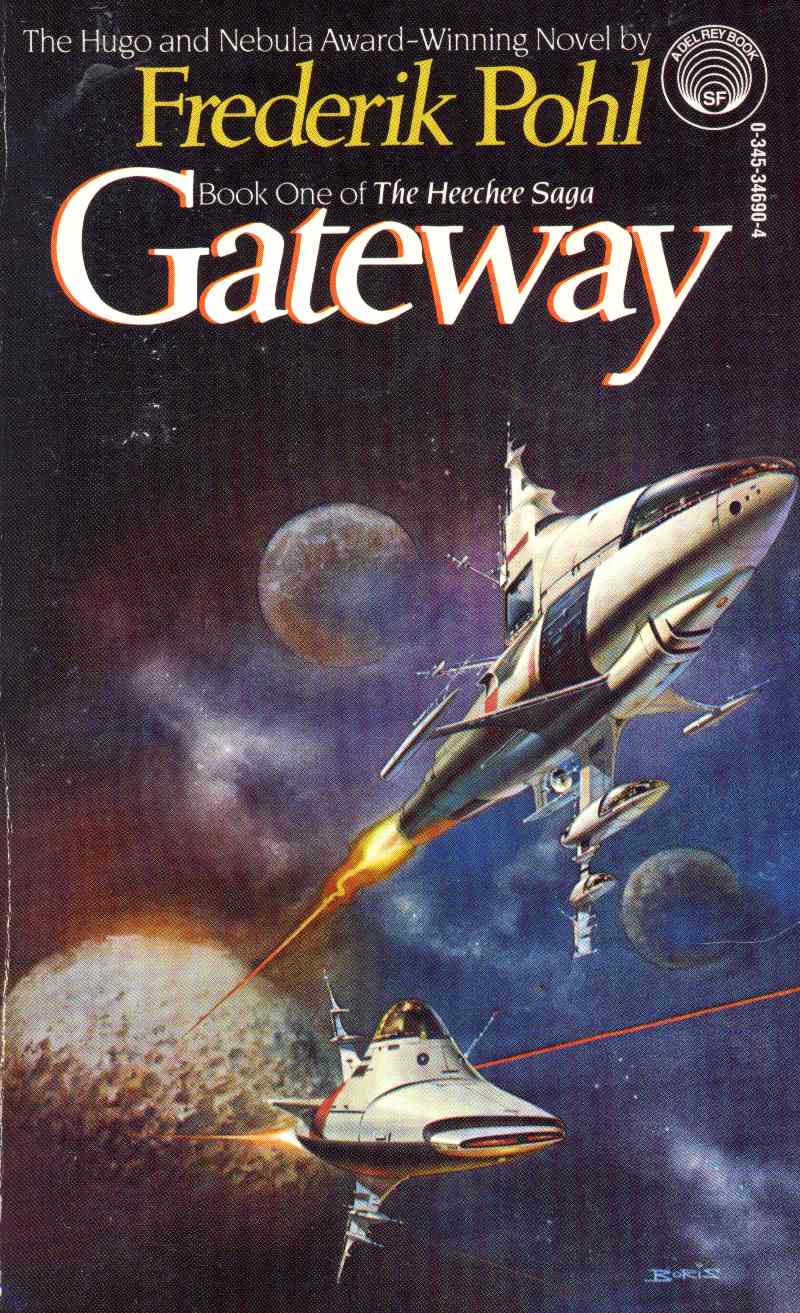
Book Review: Gateway

Frederik Pohl
1977
Awards: Nebula, Hugo, Campbell, Locus
Rating: ★ ★ ★ – –


The best thing about Gateway is the unique setting and very cool premise. And Pohl explores that setting and that premise with a story line that is interesting enough that it doesn't seem like it was created half-heartedly just to show off the universe he invented.

It is the relatively near future. During our exploration of nearby space, we have discovered a spaceport, which we have named "Gateway," which was been abandoned long ago by an alien species, who we have named the "Heechee."

The Heechee were highly technologically advanced and left behind an array of valuable artifacts at Gateway, including spaceships with the capability for hyperspace travel. There are many of these ships still fueled up and docked at the spaceport’s gates. Everything is in perfect working order. It is like the Heechee just up and left one day, leaving everything intact and running.

This discovery is a boon for mankind. And, conveniently, the Heechee appear to have been about our size and to have had similar environmental requirements as us, so it is possible for us to use their station and their ships in relative comfort.

The only catch is that we can’t read any of their instruction manuals or any of the indicators on any of their equipment. Everything we know about their technology we have learned from brute force experimentation – by getting into the ships, pressing a bunch of buttons, and seeing what happens.

We have learned some very basic things. We have figured out how to select a destination code and to start the ships on their journey. We know that once the ship is started, it will not deviate from its pre-programmed course and it will automatically return to Gateway on its own.

But we don’t know what the vast majority of the destination codes stand for. So most of the time we don’t know where the ship is going. We don’t know how to program it to turn around or go somewhere else while it is in flight. We don’t know how to tell how long the voyage is going to be. And we don’t know whether or not the ship actually has enough fuel to get there.

So an industry has grown up around Gateway in which a corporation hires people to risk their lives flying the Heechee ships to where ever the ships might take them, and then gives them a share of the profits if they (a) survive the trip and (b) find something that is useful to the company.

Sometimes the ships end up in the middle of a supernova. Sometimes they run out of fuel and never come back. Sometimes the ships return with a dead crew whose food or oxygen ran out before the trip was over.

But sometimes the ships take the crew to a brand-new planet that is habitable or has a supply of valuable ore. Sometimes it takes them to a new Heechee port with still more artifacts. And sometimes the trip gives us more of a clue to the navigation system. When anything like that happens, it makes the lucky crew on that ship very wealthy.

The main character, Bob Broadhead, is one of these Gateway pilots. His first two missions were small and uneventful. His third mission made him wealthy beyond his wildest dreams, but left him a traumatized wreck with guilt and nightmares that he can’t get rid of. 

The book starts with Broadhead in therapy (with a computerized therapist he calls Sigfrid von Shrink) after this third mission. Through flashbacks and sessions with Sigfrid, we learn first about Gateway and the Heechee, and then gradually what happened to Broadhead to make him both so wealthy and so messed up.

The best part of the book is the core premise: the Gateway spaceport and the ships that can set people up for life or kill them in any number of horrible ways. I also found it interesting to try to put together a picture of the Heechee from the stray bits that pilots discover here and there. 

Broadhead himself is not a terrifically inspiring character, however. And the story is not tremendously strong or arresting; it was adequate, but it was mainly the strength of the premise that carried my interest through to the end of the book.

And I do have to admit that although I can see that Broadhead’s third mission was scientifically very important, I don’t understand why it was of concrete monetary value to a corporation.


An earlier version of this review originally appeared on Cheeze Blog.

Friday, November 8, 2013

Book Review: Stand on Zanzibar

John Brunner
1968
Awards: Hugo
Nominations: Nebula
Rating: ★ ★ ★ ★ –

Stand on Zanzibar is set in the 2010s which, in 1968, was the relatively near future. The world has become severely overpopulated, which has serious effects on everyday life.

Internal combustion engines are banned in most large cities and have been replaced by fuel-cell and fly-wheel vehicles. Almost everyone has to share housing, even the rich. In jails, prisoners are tranquilized and stacked one on top of another on bunk beds which can be pulled in and out of cells like drawers in a filing cabinet.

Rich countries have enacted various forms of eugenic legislation to control birth rates. In the US, for example, you are forbidden to have children if you have genes for certain hereditary conditions like hemophilia, diabetes, phenylketonuria, or color-blindness.

~~~~~~~

The book has two semi-intertwined main plots, each of which is centered on one of the two somewhat asocial main characters, Donald Hogan and Norman House. Donald and Norman are roommates and are also probably as close to being friends as would be possible for either of them.

Norman is black, Muslim, and a VP at General Technics, the world’s largest technology firm. His company sends him to Beninia, a remote African country, to work out a deal to allow GT to mine Beninia’s natural resources before its neighboring countries can invade and do so. While there, Norman finds that Beninians are very strange – no wars, no murders, not even lost tempers – and he sets himself to learning why.

Donald is white, Christian, and a spy for the US government. He gets sent to Yatakang, a remote Asian country, which has announced that it is developing the technology that will allow it to clone embryos, select out the ones with undesirable traits, and then implant the best in any woman. This may have disastrous capacity consequences for governments, as it will allow anyone to get around eugenics laws and have a child. Donald’s mission is to either expose their claim as a fraud or, if it is not a fraud, to make it not come to pass.

~~~~~~~

Reading Stand on Zanzibar is a little like reading Shakespeare or A Clockwork Orange, in that it is pretty hard to follow at first. Brunner creates a whole new vocabulary for this future dystopia that you have to get used to. Some of the new terms are abbreviations (“dicty” for “addict”); amalgamations (“Afram” for “African-American”); free-associations (“codder,” from “codpiece,” for “man”); or just plain slang (“shiggy” for “girl”).

But if you persevere, by the time you’re halfway through the book, you can read and understand a sentence like “Sheeting hole, Frank, I’ll never forgive those bleeders!” without batting an eye.

Even the table of contents is wacky. Chapters are listed not in chronological order but by category, of which there are four:

“Continuity” (the main plot)
“Context” (explanations of the main plot)
“Tracking with Closeups” (side stories about minor characters)
“The Happening World” (jumbles of ads, gossip, conversations, and news)

The four types of chapters are interwoven throughout the book. It is a little chaotic, but that is part of what Zanzibar is all about. The combination keeps the plot going, helps you understand it, provides detail and color, and gives you an idea of the volume of stimuli constantly bombarding the populace.

~~~~~~~

Stand on Zanzibar is also similar to Neuromancer in many ways. It has a trippy style and a unique vocabulary. It has advanced technology such as fuel-cell cars and internet-like, real-time global media. It has widespread use of hard-core drugs. It has a massive self-aware computer that controls many everyday operations for all of humanity worldwide. And it even has a woman with metal eyes (in this case, chromed contact lenses).

The main difference (aside from the fact that Zanzibar came out 16 years earlier than Neuromancer) is that it is less about the self-aware central computer and more about humans coping with each other in a crazy, overcrowded world. Brunner is bitingly sarcastic and cynical and, at the same time, handles complex issues with a lot of sensitivity and understanding.

Brunner’s main focus is how the loss of privacy and property affects us psychologically and sociologically. Humans are social animals able to deal with each other pretty well...until we get overcrowded, and then we turn on each other. The world of Zanzibar is full of violence: individual killing sprees, terrorism, riots, and war. Many people try to escape from it all with drugs, most of which are legal or at least tacitly allowed: everything from marijuana to powerful, laboratory-synthesized hallucinogens with names like Triptine and Skulbustium.

Brunner shows that the pressure created by overpopulation both exacerbates the gap between rich and poor and, at the same, binds them more closely. His message (sent primarily through the character of the popular, cynical sociologist/commentator Chad Mulligan) is that even though you may think you are rich, you are not, really, if the rest of the world is horribly poor. And many elements of his analysis have come depressingly true; Mulligan (presciently) points out that water is eleven times more expensive than it was fifty years ago; that all our foods are prefabricated in factories; and that the fanciest new building being built in the world is a jail.

And throughout the whole book runs another brave, touchy debate about reproduction. In an overpopulated world, choosing to have a child is itself a political statement. There are a million different ways to have a child: donor eggs or sperm, externally-fertilized ova, adoption, cloning. Each option brings anxiety and pain. And when the Yatakangis announce their cloning program, it brings up new questions about tailored babies. Is it right to breed for certain traits and against others? And do parents really want children who are more advanced than them?

And whether or not you want a child, you still have to deal with complex emotional issues. Some couples desperately want to have a baby but are not allowed to because one partner has a bad genotype. Some have good genotypes but are infertile. Some people have excellent genotypes but don’t want children, and are constantly questioned (and constantly question themselves) why they don’t. Brunner handles all of this with perceptiveness and sensitivity, as well as humor.


An earlier version of this review originally appeared on Cheeze Blog.

Tuesday, November 5, 2013

Buddy Holly Is Alive and Well: The Movie?

So... as of 2011, there were plans to release a movie version of Buddy Holly Is Alive and Well on Ganymede, starring Jon Heder, in 2014. Hopefully this is actually going to happen someday.

Friday, November 1, 2013

Book Review: Stations of the Tide

Michael Swanwick
1991
Awards: Nebula
Nominations: Hugo
Rating: ★ – – – –

I started out excited to read this book because of the setting. It takes place on a planet called Miranda, which has a very long annual cycle around its sun lasting several of our years. Miranda has one large dry-land continent (named “Continent”) and one ocean (named “Ocean”) surrounding the continent. During half of the year, the polar ice caps melt and the tides come in and Ocean rises to cover half of Continent. Any creature living on the land who is not prepared for the annual tides gets swept into Ocean and drowns.

The indigenous animals of Miranda, collectively called the “haunts” by the colonizing humans, have evolved to be able to change to either land-suitable or water-suitable form, as necessary. Miranda’s native mice, for example, change into sort of swimming mini-otters when the tides come in.

Unfortunately, although the setting has great potential, the plot is confusing and ill-defined, and the characters are all either annoying or just plain boring. I don’t know how William Gibson and Kim Stanley Robinson could have given it the stunning reviews they did.

Basically, the story is about a bureaucrat (“the bureaucrat”) visiting Miranda from its governing worlds, which are many light years away. A mysterious Mirandan wizard named Gregorian is rumored to be in possession of proscribed technology, and the bureaucrat has been sent to find him and get him to give it back. Over the course of completing his mission, the bureaucrat has life-threatening adventures, learns Gregorian’s true identity, experiments with mind-altering drugs, and has pretty kinky, very explicit sex with a witch. It all takes place on the coast in the last days before the tides are scheduled to come rushing in, adding a certain urgency to his task.

My major problem with the book is that Swanwick has a Vernor Vinge-like habit of continually bringing in new ideas and plot lines and technology, and then never carrying them through. From the Mirandans’ vaguely restrictive census bracelets, to the feverdancers that affect your brain when you’re on drugs, to the weird TV drama that everyone is always watching, many of the early details you think hold promise and are going to be explored further are just left amorphous and hanging. And some elements essential to the ending are brought up for the first time in the last five pages.

To make matters worse, many of the ideas in this book are painfully derivative of better earlier work by other people. For example, one of the characters has to go through a test of strength and character that involves sticking their hand in a pain-box in a scene that could have been copied directly from Dune. And the dual nature of Miranda’s haunts seems similar to, although not as well developed as, the local fauna and flora in Speaker for the Dead. (Note: I did appreciate the overt homage in which the massive, multi-towered granite government buildings the bureaucrat works in are called “the Mountains of Madness” by the employees.)

Swanwick sprinkles references to The Tempest throughout the book, undoubtedly inspired by the ocean forces that hover in the background, threatening inundation at any moment. Celestial bodies are all named for characters in Shakespeare's play – the sun is Prospero, one moon is Caliban and the other is Ariel, and then of course there is the planet Miranda itself.

None of the references are carried through with any meaning, though. He throws them out but feels no need to incorporate any deeper parallels to The Tempest into the story. That would have been quite possible; after all, one of the main characters is a powerful magician, and it takes place on what is essentially an island whose inhabitants feel constrained by their colonial government (although they are also kind of colonizers themselves). (I have to admit, though, I never really liked The Tempest either. I don’t like Shakespeare’s plays about fairies and romances nearly as much as the ones about despotic rulers.)

Our lives may be such stuff as dreams are made on, but this book definitely is not.


An earlier version of this review originally appeared on Cheeze Blog.