Showing posts with label Nebula Award. Show all posts

Friday, April 3, 2020

Book Review: All the Birds in the Sky

Charlie Jane Anders
2016
Awards: Nebula, Locus (Fantasy)
Nominations: Hugo
Rating: ★ ★ – – –

All the Birds in the Sky is a story in the old traditional pattern of boy meets girl, boy loses girl, boy and girl become central figures on opposing sides in a potentially world-ending conflict. It had a lot of potential, and certainly some funny, endearing, and dramatic moments. But, on the whole, it did not wear as well as it might have.

The novel is the story of two kids, both outcasts, who meet in elementary school and become frenemies. Patricia is a nascent witch who loves the outdoors and, at least at one point, learns how to talk to birds. Laurence is a techno-nerd who is building an artificial intelligence in his bedroom closet. Their parents are hopeless and the other schoolchildren taunt them both mercilessly.

Saddled with talents they don’t yet know how to control, they struggle through junior high and high school, unaware that they’re being stalked by a ninja assassin posing as their guidance counselor, whose plots they keep escaping by accident.

Eventually they each respectively find groups of people who understand and support them, and who train them to focus their powers in productive but opposing directions. In Patricia’s case, it is a group of witches, and in Laurence’s case, it is a group of astrophysicists working for a multizillionaire inventor patterned a little too obviously after Elon Musk.

Both Patricia and Laurence are trying to solve the problem of global climate changes from their own angles. But Laurence’s team’s experiments go horribly wrong and send one of his co-workers into another dimension of space-time. Patricia helps him out by rescuing the co-worker with witchcraft, but her help, as is the case with most powerful spells, comes with unintended consequences, and unintentionally ratchets up the simmering tension between Laurence’s team and the team of witches.

Eventually the whole thing culminates in a somewhat contrived apocalyptic battle royal of magic versus science, with Patricia and Laurence on opposite sides. The fate of the Earth hangs in the balance while they try to figure out how to end the conflict and how to admit how they feel about each other.

As a coming-of-age romance, it is generally effective and enjoyable. As a science fiction story of an Armageddonish duel between two formidable sides, it is wanting.

There are certainly funny episodes in the book. The first time the birds talk to Patricia is hilarious. And it’s amusing when Patricia jokingly identifies their guidance counselor as an assassin based on his shoes, because, of course, he really is an assassin.

But the way the kids think and talk doesn’t always ring true or consistent; in particular, Laurence is a little too precocious and snarky when he talks to his parents, compared to the way he talks and thinks the rest of the time. Anders also tries just a little too hard to be funny in Laurence’s internal dialog, and most of the time it ends up clanking, like when he interprets his dinner as “turnip slurry.” (FEED author Seanan McGuire does this sort of thing much more skillfully, in a somewhat similar genre with somewhat similar main characters.)

The wealthy inventor Laurence works for is a little too obvious a carbon copy of Elon Musk. Anders relies too much on the cleverness of the very slight changes she makes to his image and company, rather than using him as inspiration and putting her own unique twist on the character.

And although Anders puts all she has into the Transformers/monster-movie-style climax, it is more workmanlike than actually exciting. In general, the backstories of the kids—especially Patricia—and the ramp up to the final confrontation are more interesting than the confrontation itself. In the end, I'm afraid to say that the book falls disappointingly flat.

Friday, February 12, 2016

Book Review: Ancillary Justice

Ann Leckie
2013
Awards: Nebula, Hugo, Clarke
Rating: ★ ★ ★ – –
   
I have a knee-jerk reaction against jumping on the reading bandwagon. If everybody is raving about a book, something in me automatically rebels against liking it.

So when I found out that Ancillary Justice won three of the major science fiction awards in 2014—the Hugo, the Nebula, and the Arthur C. Clarke—I have to admit that I was skeptical about it. But I tried to resist my bias and give the book a fair shake.

~~~~~~~~~~

Ancillary Justice takes place in a galaxy where the majority of humans, on all their hundreds of disparate home planets, are ruled by a single totalitarian regime called the Radch. The Radch, which Leckie says she based loosely on the Roman Empire, is a military superpower with countless armies, bases, weapons, and machinery at its disposal.

The Radchaai expand their empire by taking over new planets one by one, co-opting existing governors into their political hierarchy when it is possible and killing them when it is not, drafting a good chunk of the able-bodied adult population into their army, and cowing everybody else into subservience with the threat of the same happening to them.

In addition to being militarily powerful, the Radchaai are also highly technologically sophisticated. Each of their spaceships—whether troop carrier, medical vessel, or warship—is actually a sentient being unto itself, with a central artificial intelligence at its core. And when the Radchaai “draft” conquered people into their army, what that actually means is kidnapping them, wiping their consciousnesses, and then linking their brains into the artificial intelligence of the ship that has captured them. These walking corpses, or “ancillaries,” become (almost always) obedient auxiliary segments of the ship, fully interconnected with each other and the central AI at all times.

The advantage to this is that everywhere an ancillary is, whether on board or on the ground, the ship can see and hear everything that is going on around it. The disadvantage is that the conquered populations of the planets the ancillaries come from are somewhat put off by their people being turned into zombie automatons in service to the Radch.

Our main character and narrator, Breq, is one of these zombie automatons: an ancillary of the Radch warship Justice of Toren. Nineteen years ago, we learn, the entire Justice of Toren was somehow destroyed, and Breq is its lone surviving segment. She has lasted, all alone, for almost two decades, driven only by a desire to find and kill those responsible for destroying her ship.

The novel's story is told in two separate narratives simultaneously. One narrative is the story of the present day, in which Breq is searching for a weapon that will allow her to exact her revenge against the mysterious and, as it turns out, extremely powerful forces that destroyed her ship. The present narrative, and the book itself, opens on the wintry planet Nilt, where Breq has run across Seivarden, one of her former human officers, high on opiates, beaten and left for dead in the snow. Out of some lingering sense of Radchaai responsibility, Breq saves Seivarden, warms her up and dries her out, and then saves her life a couple more times, all the while trying to prevent Seivarden from figuring out who she is. Seivarden becomes attached to Breq, insisting on traveling with her where ever she is going, even up to the end, when Seivarden is confronted with upsetting truths about Radch society that she never wanted to see.

The other narrative is the story of the past, which tells how the Justice of Toren was destroyed and Breq became a lone isolated ancillary in the first place. This past narrative (which was the more interesting, if confusing, of the two) also explores one more key aspect of Radch society: its rigidly hierarchical class structure.

In the Radch, people are born into “houses.” The status of your house largely determines your career success and how others will treat you. Even though there are aptitude tests supposedly designed to ensure merit-based job assignments, the upper-class houses are still disproportionately over-represented in the officer corps, and they treat officers from lower-class houses with no little scorn.
   
In addition, interactions between Radchaai citizens, especially those from the upper-class houses, are highly mannered and governed by strict societal conventions. The smallest change in tone of voice or change in wording can result in a horrible slur. It is difficult for those born into lower-class houses to avoid making mistakes and thus exposing their origins.
   
Nineteen years ago, the Justice of Toren was posted at the planet Shis’urna, a recent Radch conquest. The Radch’s representative in charge of the occupation was Lieutenant Awn. Awn was an extremely competent officer, but she had come from one of the lower-class houses, which made her a bit skeptical of the motives of the Radch ruling class. Breq, even though she was then just a segment of the larger Justice of Toren, nevertheless became personally (ancillarially?) devoted to Lieutenant Awn.
   
The occupation’s offices on Shis’urna were in the city of Ors. Ors was experiencing growing tensions between the wealthier residents in the upper city, who were obsequiously aligning themselves with the higher-status houses in the Radch regime, and the poorer residents in the lower city, who were just trying to go about their daily lives. The upper city residents variously tried to frame the lower city residents for murder and treason, but Awn wasn’t fooled by these shenanigans, and refused to arrest the poor for crimes they hadn’t committed.
   
Then, one day, Anaander Mianaai, the head of the Radch, visited a temple in the lower city, which was a slight to the wealthy, and the tension finally boiled over into full-scale rioting. Dozens of residents of the upper city came rampaging down into the temple grounds where Mianaai and Awn were. The resulting actions of Mianaai, Awn, and Breq caused one domino after another to fall, and eventually ended up causing, among other things, the destruction of the Justice of Toren.

The two narratives get alternating chapters and they intertwine and draw closer through the course of the book, until eventually they join to become the same story and Breq’s revenge is imminent.

~~~~~~~~~~

All in all, the book turned out to be fine. The main character is appealing, even if a bit (understandably) stiff; Leckie’s writing style is clear and unpretentious; and the societal and governmental structures she has created are complex enough to be believable on a galactic scale. The double plot line is a nice device; it reveals detail and background in a non-traditional order and yet still makes the tension escalate well towards the end.
My only major issue with the book is that the story spends far too much time on political discussions and its characters’ internal psychological struggles for my taste, and not enough on actual physical events. In the rigidly mannered society of the Radch, most interactions require subtle language and careful political maneuvering, which means the characters are almost always repressing their true emotions. This results in a lot of internal distress and agony which we are made aware of in detail, but which they almost never get to actually do anything about.

Certainly some authors have been able to create a riveting story that consists mostly of its characters just thinking or talking to each other. But in this book I found it made me lose interest from time to time in what was happening, and I would put it aside for days at a time between chapters without feeling any great desire to pick it up again.

The complexities of the politics in this story were also very convoluted and I am afraid I found myself having occasional flashbacks to the excruciatingly intricate political maneuverings in C.J. Cherryh’s book Cyteen.

~~~~~~~~~~

One plot device in Ancillary Justice that Leckie got both raves and rants for is that the Radchaai do not make any gender distinctions, either in their language or in their perception of individuals. To the Radchaai, every person is female. When Radchaai citizens go to a planet that does have gender distinctions, they have to study hard to figure out what those local distinctions are—whether clothing or language or physical attributes—and, out of politeness, try to correctly identify the genders of the people they are interacting with. But the whole idea is confusing to them, and internally they still end up thinking of gender-identified foreigners as “male she” or “female she.”

Since the book is told from the point of view of a Radchaai ancillary, every character in the book is therefore referred to as “she,” whether that person is female in her own culture or not. With few exceptions, you never find out if any specific person is actually male or female. And it turns out that the gender of any particular character makes zero difference to the plot—which is probably Leckie’s point.

The idea of characters that identify as neither (or both) male or female is not unique to Leckie; Ursula LeGuin used a similar idea back in 1969 in The Left Hand of Darkness. But what is great about it in Ancillary Justice is that you have to assume all characters are female until proven otherwise—a satisfying reversal of the usual state of affairs.

Friday, March 14, 2014

Book Review: The Terminal Experiment

Robert J. Sawyer
1995
Awards: Nebula
Nominations: Hugo
Rating: ★ ★ ★ – –

The Terminal Experiment reads quickly and easily, like a fast-paced thriller, zipping you effortlessly through the plot. It also has a fantastic initial premise.

Unfortunately, although the plot starts off following a tantalizingly interesting opening idea, it switches course about halfway through and plunges off into a much less interesting, almost completely separate story line for the remainder of the book. It ends up seeming like two independent stories stuck together with a minimum of connective tissue in the middle and at the end. And the writing can also sometimes be, well, juvenile.

The main character, Peter Hobson, is a brilliant Toronto-based biomedical engineer. At the beginning of the story he is in grad school and is asked to assist with an organ harvest from the victim of a traffic accident. From the donor’s body’s reactions, Peter thinks that the donor might still have been technically alive when they began the harvesting operation.

This gets Peter thinking. After he gets his doctorate, he invents a kind of a super EEG machine that will detect the instant a person is actually, really dead—no brain activity at all.

The thing is that when his machine reads a person’s brain activity at the moment of their death, it consistently records a powerful last electric impulse that travels from the center of the person’s brain out to the person’s temple where it leaves the head, still intact. It turns out that Peter has accidentally scientifically proven the existence of the human soul.

This, of course, changes the way everyone looks at everything. It gets especially interesting when other scientists using Peter’s machine are able to discover that (a) cows don't have a soul but chimpanzees do, and (b) the soul enters a fetus sometime between the 9th and 10th weeks of pregnancy (which makes both sides of the choice debate unhappy).

This is all great as a cool, thought-provoking plot line. But just as it really gets going, the story veers in a different direction. During a dinnertime discussion only tangentially related to the soul wave, Peter and his friend Sarkar, a brilliant software engineer, decide to do an experiment with artificial intelligence to figure out what it’s like to be dead and what it’s like to be immortal.

Using an invention of Sarkar’s, they create three identical copies of Peter’s brain patterns. One is identical to Peter (a control); one has had all impulses removed that are related to the physical body (this one is supposed to be the dead one); and one has had all fears about aging removed (this one is supposed to be the immortal one).

Then everything goes to hell in a handcart when the three Peter simulations escape out onto the internet and one of them arranges to have Peter’s wife’s former lover killed. The Toronto police start zeroing in on Peter and it becomes a race against time to see if Peter and Sarkar can identify and shut down the errant sim before either (a) they are both arrested or (b) the bad sim kills again.

If the book had just ended after the first half—hopefully after coming to some creative resolution of the soul wave story—it would have been great. The questions it raises are intriguing enough in their own right. But the second half of the book, the sim murder mystery, is awkward and much less interesting. It’s all a bit far-fetched as a scientific experiment to start with and the sims themselves are personally irritating. Plus, it is all centered around Sarkar’s invention while Peter’s invention has fallen, essentially forgotten, by the wayside.
                                                    
The other problem is that the writing, while easy to read and fast-moving, also sometimes feels klunkily immature. The emails that the bad sim sends to set up the hit on the wife’s lover are particularly goofy; they read like a teenager wrote them trying to sound like an adult. The news stories about the soul wave discovery that Sawyer sprinkles throughout the text don’t sound like stories serious reporters would actually write; they have too much witty joking around.

The dialogue of peripheral characters doesn’t always ring true to their professions. At one point, for example, a police detective asks a medical examiner about an autopsy, and the medical examiner says, “the gym teacher who combed his hair over?” it just klunked. I would think an M.E. would say, “the heart attack?” or “the car accident?” to identify a case, but not whether a guy had a comb-over. It seemed not only unrealistic but also needlessly mean.

And one final annoying thing is that Peter is constantly ogling and fantasizing gratuitously about every woman he comes across. The physical appearance of each luscious female character is described meticulously, while all we know of Peter is that he has a bald spot. (And we know nothing physically about his male friend Sarkar; all we know is that he is a devout Muslim and likes Star Trek and Agatha Christie.)

Friday, February 21, 2014

Book Review: Rite of Passage

Alexei Panshin
1968
Awards: Nebula
Nominations: Hugo
Rating: ★ ★ – – –

SPOILER ALERT

The main character of Rite of Passage is a twelve-year-old girl, Mia Havero, who lives on a spaceship with her father and a couple tens of thousands of other people. They live on the ship, wandering across the galaxy, because 160 years ago Earth was rendered unfit for human habitation in some kind of apocalyptic war. The war's survivors fled in ships; intellectuals (like Mia’s forebears) stayed aboard, and less skilled, less educated people settled on various colony planets.

The ships and the colony planets have had a strained relationship ever since, one in which the ships get goods and materials from the colonies and the colonies get a teensy bit of carefully doled-out technological help in return.

Because space on the ships is finite, overpopulation is a potential problem. Ship residents learned hard lessons from overpopulation on Earth (which is sort of implied to be the cause of the war) and have taken measures to keep their numbers constant. One such measure is that when any child turns fourteen, they have to go through a Trial: they get dropped on a random colony planet, raw and wild and backward, and have to last there, alone, for a month. If they survive to be picked back up by their ship, they are adults with full voting rights. If they don’t, well, then, they don’t. It’s a bit far-fetched and passive-aggressive as a method of population control, but there it is.

Mia is precociously smart, self-reliant, and inquisitive. She is also undisciplined (by either her absent mother or her preoccupied, hands-off father), obnoxiously prejudiced about people who are different than her, and more than a little bit antisocial in the way she thinks only about herself. She doesn’t know, and doesn’t seem to really care, how her rude and snotty comments hurt others.
                                         
This book is billed as a sympathetic coming-of-age story, in which our heroine starts out as a naïve child in a cloistered world and then is forced to grow up and conquer her fears and preconceptions through a series of challenges. But it comes off more as the story of a self-centered girl who gets away with a lot of insensitivity by being brash, plucky, and resourceful. And maybe learns a little bit of tolerance at the end, in spite of herself.

Mia’s challenges start when her father gets elected to the chairmanship of the Ship’s Council, and they have to move to a new level of the ship away from all her friends. At first she thinks that all the people on her new level are stupid, but eventually she fights, bullies, and daredevils her way into the good graces of a new group of friends and realizes that maybe they’re pretty much the same as the people she knew on her old level.

Her second challenge is when her father brings her with him on a diplomatic trip to the colony planet of Grainau, where she first meets some of the planet-dwellers that she and her friends have grown up calling “Mudeaters.” She meets colonist kids who think she is snotty (which she is) and self-centered (which she is) and part of a system that denies them access to technology that would help them advance (which she is) and she, in turn, thinks that they’re grubby and smelly and stupid and wear weird clothes. She doesn’t really leave the planet having changed her mind about any of this.

Mia’s training for trial, which starts a year and a half before Trial itself, brings on more challenges, including proving herself to a new group of peers and, somewhat randomly, learning to ride a horse, building a log cabin, and killing a tiger. It is pretty taxing, and I guess there is a sense of victory in it when she accomplishes each of these things, but it doesn’t seem to teach her to be any less opinionated or any more aware of others.

And, finally, at fourteen, Mia goes through her Trial itself. She is dropped onto the colony planet Tintera and discovers that the people there are Free-Birthers, which means they go having children willy-nilly as much as they want, and she is appalled by that. She runs afoul of a bunch of nasty road bandits who destroy her homing beacon, and she is angry at that. She meets locals who seem like they are enslaving the indigenous semi-intelligent life forms, and she is disgusted by that. But, all in all, it is oddly anti-climactic; it doesn't seem all that much harder than any of the challenges she faced on the ship when she was younger.

And she also doesn’t go back to the ship all that much changed. She does run into the elderly Tinterian Mr. Kutsov, who provides her with her obligatory example of the Kindly Mudeater, letting her hole up in his house for a couple weeks. But she later abandons Mr. Kutsov, and then witnesses him being beaten to death by the police, which doesn’t do much to alleviate her prejudice of planet-dwellers in general. And she does rescue her friend Jimmy, also on Trial on Tintera, who has been clapped into jail by the colonists when he was spying around one of their military yards, and who, conveniently, still has a working homing beacon. But she still says and does things that hurt him and offers little in the way of apology.

Friday, February 7, 2014

Book Review: 2312

Kim Stanley Robinson
2012
Awards: Nebula
Nominations: Hugo
Rating: ★ ★ ★ ★ –

Kim Stanley Robinson writes long books. While there are, from time to time, exciting sections, you cannot count on them for constant page-turning action. They are not taut, fast-paced thrillers. And his central characters tend to be opinionated, idiosyncratic, aloof people who have difficulty getting along with others.

But what Robinson lacks in breathless plot pacing and likeable characters he makes up for—in spades—with his imaginative, vivid, and realistic descriptions of other moons and planets, the colonies we humans build in those places, and the remarkable but completely conceivable technology it takes to create and maintain those colonies. No one does a better job at this than him.

2312 is true to Robinson form in all of these ways. It is a good story—not fast moving, generally, but it keeps you interested enough, and there are several parts that are actually quite exhilarating. There are loads of excellent, realistic off-Earth locations and ingenious, not-so-out-of-reach machinery. And the love story is surprisingly touching.

~

The year 2312 comes almost two hundred years after our successful colonization and terraformation of Mars. During that time, human exploration has spread; there are colonies and, in some cases, the beginnings of terraformation on Mercury, Venus, and several of the moons of Jupiter, Saturn, and Neptune. We have also hollowed out the insides of thousands of asteroids and turned them into mobile, steerable, life-supporting terrariums, which we use simultaneously as space transport vehicles and as biomes for preserving extinct and endangered Earth flora and fauna.

For, sadly, in spite of our success in greening and animating much of the rest of the solar system, we have just about destroyed our home planet. By 2312, global warming, in combination with massive overpopulation, has had catastrophic effects, which Robinson depicts with depressing realism. Earth’s ice caps have completely melted except for two small, carefully tended glaciers in Greenland and Antarctica. Sea levels have risen more than thirty feet, so that Florida and all of the South Pacific islands and the bottom several floors of all of Manhattan’s skyscrapers are under water. Forests have turned to grasslands, grasslands to deserts. Earth is full of poverty, disease, and sharply divided classes of haves and have-nots.

Ironically, the geoengineering that we are doing everywhere else in the solar system won’t work on Earth—the ecosystem is too complex. The bombardments, sunshields, and gas emissions that we’re using in other places would upset the delicate balance of life that is left.

And the incredible political bickering on Earth leads only to indecision. Earth needs an ecological revolution, but the people of Earth variously can’t see it, can’t accept it, and can’t agree on what is needed. So nothing gets done, and the situation gets worse.

~

The first person we meet in 2312 is Swan Er Hong, currently residing in Terminator, a domed colony city on Mercury. At a spry 137 years old, Swan has been a designer of asteroid terrariums, an architect of cities and landscapes, a terraformer, and a visual artist.

Swan is also kind of a mess as a person. She is brash, whiny, cranky, and impatient. She has a tendency towards depression, self-mortification, and self-punishment. She berates herself about early biome designs that seem misguided to her now. She has a cantankerous personal Artificial Intelligence computer (or “qube”) implanted in her head; she once injected herself with alien microbes from Europa for a high without knowing what the consequences might be; she had treatments to implant animal genes into herself so she can sing like a lark and purr like a cat.

But what prevents her from being completely unappealing is that, at the heart of it all, she loves life. She appreciates everything: the croaking of frogs, the wind, the sun, the soil. She can be happy living for days out in the wild of a terrarium, following a pack of wolves. She likes risky sports and other activities that drive her to the limits of her endurance, because they make her feel fully human and alive.

At the beginning of the book, Swan’s beloved grandmother Alex has just died. While Swan is trying to grieve, her grandmother’s associates come to Terminator from across the solar system to pull her into the project that her grandmother had been working on.
                       
Which, Swan learns, wasn’t just ordinary terraformation research. It turns out that Swan’s grandmother had an all-encompassing, Seldon-esque theory of power in the solar system, which predicted that the instability on Earth would eventually lead to a crash, which would in turn mean disaster for the entire Earth-dependent solar system. And her grandmother had enlisted others across the space colonies to help her with an ultra-secret project to save Earth—“to help Earth cope with its problems by ecological means.”

Swan isn’t actually all that thrilled about being sucked into this project until catastrophe hits her personally. The city of Terminator, which Swan helped to design, is built on rails that circle the entire circumference of Mercury at a single latitude. As the planet rotates through its extremely slow day, the tracks in the daylight behind the city heat up and expand, pushing the entire city down the rails towards the night side, where the tracks are cooling and narrowing. In this way, the city is constantly moving, constantly staying slightly ahead of the deadly radiation of the Mercurial sunrise.

One night Swan and Fitz Wahram, a big lumbering co-worker/co-conspirator of her grandmother’s from Titan, go outside the city, farther ahead into the night side, to a concert. As they are returning, a meteor hits the tracks in front of the city, destroying the rails and forcing the city to stop. Terminator’s human residents are all able to evacuate in emergency shuttles, but when the sunrise finally hits the stalled city, everything else—buildings, gardens, forests, animals—burns to the ground.

Swan & Wahram are able to get to an underground conduit and walk for over a month to the nearest shelter where they can be rescued. During the time they are in the conduit, the Interplanetary Police discover that it was not a meteor at all, but a very cleverly disguised missile attack by someone who wants to subvert their project.

The rest of the book is a combination of intense cross-solar-system geoengineering and crime-solving challenges for Swan. She and Wahram and the rest of her grandmother’s allies struggle to get past sabotage, terrorism, and interplanetary politics to reverse the damage to Earth’s ecosystem, while at the same time trying to track down the forces against them and prevent them from doing even more harm. It starts getting particularly sinister when it appears that the relatively new AI “qubes” may be involved in the sabotage—because, of course, Swan has one of them implanted in her brain.

Eventually Swan and her cohorts decide that the time has come to force her grandmother’s revolution on Earth, whether it wants it or not.

I won’t describe what that revolution is here, but I will say that it is a beautiful thing. And that, in contrast to the ideal Hollywood narrative, but in keeping with both Robinson’s style and the way things really work, it is hard to definitively call it either a complete success or a complete failure.

Friday, January 24, 2014

Book Review: American Gods


Neil Gaiman
2001
Awards: Nebula, Hugo, Locus
Rating: ★ ★ – – –

At the beginning of American Gods, the main character, Shadow, is in prison serving the last few days of a multi-year sentence. Shadow is in jail because he allowed himself to be roped into participating in a stupid robbery and ended up taking the full rap for it, but he has a good heart and no intention of getting back into crime. He plans to return to live with his beloved wife and work at a job promised him by his best friend.
                     
The day Shadow gets out of jail, though, he learns that his wife and his friend have both died in a car accident just the day before. Bereft and in need of money, he is lured under the wing of a creepy grifter named Wednesday who offers him a job as his bodyguard/driver/gopher/assistant.

Shadow quickly discovers that Wednesday is no ordinary con man; he is actually the embodiment of the Norse god Odin. And, through Wednesday, he learns that there are gods all over the United States in human (or semi-human) form. They are old gods from the “old countries” (mainly Europe, Africa, and India, with a tiny bit of representation from East Asia), brought over in the heads and hearts of immigrants.

But America is not a fertile country for gods. They tend to wither and die, forgotten in favor of the modern gods of money and technology. Those old gods that do survive subsist by stealing and cheating, clinging thinly to the edges of society.

Wednesday tells Shadow that there is a war coming between the old gods and the new gods. He takes Shadow along with him as he goes around the country trying to get the tired, recalcitrant old gods prepared to fight, as the story progresses (somewhat) inexorably towards that final showdown.
                                                                                                                    
Gaiman’s writing is quite good—up close, on the small scale. He’s a skilled inventor of characters and craftsman of scenery; each setting is well-described and colorful, whether it is peaceful and dreamy or gross and oppressive. A starvation vigil that Shadow has to sit at one point is particularly vivid and pain-filled. And Gaiman sprinkles in several quite entertaining three-or four-page vignettes that tell the mini-histories of particular spirits brought to the new world, like Papa ‘Legba or the piskies from Cornwall.

The problem is that this is a very long book. While individual scenes are often good by themselves, they aren’t well connected to each other. The overall plot meanders, often wandering widely off track, and it had a tendency to lose me. Every time Gaiman kills off one or another main character, I thought that was going to finally be the end of the story, but it just kept going and going.

It almost seems as if he went through the ancient religions section of the encyclopedia and decided to base a book on all of the coolest ones, so he cobbled together some characters and a plot to string them together and dumped it all into the town from Stephen King’s NeedfulThings.

And while the idea of gods in human form is intriguing at first, over the course of the book (especially as I was getting bored with the overall story line) it becomes more and more tiresome and begins to feel like a gimmick. It reminded me a little of a Saturday Night Live skit where the original idea is good but they just work it to death until it’s no longer funny.

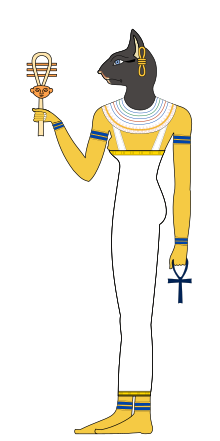
Bastet.svg
Bast (Bastet)
Some of the god representations are more clever than others. I liked Mad Sweeney the Leprechaun and the very cat-like Bast. But I thought the modern gods of Media and financial Intangibles were pretty darned clunky.
And the primary god, Wednesday, is slimy and unethical and mean. He is a grifter with no conscience. I was prepared to cut him a tremendous amount of slack, since he was Odin, after all, but after about a hundred pages I didn’t like him one bit and I didn’t want to hear any more of his slick patter. And I didn’t want to hear any more about his creepy attitude towards women (to wit: they are a dime a dozen, and the best ones to sleep with are naïve, innocent virgins that you can despoil).

Which brings me to my final complaint: by and large, women come out really badly in this book. They are either (a) beautiful, innocent nymphs; (b) horrifying man-eaters; (c) motherly, house-bound caretakers; or (d) priggish, controlling, and sour.

Many of the female gods use their bodies as their primary weapon and their exploits involve titillation, sex, pregnancies, and/or a lot of blood. The male gods have a wide range of attributes—they can be furtive or powerful, showy or gray-suited, efficient and businesslike or sleazy and alcoholic—but are rarely sexualized. Female gods are often shown partially or completely naked as a matter of course; male gods are hardly ever undressed except as part of a specific religious ritual. When female characters are not sexy they are usually crabby, and the male characters commiserate with each other about what joy-killers they are.

Here’s one of my favorite quotes on this topic from the book: “Shadow smiled at the pretty women, because they made him feel pleasantly male, and he smiled at the other women too, because he was having a good time.” (p. 459)

Oh, thank you so much, Shadow.

One woman in the book, Samantha Black Crow, does actually come off as a relatively realistic person. She is snappy, sarcastic, and not averse to telling some tall tales herself. She goes by the name “Sam,” has a face that is described as “slightly mannish” and is leaning decidedly towards the lesbian end of the bisexual scale. Maybe since she isn’t interested in any of the male characters, she can be allowed to have a deeper character development.

If you want a better book about gods who appear in human form to create trouble, I would recommend Roger Zelazny's Lord of Light instead. (Gaimain does acknowledge Zelazny at the end of the book; not as an inspiration but as someone who has tackled this premise before.)

Friday, January 10, 2014

Book Review: Camouflage

Joe Haldeman
2004
Awards: Nebula
Rating: ★ ★ ★ – –

SPOILER ALERT

Camouflage is not a deep or complex book, but it is a real treat to read. It’s a fast-paced, excellently-written story with an interesting central character, and it’s funny.

The plot is this: millions of years ago, two aliens landed on earth. They don’t know about each other, having come from different planets and having landed at different times and different places. One came in a spaceship that crashed on the floor of the Pacific Ocean. We’re not sure where or how the other one arrived.

Both aliens are shape-shifters and can take the shape of any one or any thing they want. The body chemistry that allows them to do this also makes them invulnerable to any germ or weapon or predator so they can, theoretically, live forever.

The alien that arrived in the spaceship, “the changeling,” is primarily interested in gaining knowledge of the world around it. The other alien, “the chameleon,” is primarily interested in eliminating competition and staying at the top of the food chain.

The two aliens take the form of various animate or inanimate objects as necessary to best pursue their respective goals. Over the centuries, the memory of who they are and where they came from becomes hazier and hazier, but they both know they are not like the rest of life on earth and both are constantly searching for others like themselves (for different reasons, in keeping with their different aims).

Being drawn to intra-species violence, the chameleon makes the transition to human form quite early, several millennia B.C. The changeling, on the other hand, finds itself drawn to the Pacific Ocean and spends a lot of time as sharks and whales and only takes human form for the first time in 1931.

Eventually, in 2020, the changeling’s crashed spaceship is discovered and hauled up on land to be analyzed. This gets a lot of press which immediately attracts the attention of both aliens, who then wangle their respective ways into the closely-guarded spaceship analysis project where they inevitably meet other.
 

At first the changeling, like the chameleon, is only concerned with survival; it has no concept of human emotions and makes several terrible mistakes which hurt people around it. But little by little it gains understanding and sympathy. The chameleon gains no such understanding.

Both the changeling and the chameleon experience war but have opposite reactions to it. The chameleon feeds off of the violence and joins in as often as possible. The changeling, who in one incarnation does a stint as an American prisoner of war in the Bataan Death March, is confused by atrocities and our inconsistent behavior and eventually becomes repulsed by the killing.

The only real gripes I had with the book were that (a) the chameleon’s pre-Earth background was so undefined, (b) the suspense about the inevitable confrontation between the two aliens builds through the entire book and then at the end everything is wrapped up in a nice bow in just a couple pages, and (c) I didn't really like the human characters all that much.

But that’s okay. It is all made up for by Haldeman’s terrific writing, which, to me, is the best thing about the whole book. He is succinct, matter-of-fact, and funny. He writes the way I’d hope I could write if I wrote a novel.

I know that individual paragraphs will not do him justice, because, out of context, they lose much of the book’s overall flavor. Nevertheless, here are a couple examples from Camouflage.

Describing the changeling’s experiences as a Marine at boot camp in 1941:

“For the first week they did little other than run, march, and suffer through calisthenics, from five in the morning until chow call at night – and sometimes a few more miles’ run after dinner, just to settle their stomachs. The changeling found it all fairly restful, but observed other people’s responses to the stress and did an exactly average amount of sweating and groaning. At the rifle range, it aimed to miss the bull’s eye most of the time, without being conspicuously bad.”
On how the changeling spent much of the ‘80s and ‘90s:
“It was an exotic dancer and part-time prostitute in Baltimore for a while, then a short-order cook back in Iowa City. As an old lady, it read palms on the county-fair circuit in the Midwest, and returned to California in its old Jimmy body to be a surf bum for a couple of seasons.

Sacrificing half its mass, it became a juggling dwarf with the Barnum & Bailey Circus, making contacts in the freak world. It met some interesting people, but they all seemed to be from Earth, no matter what they claimed.

It married the Bearded Lady, an even-tempered and sardonic hermaphrodite, and they lived together until 1996. The changeling left behind a hundred ounces of gold and no explanation, and became a student again.”
When the scientists studying the alien spaceship realize that there is likely at least one alien on earth, and that the alien will likely have taken human form and could be anyone, and that the way to identify the alien is that it will not have human DNA:
“In fact, by the time Jack said this, every employee at the CIA had donated a few cheek cells to the agency, as had employees of NSA and Homeland Security. A ‘suggestion’ had come down from the White House that all of the country’s leaders be tested. …

The tests proved that every member of the American intelligence community was human, at least in a nominal sense, and so were all prominent politicians, including the president, which surprised a few people.”

An earlier version of this review originally appeared on Cheeze Blog.

Friday, January 3, 2014

Book Review: Darwin's Radio

Greg Bear
1999
Awards: Nebula
Nominations: Hugo
Rating: ★ ★ ★ – –

SPOILER ALERT

I really enjoy Greg Bear’s books. His writing is straightforward and his ideas are original and satisfyingly weird. He’s like the Stephen King of sci-fi. This particular book isn’t overwhelmingly great, but it does have a Bear-ishly unique plot and is fun to read.

Since Charles Darwin published On the Origin of Species, there has been a debate over the extent to which evolution happens gradually and the extent to which it is punctuated by relatively sudden leaps. In Darwin’s Radio, not only does evolution occur in sudden leaps, but the leaps can be very dramatic, with an entire species reaching a new stage of biological development within a generation or two.

This includes humans.

The book begins with the discovery of the frozen, mummified remains of a prehistoric family – a man, a woman, and a baby – in the Alps. At first, the paleontologist who discovers them thinks they are Neanderthals. But it turns out, upon further investigation, that the baby is Homo sapiens and that the adults were Neanderthals who appear to have physically changed into Homo sapiens shortly around the time their baby was born. It looks as if the parents literally shed their skin to reveal the new evolutionary form. It also looks like these three early humans were murdered.

(Note: I think that at the time this book was written, the scientific consensus still was that Homo sapiens evolved from Neanderthals. In order to get into the story, you just have to go along with that.)

At the same time that all this prehistorical investigation is going on, something strange is happening to contemporary humans. A new flu-like retrovirus is spreading around the world. Men can be carriers but only women get infected. When a pregnant woman contracts the virus, it makes her abort the fetus. This is very upsetting, of course, and people start panicking. What it takes people a while to realize is that before the fetus aborts, it itself ovulates and leaves behind a new viable fetus… with six extra chromosomes than normal... that continues to develop.

And then, even weirder, when a man and a woman are about to have a baby from one of these new extra-chromosome fetuses, they both start to change physically. Their vocal chords and sense of smell get more sensitive and their facial skin starts peeling off, revealing new patches that change color with emotion.

A biological researcher investigating the retrovirus eventually hooks up with the paleontologist who found the mummies and they put two and two together. They develop the theory that a Homo sapiens gene existed all along in early hominids, in the form of a dormant retrovirus. At some point some kind of species-wide biological clock determined that it was time for the next evolutionary step and activated the virus in the Neanderthals. It caused them to have Homo sapiens babies and caused the parents to change form too, to match their children. Because they were different, these new-form humans were likely feared and persecuted and sometimes even murdered by their earlier-form relatives.

And this is also, of course, what is happening to modern humans. The biological master clock has activated another dormant part of our genetic code. When the first few extra-chromosome babies are born they, too, have sensory patches of color on their faces and they can communicate with their parents in an almost empathic or telepathic way. They are a new stage of human. And they, too, are feared and persecuted by regular old-style humans, and are forced to go into hiding from their families and neighbors and the government. (Setting us up nicely for a sequel, Darwin’s Children.)

My main problem with Darwin’s Radio was that I didn't really like the main characters very much - either the paleontologist or the biologist working on the retrovirus or the modern evolutionarily advanced families. They seemed more like tools for telling the story rather than real rounded personalities. Fortunately, however, the basic ideas were cool and well-developed enough to carry me through the book in spite of the people not being very appealing.


This review originally appeared on Cheeze Blog.

Friday, December 13, 2013

Book Review: Powers

Ursula K. Le Guin
2007
Awards: Nebula
Rating: ★ ★ – – –

SPOILER ALERT

This book was only available in the Young Adult section of my library. And, after reading it, I can see why; this is definitely a book for teenagers.

I have really enjoyed some of Le Guin’s books, and others not so much. The books that I don’t like usually fall into one of two groups: those that are too dreamy and those that have too heavy-handed a Message. This book fell too far into both of these negative categories for me. (The Message in this particular book is that slavery is evil.) (Which, of course, it is.)

The story is about a young slave boy, Gavir, who has been brought up in a relatively benevolent household. He is able to be in denial, at first, that it is bad to be a slave, because his life seems to be pretty good. His masters are not overtly cruel; he is able to live with his beloved sister, Sallo; and he gets to go to school with the master’s children because he is being trained to be a teacher.

But eventually his little world starts falling apart and he starts to question the system. He is bullied by some of the less benevolent members of the household. His home is invaded by people from another country. And finally his sister is murdered, which is the last straw and makes him run away.

After he runs away, he lives in several different types of societies, including a city of freed men; a camp of runaway slaves in the heart of the forest run by a misogynistic megalomaniac; and the poor marshland settlements of his own people from whom he was stolen as a baby. This all conveniently exposes him to alternative governments and different attitudes towards women, work, war, and cooperation.

The Message, which, of course, Gavir eventually learns, is that a cage is still a cage no matter how gilded it is. That slavery is an evil institution, however disguised it may be, and a limited freedom is no freedom at all.

This is all very well and good a Message, but so obviously delivered.

And the characters are so black and white. Gavir and his sister are one hundred percent good, eager naïfs. They have unquestioning obedience to and reverence for their masters. They are hard-working and earnest. And the bad guys are uniformly awful bullies.

The story is also not all that exciting. Gavir’s story is the classic monomyth: he is born under mysterious circumstances, shows early evidence of supernatural abilities (he can see visions of the future), goes on a long journey or quest, encounters several father figures from whom he has to become independent, and has to have a showdown with an arch enemy to finally prove himself. But Gavir's life really isn’t all that difficult most of the time. He is in physical danger maybe twice, and in an actual physical conflict a couple more times, but these situations are all generally over in about a minute. Even his escape from slavery is easy.

And all of the pivotal events in the book are instigated and resolved by external forces without any action on Gavir's part. He is swept along by events, not directing of them. Even his final showdown is won essentially passively, by natural forces, not by anything special he does.


An earlier version of this review originally appeared on Cheeze Blog.

Friday, November 29, 2013

Book Review: Seeker

Jack McDevitt
2005
Awards: Nebula
Rating: ★ ★ ★ ★ –

This book is great in many ways. It is an exciting detective story with appealing central characters, plenty of outer-space travel, and a satisfying ending.

The story takes place many centuries in the future, after humans have developed faster-than-light travel and colonized several worlds. It is narrated by Chase Kolpath, an interstellar pilot. Kolpath and her boss, Alex Benedict, make up the staff of Rainbow Enterprises, a company that explores remote sections of space, finds ancient artifacts from abandoned space stations and failed colonies, and sells the artifacts to collectors.

It is lucrative. But Kolpath and Benedict are always running afoul of academic archaeologists and historians who view their business as theft, and this tension pervades the entire book.

The book’s adventure begins when a woman asks Rainbow Enterprises to appraise an antique cup with the seal of the starship Seeker on it. The cup turns out to be 9,000 years old and to be, just possibly, a relic of an ancient lost colony.

In researching the cup, Kolpath and Benedict find out that back in the 25th century, Earth was poor, overpopulated, plague-stricken, and ruled by a series of harsh authoritarian regimes. A small group of idealists, the Margolians, fled Earth in two rickety starships, one of which was named Seeker. They may have successfully established a new Eden for themselves or they may have died in the attempt, but, either way, they were never heard from again.

Their fate at first became the subject of novels and films but gradually their memory faded to the point where most people in Kolpath & Benedict’s time now think they are merely a legend and never existed at all.

If the cup can be proven to be from this lost colony, and if it can be used to trace the colony’s location, it could be Rainbow Enterprises’ greatest find ever.

Together, Benedict and Kolpath unravel the secrets of the ancient emigrants. They do library research; they talk to avatars of the long-lost Margolians; they explore remote sections of outer space; they have daring adventures and evade several attempts on their life.

This was the first time I had read anything by Jack McDevitt. I liked it so much I immediately read the prequel, Polaris, which was just as good and which suffered not at all from being read out of order.

Stephen King has called McDevitt “the logical heir to Isaac Asimov and Arthur C. Clarke.” That is a pretty high bar, but King may just be right. McDevitt’s writing is straightforward and the process of putting together the pieces of the puzzle keeps your attention the whole time.

One of the things I liked best about this book (and about Polaris, too) was Chase Kolpath. She is matter-of-fact and thrives under pressure. People naturally call her by her last name. She is a great pilot and her boss respects her as such. Benedict is a better sleuth, but when his investigations repeatedly put their lives in immediate physical danger, she’s always the one who keeps her head clear and gets them out of it. She has a private life and keeps it private, from both her boss and largely from the reader, too. She likes a party and goes out with guys but doesn’t get attached to any one of them.

As a side project, Kolpath decides to watch all the films based on the Margolian legend. Her summaries of the plots of the movies she watches are really quite funny.

I also liked the ways that McDevitt layers fiction within fiction. He puts a quote at the beginning of each of his chapters, for example; sometimes it is from a real (19th-20th century) author, but more often it is from fake fiction or fake philosophy, written sometime during the 21st-26th centuries. Even the fake quotes don’t feel like the rest of McDevitt’s writing, so it really does feel like he is borrowing from other authors.


An earlier version of this review originally appeared on Cheeze Blog.

Friday, November 22, 2013

Book Review: Tehanu

Ursula K. Le Guin
1990
Awards: Nebula
Rating: ★ ★ – – –

SPOILER ALERT

Tehanu is the last book in Le Guin’s Earthsea cycle, a series of books set in a rural middle-ages-y fantasy land filled with mages and dragons.

With all due respect to Ms. Le Guin, who has written some complex and groundbreaking books, the Earthsea series is really not my bag. And Tehanu is no exception.

For one thing, there is not much of a plot. The main character, Goha, was tutored as a girl by a powerful mage (i.e. wizard) but left that life as a young woman to marry a farmer and raise a family. At the time of the book, Goha is somewhere in middle age. She has adopted a girl, Therru, who was so unwanted by her parents that she was permanently disfigured in a fire that they set to kill her.

At the start of the book, Goha and Therru travel far overland to see Goha’s old tutor, Ogion, who is dying. After he dies, Goha and Therru stay on in his house and are beset alternately by ruffians vaguely related to Therru’s parents and by Aspen, an evil, Wormtongue-esque rival mage, who has it in for Goha for some reason.

They while away the time at Ogion’s house amidst all of this until one day a dragon comes, bearing the half-dead body of Ogion’s other pupil, Ged, who was once a super-powerful arcmage but who lost his power defending his master in a terrible battle. Goha nurses Ged back to health and then they all make their way back to Goha’s farm, where they are beset by the same ruffians they were beset by at Ogion’s house.

Then, when Goha’s estranged son comes to claim the farm, they all decide to go back to Ogion’s place, where they again immediately run afoul of Aspen, who puts a spell on Goha and Ged and is about to drive them off a cliff, when Therru saves the day by calling the dragon to come back and rescue them.

I spent the whole book thinking something was about to actually happen but nothing ever really did. They mainly just travel back and forth between Ogion’s and Goha’s houses, and are only occasionally, and only briefly, in danger.

Le Guin’s treatment of women in this book is also frustrating, given how good she can be at representing the misunderstood or the different.

In Tehanu, only men can be mages; women with magical powers can only be witches. Mages are involved with big-time projects and politics; witches concern themselves only with small-time magic like healing illnesses or finding lost objects. In the plot, the men are the active elements and the women are the ones who are passively acted upon; the men either put the women in danger or save them – up to and including the male dragon at the end.

Goha’s life has been split between her unusual magical life under Ogion’s tutelage and her more ordinary human life with her husband and children. She never really comes to grips with either one or reconciles the two. She seems drawn towards magic, but never really accepts the power it would give her, and tends to want to go running back to the farm.

And, finally, the dragons in Tehanu are just too dreamy for me. With the exception of the dragon in Shrek, I like my dragons to be mean and uncompromisingly tough, fought by knights with swords or by men and women with bows and arrows. 


This review originally appeared on Cheeze Blog.