1957
Awards: Edgar
Rating: ★ ★ ★ ★ –
 This novel just goes to show that you can’t judge a book by its ridiculous cover – or its teensy size.
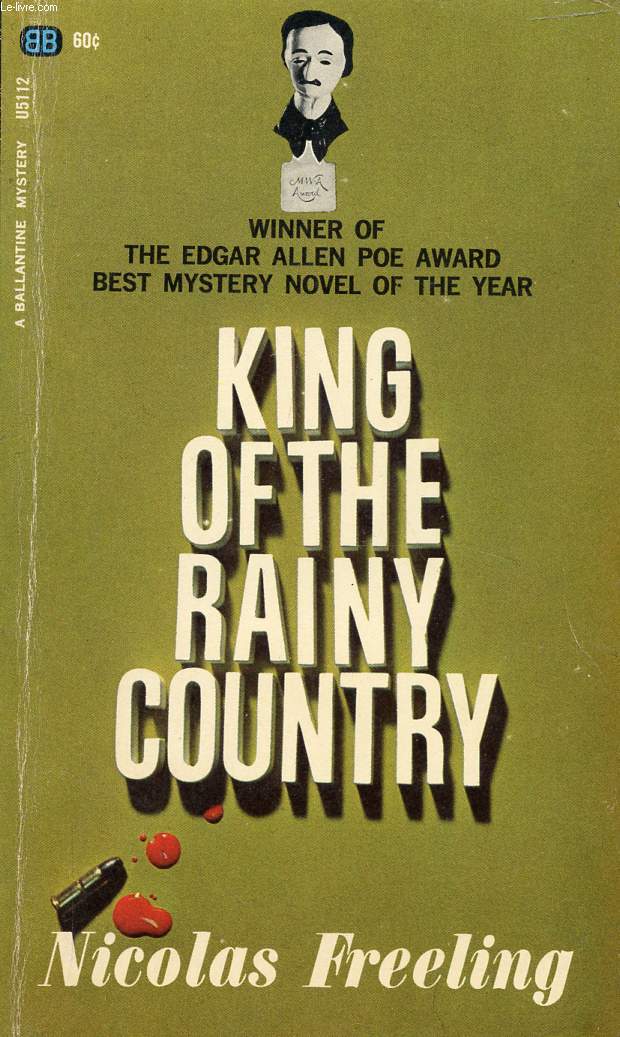
It proves that just because a book is short (a tidy 128 pages) and just because it went out of print and had to be resurrected by a tiny publisher who obviously scanned in the original text and then didn’t edit it afterwards so that there are typos, skipped sentences, and "& pound; s" scattered throughout the text, and whose extensive cover design consisted of reprinting a tiny picture of the original 1957 cover artwork (shown here) surrounded by an enormous plain black border, and who jammed the text so close to the tops of the pages that the headers and page numbers are practically cut off, doesn’t mean it can’t be action-packed and establish great characters.
The plot is tried-and-true mystery fare: the main character, Toussaint Moore, is a New York detective hired to track a man who quickly winds up being murdered. Moore is the first to find the body and is of course mistakenly accused of the crime; he then has to solve the murder in order to prove his own innocence.
I loved Moore’s style. He doesn’t take any guff and doesn’t go out of his way to make other people feel comfortable. He is abrupt, snappy, and slangy, like Raymond Chandler's Philip Marlowe at his best. But Moore is also human, and his fears are plain.
Lacy’s writing is fast-paced, clear-headed, and straightforward–which is the only way the book can be this complex and this short and still work. I liked that he starts by dropping you right smack in the middle of the story, so you have to put the background together for yourself as he gives it to you. And what I liked even more was that you got the clues and solved the mystery at the same time Moore does. It seems like this might make it less suspenseful, but it actually makes it more so.
What makes this novel unique for 1957 is that Moore is black. (He is, in fact, described on the back of my copy of the book and in several reviews as “the first credible black detective” in popular mystery fiction.)
For Moore, a black detective in the ‘50s, racism is never far away. Especially when most of the people he has to deal with in the story are white, including the people who hired him, the police who are chasing him, and the man he was trailing and is accused of murdering. This is a constant additional tension, to say the least, that a white detective would not have had to cope with.
In the course of solving the crime, Moore ends up traveling from New York to Bingston, Ohio, a small town just north of the Kentucky border. The contrast is educational for him. Bingston is plainly, overtly racist; Moore can only make phone calls from certain gas stations, can't eat at the cafeteria or stay at the hotel, and is constantly called “boy” and treated with hostility.
New York is certainly better than Bingston on the surface; black people have a wider choice of professions, have at least the legal right to eat and lodge anywhere they want, and night clubs often have both black and white patrons. (It even has out-of-the-closet Lesbians (capitalized), whom, by the way, Moore is totally okay with.)
But even with the most “liberal-minded” white New Yorkers, Moore constantly walks a tightrope of behavior, judging when to put up with insensitive remarks or outright insults and when to defend himself. And he still has to fight the pressure, even from his girlfriend and his own pesky conscience, to give up his risky detective agency venture and run to a safe civil service job.
An earlier version of this review originally appeared on Cheeze Blog.


 This book is not a stereotypical murder mystery with a lot of drama and
gore. As advertised, it follows the progress of a crime very closely and
realistically, from the murder to the trial of the chief suspects. You
experience the investigation from the point of view of several people
trying to figure out what happened – reporters, policemen, and lawyers.
Sometimes they get information through good detective work, and
sometimes they get it accidentally. You find out what they know as soon
as they know it, and you put the story together with them.
 This
murder mystery takes place in Los Angeles in the 1950s. A wealthy,
antisocial woman, Helen Clarvoe, starts getting weird, threatening phone
calls from an old acquaintance. The calls scare her, so she hires her
family’s financial advisor, Mr. Blackshear, to try to find out who is
calling her and why. This leads Mr. Blackshear on a nice investigation
in which he uncovers all sorts of interesting secrets about Helen’s past
and the other members of her family, and during which one of the people
he is investigating commits suicide and another is murdered.


 Here is yet another well-put-together British mystery.
 This book is a blockbuster page-turner with all the ingredients - war,
sex, human drama, and international intrigue with the fate of the free
world at stake. It also has several elements that I am a particular
sucker for: spies, WWII-era Britain, remote Scottish islands, and
violent storms at sea.


 I really liked most of the characters and the setting of this book. But the main murder plot just wasn’t very gripping.


 As
usual with Dick Francis, the story revolves around horse racing. The
detective in this book, Sid Halley, is a former jockey who had to quit
riding because he lost his left hand (his whip hand) in a racing
accident. Sid’s missing hand is a perfect device for making him unique
and giving him both physical and mental challenges to overcome.