Friday, August 31, 2012

Book Review: The Dispossessed (Part 2 of 2)

Ursula K. Le Guin
1974
Awards: Nebula, Hugo, Locus
Rating: ★ ★ ★ ★ –

SPOILER ALERT

This is a continuation of an earlier review. For a description of the back story and plot of this book, see my post from last week.

I think that the real power of The Dispossessed is that it gives you a chance to explore both a libertarian anarchy and a capitalist government - populated by very similar people - through the eyes of someone with a very open mind. And in a more subtle way than either Le Guin's own earlier work or Heinlein’s polemics.

The main character, Shevek, was born and raised on the moon Anarres, in a society founded as an experiment in nonauthoritarian communism. For him, this is the comfortable default; he has been raised to think of governmental structure as inherently corrupt and of the drive for profit as an unjust and ineffective motive.

In many ways, the Anarresti system is a good one and Shevek is justifiably proud of it. People trust each other (there is no reason not to, since nothing is private). People do, for the most part, work together. No one is left to starve while others have extra food. No one is forced to take an illegal, oppressive, or dangerous job just to survive. Everyone is of equal status – men and women alike.

The problem is that, in spite of itself, Anarres has started to develop a government-like bureaucracy. The Anarresti structure is meant to foster choice and open-mindedness. But every crisis requires the imposition of a little more process which never really goes away when the crisis is over. 

It doesn’t help that the moon is so inhospitable. A five-year famine tests the Anarresti social commitment to the breaking point, with mobs coming awfully close to hijacking food shipments designated for somewhere else. So the bureaucracy, such as it is, clamps down tighter to make sure everyone gets fed. This, plus Shevek’s own experiences with close-mindedness and even censorship at work, make him realize that their system may not be as infallible as he was raised to believe. More and more, norms and regulations are putting the needs of society as a whole before individual freedom.

Urras opens Shevek’s eyes even more - and confuses him.

Some aspects of Urrasti capitalism are indeed as bad as he was taught. When he meets the elite, they all seem anxious, and he wonders if it is worry because someone always has more, or guilt because someone always has less. Women, servants, and laborers are second-class citizens, and they are by no means all happy about it. Large groups of sometimes violent Urrasti people want a change and want him to be their spokesman.

But he also sees things that show him that a profit-driven system might not necessarily be all bad:
“He had been taught as a child that Urras was a festering mass of inequity, iniquity, and waste. But all the people he met, and all the people he saw, in the smallest country village, were well dressed, well fed, and, contrary to his expectations, industrious. They did not stand about sullenly waiting to be ordered to do things. Just like Anarresti, they were simply busy getting things done. It puzzled him. He had assumed that if you removed a human being’s natural incentive to work – his initiative, his spontaneous creative energy – and replaced it with external motivation and coercion, he would become a lazy and careless worker. But no careless workers kept those lovely farmlands, or made the superb cars and comfortable trains. The lure and compulsion of profit was evidently a much more effective replacement of the natural initiative than he had been led to believe.”
What Shevek is learning is that neither type of society is inherently, self-consciously evil. Both kinds of incentive can be used to get people to do things. Both can be effective, to a point and in the right context. And both have dangers.

He also realizes that the mental and physical walls between the worlds hide a big lie: Anarres needs Urras. Although Anarres is anti-capitalist, it is essentially a mining colony of Urras. The Anarresti receive manufactured goods, machinery, and new strains of plants in exchange for their ores. And, although no one seems to acknowledge it, it is largely the fear and hatred of Urras that keeps the Anarresti social bond strong.

In addition, it may be mainly Anarres’ isolation that allows the system to persist. As one of Shevek’s new Urrasti friends points out, it’s easy to be anarchists when your population is small and you have no neighbor states. If Anarres was threatened by an aggressive nation, they’d have to change (like by developing a military) or be wiped out.

By the end, you find yourself feeling that it is impossible to be an ideological purist about any one system. Every system, no matter the theoretical underpinnings, requires vigilance and creativity to avoid either tyranny or stultification.

In describing the theoretical physics he works on, Shevek explains that he thinks in terms of two types of time. One is “arrow time,” in which time is linear, progressing from past to future. The other is “circle time,” in which time goes in predictable, repeatable cycles like the seasons; where past and future exist simultaneously and our "now" is just us experiencing a sliver of what always has been and always will be.

Shevek says that in order for his theories to work, we must exist in both types of time simultaneously. Arrow time enables us to have progress; without it there is no change. Circle time enables predictability and constancy; without it there is chaos.

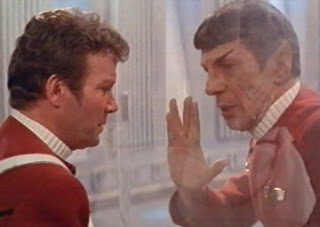
The needs of the many outweigh the needs of the few... or the one.
Sometimes the needs of the many
do outweigh the needs of the few...
or the one.
I think Le Guin is drawing a parallel between Shevek’s physics and society. We need to make sure that fulfilling the needs of a few individuals doesn’t mean that the needs of the many go largely unmet. But we also need to make sure that the needs and drives of the individual don’t get entirely submerged by the needs of the whole.

The best solution lies in a balance. And achieving a balance, in turn, depends on open communication between people with different ideas, each constantly providing feedback and challenge for the other.

All of this makes me think of the words of the wise and articulate poet Jello Biafra, when he wondered: Where Do Ya Draw the Line?


An earlier version of this review originally appeared on Cheeze Blog.

Friday, August 24, 2012

Book Review: The Dispossessed (Part 1 of 2)

Ursula K. Le Guin
1974
Awards: Nebula, Hugo, Locus
Rating: ★ ★ ★ ★ –

SPOILER ALERT

So far, this is my favorite of Le Guin’s novels.

I have criticized some of her other books for having too obvious a message. This one is obvious about its real subject matter – different governmental philosophies – but it is subtle about delivering any simple message or judgment about them.

I also liked the main character very much. He is a smart guy going through a difficult time, learning hard truths about the way he was brought up.

And her writing, as always, is clear and flowing - if maybe a little dreamy.

This book is about two worlds: the planet Urras and its moon Anarres. Urras is a densely-populated analogue for Earth; its main superpower nation is a prosperous capitalist country with a comfortable upper class and struggling lower classes. Anarres is a dusty, barren, barely hospitable mining colony.

Several centuries ago, a small group of Urrasti anarchists were banished to the moon Anarres. After the freighters brought the last group of them up, the exiles built a wall around the spaceport. They kept the port operating for a handful of cargo shipments each year, but resolved that no one else from Urras would ever be allowed up. Then they set about building a non-authoritarian communist utopia based on the teachings of their philosopher Odo.

As a result, today, on Anarres, there are no governments, no bosses, and no wages. Clothes and other necessary goods are available free to anyone at communal depositories. Food is served for free at communal refectories.

Jobs are dispensed by a central computer. You feed in your skills and your requests for location and the computer comes back with a suggested placement. You do not have to accept the placement, although pretty much everyone does.

You have no obligation to do anything in particular. You have the freedom to learn or work at whatever you want at any time. You are owned and governed by no one.

The catch, of course, is that no individual can own or govern anything. No one can become rich or powerful. If you are found to be “egoizing” – keeping goods for yourself or doing things solely for your own aggrandizement, you are isolated and ostracized.

Anarresti children are brought up to see themselves as part of a whole; as a single cell in the body of society. Their role is to find their own best individual cellular function and do that – the idea being that if they do what they do best, that is the greatest contribution they can make to society.

The plot centers around an Anarresti physicist named Shevek. Shevek is happy; he has a loving partner, children, and friends. He is always willing to do his part. He grows up trusting his countrymen and assuming unquestioningly that everyone is working together. He grows up distrusting and fearing the profit-driven people of Urras.

But as Shevek gets closer to developing a General Temporal Theory, which will enable faster-than-light space travel, he discovers that instead of being freely exchanged, his ideas are being stifled.

For one thing, his work is threatening to his advising professor, Sabul. Sabul has been discouraging the publication of those ideas of Shevek’s that he doesn’t understand and, contrary to Odonian teaching, has been publishing the ideas that he does understand under his own name.

Shevek’s work is also a threat to his society; it threatens to break down the walls that protect Anarres from Urras. His university will only permit him to teach basic courses, claiming that not enough students are interested in the more complex ones. The job-posting computer starts to send him to godforsaken places to do mining or agricultural jobs that have nothing to do with physics and separate him from his family for long periods.

An Odonian society is supposed to be in a state of permanent revolution, encouraging of initiative and freedom of thought. But Shevek starts to realize that, little by little, in spite of itself, Anarres is developing a bureaucracy that functions very much like a government and serves to limit radical thinking.

So Shevek reaches out to physicists on Urras, sending them letters via cargo shipments. His correspondence often gets “lost” in transit but the few responses that come back show him that the Urrasti physicists are intensely interested. Thinking that this could be a way to reunify the two worlds, he smuggles himself off to Urras.

The Urrasti receive him with open arms. At first, he is astonished by how luxurious everything is and how happy the people are. But he gradually realizes (mainly through clandestine little notes slipped into his pockets by servants) that he is being coddled by the elite, who hope that they will profit from his General Temporal Theory. They have carefully prevented him from seeing any slums or poverty or other downsides of Urrasti capitalism.

Shevek eventually goes on the lam, gets caught up in a street protest, and is almost shot by the police, before coming up with a solution that serves his needs – and almost everyone else’s, whether they realize it right away or not.

But here I’ve gone on and on about the plot and I’ve hardly talked at all about the real reason to read the book, which is the subtlety and thoughtfulness with which Le Guin, through Shevek’s eyes, compares the Anarresti and Urrasti systems. Any review of The Dispossessed should really include an insightful, complex discourse on capitalism versus socialism, on anarchy versus government, and on how it is impossible to be an ideological purist about any one system.

I feel that this is, alas, beyond my analytical abilities but, to at least show my appreciation for what Le Guin has done, I will try to address it in a small way in my next post, here.


This review originally appeared on Cheeze Blog.

Tuesday, August 21, 2012

Princess Leia: Role Model

Although on the surface it might appear that Princess Leia is merely a helpless princess needing to be rescued, she is actually a bad-ass. This is a great post on Tor.com by Emily Asher-Perrin about why Leia always ends up on--and deserves to end up on--any list of strong female characters in SF.

http://www.tor.com/blogs/2012/08/can-we-talk-about-why-we-really-love-princess-leia


Friday, August 17, 2012

Book Review: The Quantum Rose

Catherine Asaro
2000
Awards: Nebula
Rating: ★ – – – –

This book was billed as "romantic fantasy," which made me skeptical from the start. But it did win a Nebula. And an essay at the end of the book said the plot was a rough allegory to quantum scattering theory, which is what Asaro did her PhD thesis on. So I tried to keep an open mind as I read it.

It turned out that it was, indeed, all the worst things that "romantic fantasy" made me think of. It was basically a Harlequin Romance with a science fiction veneer. Our incredibly beautiful and intelligent heroine is a provincial ruler on her planet; she is forced to get herself betrothed to a beastly but wealthy man in order to save her people from starvation; she then is rescued from said awful match by a virile stranger from another planet.

For the first half of the book, the plot itself actually had potential. It takes place on a rural, backwards planet where much of the populace is in poverty. Unbeknownst to the inhabitants, the planet was purposely seeded with life by a rich, highly technologically advanced empire that is still monitoring it and interfering with it from afar, but not doing anything to reduce the suffering.

But halfway through the book the story turns into a jarringly discontinuous, space-based, mass-uprising adventure, with the main female character getting taken off her rural home world and thrust into a not really believable role as rebel leader. It's like the author was trying to combine Asimov and Clarke and Stephenson and didn't do any of them very well.

What I really couldn't stand, though, were the romance-novel-style characters, settings, and descriptions. The main character is the classic madonna/whore: an impossibly perfect, gorgeous, smart, kind, and generous woman beloved by 100% of her people and her lover, who is purportedly strong-willed and in a position of power but yet she can't make up her mind about anything and keeps getting buffeted about by the controlling men in her life. And by the fifth or sixth time that she was described as having hair in "curls that tumbled to her waist" I wanted to slap the author. 


An earlier version of this review originally appeared on Cheeze Blog.

Friday, August 10, 2012

Book Review: Ender's Game

Orson Scott Card
1985
Awards: Nebula, Hugo
Rating: ★ ★ ★ – –

SPOILER ALERT

Before I read Ender’s Game for the first time, I had heard a lot of hype from others about how life-changing this book was for them. It didn’t live up to the lofty expectations that the hype had set up and I was disappointed.

I read it again recently, though, and this second time I think I was able to appreciate the book much better for what it is.

The story is set in the future, when we on Earth are nearing the end of an 80-year break in an interstellar war against another species, the Buggers. The Buggers’ original two invasions were brutal and all of humanity is united in preparing to defend Earth against the expected Third Invasion. Governments have begun genetically engineering children to be soldiers in the coming war; they run them through a series of tests when they are little to see if they will be good candidates for Battle School (when they are elementary-school age) and then Command School (when they are teenagers). In school, they run the children through battle simulation after battle simulation, teaching them how to fight and kill.

The main character in the book is Andrew “Ender” Wiggin, a six-year old military genius (who is good at many other things as well). He is lonely at Battle School, ostracized and sometimes hated by many of the older students who are threatened by his skill. They do everything from not eating with him at meals to trying to kill him in the hallways. But he is so good that he still rises rapidly through the ranks at Battle School, leading first small groups and then whole battalions of his fellow students, entering Command School several years early.

Ender enjoys what he does. He is creative and adaptable. He learns his opponents’ patterns quickly and exploits them. The problem is that he doesn’t like to kill. And the more successful he becomes, the more agonized he gets inside about what he is doing. He knows he is being used as a tool and it makes him miserable.

What he doesn’t realize until it is too late is that the humans don’t just want to defend themselves against a Third Invasion – they want to completely annihilate the Buggers and their home world. And that at some point, the battles he is fighting have changed from simulations to real encounters with the enemy that he is commanding by remote control.

He does, finally, lead the human forces to victory over the Buggers, with huge loss of life. When he finds out what he has done he goes through a profound breakdown and decides to completely redirect his life and honor the memory of those he has killed.

It is a very good story and Ender is a very likeable character. I definitely identified with his loneliness and I liked the way he was always able to think his way into succeeding against huge odds. I just had a couple problems with the book.

One was that the ending seemed too abrupt. It was very quick. I guess I thought that Ender would eventually be on the actual battlefield himself, or that we would actually meet a Bugger, and when neither of those things happened, it was a bit unsatisfying.

The other was the more minor story of what was going on back home while Ender was at school. Ender’s brother Peter and sister Valentine are geniuses in their own rights, but Peter was too aggressive and Valentine too pacifistic to make good military leaders. Left out, they begin writing columns and editorials in global political nets, widening divisions between political factions (mainly between America and Russia). I didn’t really get into their story as I did Ender’s.

After reading Ender’s Game, I read the sequel, Speaker for the Dead. I just loved it. It was moving and complex and I enjoyed seeing what Ender had become as an adult, after he had turned away from the military. Later I read that Orson Scott Card originally meant both stories to be in the same book, but that when he got into it, he realized that it was too much and he should split off what was then just a backstory about Ender’s youth into its own book, which would then be a set up for Speaker. If that is indeed what he intended, it totally worked for me.


This review originally appeared on Cheeze Blog.

Tuesday, August 7, 2012

Born Strangers

“The world is full of surprises. We’re all born strangers to ourselves and each other, and we’re seldom formally introduced.” 

– Carol Lawton in Spin  
by Robert Charles Wilson

Friday, August 3, 2012

Book Review: Spin

Robert Charles Wilson
2005
Awards: Hugo
Rating: ★ ★ ★ ★ – 
                                                 
This is the perfect book to read while lying on the beach in the hot summer sun. It feels a little bit like a pulpy, calculated page-turner, but it is well written and satisfyingly complex and has a great plot. The characters, in general, are not terribly appealing, but the narrator is at least nice enough to make you care what happens to him. The ending is a little convoluted, but not enough to wreck the book.

The story starts in the early 21st century. A trio of teenaged friends—wealthy twins Diane and Jason and their housekeeper’s son, Tyler—are outside the twins’ house one night when suddenly the stars wink out. One minute the stars are there, and the next minute the sky is just flat black.
                                                        
They quickly learn that this is not a local phenomenon. The sun is still shining on the parts of the planet where it is day, but no one on the night side of Earth can see the stars or the moon. And all around the world, satellites are falling out of the sky and plunging to the ground.
                                                                                                                                                    
It turns out that a manned space station also fell to earth just minutes after the stars disappeared. The only surviving crew member at first appeared to have gone insane, since he claimed that (a) when they looked down from the station, all they could see was a big black sphere where the earth had been and that (b) they had stayed in orbit for three weeks, unable to contact anyone on the ground, before deciding to try hurtling themselves back to earth.

Eventually, putting all of this information together with data from exploratory probes sent up after the fact, scientists confirm that the Earth has been enclosed in a big semi-permeable wrapper. Man-made objects can pass through it but starlight and moonlight cannot. The light from the sun is being let through but is being actively moderated by the wrapper.

And the wrapper, which people have begun calling “the Spin,” has slowed down the passage of time. It has put the Earth into some kind of near stasis. To people on the planet, time appears to be passing at the same rate as it ever has. But outside the wrapper, the rest of the solar system and the universe are aging rapidly. One terrestrial second now equals 3.17 years of galaxy time. In other words, for every year that passes on Earth, a hundred million years pass by outside the Spin.

Which means that it will now only be a matter of decades before the sun expands into a red giant and burns Earth to a cinder.

The end of the world is suddenly, undeniably, right around the corner. And, not only that, but the existence of the Spin proves that there is indeed other intelligent life in the universe, that it is either cruel or uncaring, and that it exists on a time scale we can’t comprehend.

This, of course, causes all sorts of different reactions and raises all kinds of existential questions. And Wilson faces the major ones straight on. He is great at putting himself deep into his premise, seeing its potential consequences on people, and using each of his three main characters to explore them.

Diane reacts with a combination of terror and denial, grabbing desperately onto an apocalyptic religion that explains the Spin as the sign of God’s judgment. Her brother Jason throws himself into science, trying to figure out who put the Spin there and to find ways to remove it or at least ameliorate it. Tyler, the narrator of the story, becomes a doctor; he focuses on removing immediate sources of pain, helping people survive day to day and year to year, trying to ignore the fact that he can’t help humanity as a whole survive the next fifty years.
                                                                        
The positive side to Jason’s approach is that the Spin is an advantage rather than a source of hopelessness. For him, it is an opportunity to learn things about the universe we never could before. We can see stars dying and being born; we can send out probes that take millennia to reach their targets and see the results in our lifetimes. The most ambitious of Jason’s projects is a controversial effort to terraform Mars, made possible now since millions of years pass on Mars for each one of ours. Overtly using many of the processes described in Red Mars, his rockets send up containers of hardy lichens and other genetically modified life forms every few months with the goal of rapidly turning Mars into a livable planet.

Tyler is the only one who sees that even though science keeps Jason going, he is in just as much denial about the bigger reality as Diane is. Although Tyler’s job keeps him blessedly distracted much of the time, he still finds himself coming back to the same unwanted, agonizing question: what is the point of going on, of doing anything, when the end of the world is so close at hand? He is the voice of the agnostic and the realist who would like more than anything to escape into religion or science but who can’t get past the feeling that all brands of salvation are lies. Wilson handles Tyler’s existential confusion with courage and clarity.

Aside from all this deep thinking, there are also moments of truly beautiful writing. At one point, for example, the Spin barrier weakens and people can momentarily see the stars beyond it. The stars move and flicker as they go through thousands of years of change in a minute. The moon appears like a stop-motion film, flashing randomly in different phases in different parts of the sky. It is a lovely description of the universe as seen from a slow-moving Earth.

Friday, July 27, 2012

Book Review: The Diamond Age

Neal Stephenson
1995
Awards: Hugo, Locus
Nominations: Nebula
Rating: ★ ★ ★ ★ ★

Neal Stephenson is one of my favorite sci-fi writers and I’m disappointed that with all the funny, rich, and prescient books he has written, I only get to write about one of them here.

I was introduced to Stephenson by a co-worker who suggested that I start with this book rather than the somewhat more famous Snow Crash. About ten pages in, I was hooked.

The opening chapter drops you bang into a new world on the outskirts of Shanghai fifty years or so in the future. You don’t understand any of the lingo or the technology or much of what is going on at first. But (as in A Clockwork Orange or anything by Shakespeare) you learn quickly by immersion.

The society of The Diamond Age is technologically advanced but in many ways socially backward. Almost everybody belongs to a “phyle,” which is a sort of tribe or clan. Phyles are heavily class-segregated; the phyle you are in determines where you live, whether your neighborhood is polluted and crime-filled or not, how much education you receive as a child, and so on.

People who don’t belong to any phyle are called “thetes.” They live in a sort of demilitarized zone between phyle enclaves. They are outcasts who must survive by their wits and often by turning to lives of servitude or crime.

Some phyles have strength because of sheer numbers or sheer ruthlessness. Others have strength because they possess skills that others are willing to pay for. The richest and most powerful of these is the New Atlantis phyle, which is home to nearly all the “artifexes” (designers & programmers) of the nanotechnology that the world depends on. New Atlantis enclaves are on artificially extruded hills high above the poorer sea-level phyles, where the air is cleaner and their houses are easier to defend.

New Atlantans have adopted the lifestyle and mores of late-19th century Victorians – deeply repressed emotions; convoluted social etiquette; sweeping skirts and parasols for women; snuffboxes and waistcoats for men. But all of these affectations are supported by, and in some cases overtly combined with, the incredibly advanced nanotechnology that pervades everything.

Nanosites are responsible for purifying water and air and for performing most medicine. Neighborhoods are protected by grids of hovering nano-pods that can either be passive information-gatherers or defensive weapons. And the coolest thing (I thought at the time I read it) is that newspapers and books are no longer made of paper and print; they are now made of nano-paper, thin layers of nanosites sandwiched between mediatronic screens that can display a universe full of multimedia presentations at the request of the reader. (And to think it only took Apple 15 years after this book came out to come up with the iPad.)

To try to sum up the plot quickly (a tremendous injustice):

Lord Alexander Chung-Sik Finkel-McGraw, a powerful man in New Atlantis, sees that the crushing overprotectivity of his clan is causing their children to grow up without either creativity or common sense, and that this will eventually lead to their downfall. He hires a brilliant artifex, John Percival Hackworth, to build an intelligent, interactive book, a book he calls the Young Lady’s Illustrated Primer, for his granddaughter. The book will supplement and subvert the Victorian educational system; it is designed to teach a child to think creatively and to solve real problems, instead of the theoretical ones presented in schools.

Finkel-McGraw contracts with Hackworth to build one book, under top secret conditions, and makes him swear to destroy the compiled code so no one can ever build another one.

Hackworth builds the book but does not, however, destroy the code. He sneaks it out of his laboratory and takes it to a seedy neighborhood in Shanghai where he pays Dr. X, an off-network power broker with a matter compiler, to compile a second copy for his own daughter.

From here on in, of course, the gig is up. Not only does Dr. X immediately start trying to decrypt the compiler code so he can build his own copies of the book, but also, on his way back to New Atlantis, Hackworth is mugged by a gang of thete youths who rob him of everything he has, including the book. One of the thetes takes the book home and gives it as a present to his four-year-old sister, Nell.

Nell and her brother live in poverty, holed up in an apartment with a mother who entertains a steady stream of boyfriends, many of whom are abusive. They get most of their food from the free public matter compilers. Nell’s brother has steadily worsening asthma from the pollution in their neighborhood. Neither Nell nor her brother goes to school. But Nell immediately takes to the book, and the book, as it was programmed to do, bonds with her. It builds its lessons around her real life, including teaching her weaponry and self-defense. Eventually, following the arrival of a particularly violent boyfriend and with the help and advice of the book, Nell and her brother run away.

Tension builds as Nell spends the next few years evading capture by various people who want her book. Dr. X starts creating hundreds of thousands of copies of the Primer to give to orphans in China. Several phyles with terrorist bents, including one particularly scary one called the Fists of Righteous Harmony, grow stronger and begin to endanger the safety of the formerly protected ones. Eventually it starts to look like Nell, with her book-raised intelligence, pragmatism, and reluctant leadership skills, will be the one the world will depend on to take it in a new and better direction.

The style and content of The Diamond Age make you think right away of Neuromancer. While I liked Neuromancer okay, I never found myself laughing out loud while reading it like I do with Stephenson’s books. He’s got a sarcasm to him that is really funny.

Also, there’s something about the characters and the environment here that is more appealing to me. Some people have called Stephenson’s writing “post-cyberpunk,” to differentiate it from Gibson, the main idea being that in Gibson's original cyberpunk fiction the heroes are criminals bridling against a repressive dystopia, while the heroine in this one is definitely not a criminal and the world is not under any one omnipotent entity’s control.

The technology in The Diamond Age is just futuristic enough to be cool and amazing, but it is also described realistically enough that it seems like it could conceivably be developed by humans without aid of magic. It isn’t jarringly juvenile and is clearly thought up by somebody who knows about computers. It is also a great combination of old and new; for example, the New Atlantans want to ride around on horses like real Victorians, but they demand robotic horses that can take them at car-like speeds and do their own navigation.

Also, the Primer itself, as a storybook within a story, was brilliant. One of the best fairy tales Nell reads in her Primer takes place in the Dukedom of Turing, which is populated by robotic knights who throw her character into a dungeon. She has to figure out how to escape and then how to gain mastery over all of the robot knights, and along the way you (and she) see that the fable is teaching her the basics of computers and binary numbering systems and how to debug and reprogram code to do what you want it to do. It is awesome.


An earlier version of this review originally appeared on Cheeze Blog.

Monday, July 23, 2012

Friday, July 20, 2012

Book Review: Babel-17

Samuel R. Delany
1966
Awards: Nebula
Rating: ★ ★ – – –

SPOILER ALERT

I started out liking this book. I thought the main premise was good. Two opposing sides are engaged in an interstellar war. The good guys are the Alliance. The bad guys, the Invaders, have come up with a new weapon: Babel-17. Babel-17 is a language but it sort of acts as a computer virus; when you’re thinking in Babel-17, it makes you think in the ways that the language is designed to make you think, which means sometimes sabotaging your own side. It brings up interesting questions about whether the structure of your language can affect how you think. For example, if your language has no word for “I” or “you,” can you understand the concepts that those words represent?

Unfortunately, there were a number of things I ended up not liking, not least of which was the main character, Rydra Wong. Wong is a genius with languages and can feel out their translations by osmosis, and apparently she’s the only one in the universe with this capability. So she’s asked by the Alliance military command to solve the mystery of Babel-17 and figure out how to fight it. She puts a ship and crew together and goes to investigate and does, of course, figure out the mystery of the language and saves the Alliance and ends the war, yadda, yadda, yadda.

The problem is that Rydra Wong is totally annoying. Everything she does is perfect. She is the only person who has a chance of understanding Babel-17, she has a black belt in Aikido and she’s a capable starship captain. She is also totally empathetic with everyone on her crew, regardless of background, and they all just love her and all feel like they have a special connection with her. Oh, and she’s also the universe’s most famous poet, and everyone they run across is just awestruck at meeting the great author in person. And yet she’s also at times vulnerable and dependent and, worst of all, flirtatious with the big strong men in her crew. She’s always passing out after Babel-17 episodes and falling into the arms of whatever guy happens to be around.

It was all suspiciously similar to Robert Heinlein’s Stranger in a Strange Land, which came out four years before Babel-17 and which had equally unrealistic and dopey female characters.

An unrelated annoyance was that many of the situations seemed really contrived. The worst were the battle scenes. The commanders gave each battle a theme and carried that theme to the most ridiculous extent. For example, in one battle the theme was Asylum. Each division had code names like “neurotics” and “psychotics." During the battle they were given instructions like “maintain contact to avoid separation anxiety” and “prepare to penetrate hostile defense mechanisms” instead of "stay close" or "attack."

Okay, one more silly thing. Many of the characters in the book have had their bodies altered or had art implanted. Wong’s pilot, for example, has basically had himself turned into a lion, complete with fangs. Because of his fangs, he is unable to say the letter “p,” so every time he says a “p” the author replaces it with an apostrophe. So he’ll say things like, “it’s time for the shi’ to take off.” But for some reason, he can say “b” and “f” just fine. 


This review originally appeared on Cheeze Blog.