Friday, March 11, 2016

Book Review: In War Times

Kathleen Ann Goonan
2007
Awards: Campbell
Rating: ★ ★ – – –

This book is subtitled “An Alternate Universe Novel of a Different Present.” But it really is an ordinary history in which the main character is given occasional peeks into other timelines, loses friends to other timelines, and is tantalized the entire book with the possibility of being able to alter his own timeline, but never actually alters it until the very, very, very, very end. It is frustrating and disappointing if you’re a fan of alternate histories and were expecting to read one.
   
At the start of In War Times, the main character, Sam Dance, is a young American soldier in 1941 just before the U.S. enters World War II. Dance has high aptitudes for physics, chemistry, and engineering, so the Army is making him take advanced classes in all three. One of his professors, Russian émigré Dr. Eliani Hadntz, gives him all of her top-secret notes about developing a machine that could, theoretically, alter the path of history so as to eliminate all wars, and then rushes off to Hungary to try to rescue her daughter who is trapped there.

Dance doesn’t actually read Hadntz’s notes until several months later, when Pearl Harbor is bombed by the Japanese and his brother, stationed on the U.S.S. Arizona, is killed in the attack. Bereft, Dance reads everything Hadntz gave him, thinking that maybe by building her machine he can somehow bring his brother back.
   
Then the Army activates Dance and he is sent to a variety of bases on the U.S. East Coast and in Scotland. Along the way he collects a group of buddies, the best of whom is Al “Wink” Winklemeyer. Wink and Dance bond instantly over jazz, which they both play, and there are interminable paragraphs describing their rapturous enjoyment of the music. They are rapturous whether the music they hear is recorded, played by themselves, or played live by jazz superstars of the 1940s, many of whom they get to see in New York while posted nearby, and which are listed in such rapid succession and such variety that it seems like Goonan is just trying to name every jazz musician who played in New York in the 1940s. This probably would have seemed far more cool if I was at all interested in jazz.

During this entire time, in what will prove to be a recurring pattern of inaction and procrastination, Dance shelves Hadntz’s notes and does nothing about the machine at all.
   
Eventually Dance and Wink are stationed in Tidworth, England, where the Army is preparing for Operation Overlord, and the two are put in charge of a machine shop for repairing radar equipment. Hadntz reappears, visiting from a more peaceful, more socially advanced alternate timeline in which she now lives, to urge Dance to get cracking on building the time-warping machine. He figures she’s right and, after all, he has a machine shop at his disposal, so he tells Wink about it and enlists his help.

Hadntz’s notes are only at the initial theoretical stage, so Dance and Wink do a lot of musing about how the machine might actually work. None of it is much to hang your hat on. They have a vague sense that it is some sort of “fusion of the organic with the quantum”—that it goes back in time and changes the structure of people’s DNA, and that by changing people’s DNA it changes their consciousness, and that by changing consciousness, it changes all of history. Their theory is that if they can go back and change people’s DNA to make them innately peace-loving, it will remove wars from history.
   
And Wink and Dance can’t help but do a lot of comparing of alternate histories to modern jazz: how the various merging and dividing timelines of history may be like the parallel intertwining refrains in the clashing but somehow complementary scales of be-bop. Again, this might have been more interesting if I cared about jazz.

Anyway, they get a prototype built, and we then experience the first of several occasions where they turn on the current version of whatever the machine is at the time, they have either a blackout or a surreal sense of time being suspended, and the machine itself physically changes, but nothing appears to happen to their timeline.

Their activation of the machine does block everybody’s radar, however, so they draw the suspicion of the OSS. The scrutiny makes them put aside the project and the machine sits on a shelf for several months as the war goes on.

Frustrated, Hadntz reappears to Dance from her alternate timeline to give him an inspirational tour of the horrors of the concentration camps, whereupon he is again recommitted to building the machine. He and Wink, now stationed at a base in recaptured Germany, build a revised version of the machine, turn it on, and again have nothing noticeable happen. Dance puts the machine aside yet again for several more months.

Through machinations either by Hadntz or the OSS, Dance is then forced to witness the A-bomb being dropped on Japan, which re-recommits him to building the machine before he shelves it again.

After the war is over, Dance does find that some things have actually changed. For example, according to everyone else in his timeline, Wink died while they were in Germany. But the Wink he knows is actually still alive in an alternate timeline (the same timeline as Hadntz). Alternate-timeline Wink is able to visit him occasionally during Army reunions.

At this point the storytelling speeds up and the next twenty years fly by in very few pages. Dance marries one of the OSS agents and they have three kids. The family lives through the partition of Germany, the space and nuclear arms races, the civil rights movement, and hippies. Dance goes through it all in a kind of stupor, frequently agonizing about the machine, which is hidden in a trunk in his attic, but not actually working on it.

Then suddenly, in the late 1960s, with about twenty pages to go in the book, Wink visits Dance one final time to tell him that their timelines are converging and that both will be destroyed unless he changes his to be more peaceful. Simultaneously, Dance’s oldest daughter gets hold of the machine and takes off with it to stop the Kennedy assassination. And at last we finally see some history-changing-related action from the machine—although it is really in the form of machine-assisted time travel, and the only warping of history comes from the actions of humans, not the machine.

It all ends up seeming like Goonan really just wanted to write a wartime history about an American soldier. And, indeed, her postscript reveals that Dance’s diary entries, which appear throughout the book, were all taken verbatim from her father’s real WWII journal. Which is clearly where her inspiration comes from, and which is touching and certainly adds authenticity.

But maybe it would have been better to write a straightforward wartime story in honor of her father, even a fictionalized one, rather than trying to stuff it into this thin skin of alternate history. The machine ends up being an awkward writer’s device, an almost inert and irrelevant accessory. And the alternate timeline is only glimpsed occasionally, rather than being baked integrally into the story. It is most unsatisfying.

This unsatisfying feeling is exacerbated by the descriptions of New York, London, and Berlin. They are filled with the kinds of superficial details that you might find in brief read of an encyclopedia entry or a travel guide, rather than the kinds of surprising color you might get from someone who was actually there or had done really intensive research on the period.

It also didn’t help any that the 2007 hardcover edition I read had numerous editing mistakes. There were several places where commas or periods were missing or the wrong words were used (e.g. “were” was used for “we’re” and “sun” was used for “gun”). And in one place the German word for no, nein, was misspelled as nien.

For an alternate history with real bite, I’d recommend The Man in the High Castle by Philip K. Dick instead. And for a really well researched science fiction story set during World War II England, I’d recommend either Fire Watch or Blackout/All Clear by Connie Willis.

Friday, February 12, 2016

Book Review: Ancillary Justice

Ann Leckie
2013
Awards: Nebula, Hugo, Clarke
Rating: ★ ★ ★ – –
   
I have a knee-jerk reaction against jumping on the reading bandwagon. If everybody is raving about a book, something in me automatically rebels against liking it.

So when I found out that Ancillary Justice won three of the major science fiction awards in 2014—the Hugo, the Nebula, and the Arthur C. Clarke—I have to admit that I was skeptical about it. But I tried to resist my bias and give the book a fair shake.

~~~~~~~~~~

Ancillary Justice takes place in a galaxy where the majority of humans, on all their hundreds of disparate home planets, are ruled by a single totalitarian regime called the Radch. The Radch, which Leckie says she based loosely on the Roman Empire, is a military superpower with countless armies, bases, weapons, and machinery at its disposal.

The Radchaai expand their empire by taking over new planets one by one, co-opting existing governors into their political hierarchy when it is possible and killing them when it is not, drafting a good chunk of the able-bodied adult population into their army, and cowing everybody else into subservience with the threat of the same happening to them.

In addition to being militarily powerful, the Radchaai are also highly technologically sophisticated. Each of their spaceships—whether troop carrier, medical vessel, or warship—is actually a sentient being unto itself, with a central artificial intelligence at its core. And when the Radchaai “draft” conquered people into their army, what that actually means is kidnapping them, wiping their consciousnesses, and then linking their brains into the artificial intelligence of the ship that has captured them. These walking corpses, or “ancillaries,” become (almost always) obedient auxiliary segments of the ship, fully interconnected with each other and the central AI at all times.

The advantage to this is that everywhere an ancillary is, whether on board or on the ground, the ship can see and hear everything that is going on around it. The disadvantage is that the conquered populations of the planets the ancillaries come from are somewhat put off by their people being turned into zombie automatons in service to the Radch.

Our main character and narrator, Breq, is one of these zombie automatons: an ancillary of the Radch warship Justice of Toren. Nineteen years ago, we learn, the entire Justice of Toren was somehow destroyed, and Breq is its lone surviving segment. She has lasted, all alone, for almost two decades, driven only by a desire to find and kill those responsible for destroying her ship.

The novel's story is told in two separate narratives simultaneously. One narrative is the story of the present day, in which Breq is searching for a weapon that will allow her to exact her revenge against the mysterious and, as it turns out, extremely powerful forces that destroyed her ship. The present narrative, and the book itself, opens on the wintry planet Nilt, where Breq has run across Seivarden, one of her former human officers, high on opiates, beaten and left for dead in the snow. Out of some lingering sense of Radchaai responsibility, Breq saves Seivarden, warms her up and dries her out, and then saves her life a couple more times, all the while trying to prevent Seivarden from figuring out who she is. Seivarden becomes attached to Breq, insisting on traveling with her where ever she is going, even up to the end, when Seivarden is confronted with upsetting truths about Radch society that she never wanted to see.

The other narrative is the story of the past, which tells how the Justice of Toren was destroyed and Breq became a lone isolated ancillary in the first place. This past narrative (which was the more interesting, if confusing, of the two) also explores one more key aspect of Radch society: its rigidly hierarchical class structure.

In the Radch, people are born into “houses.” The status of your house largely determines your career success and how others will treat you. Even though there are aptitude tests supposedly designed to ensure merit-based job assignments, the upper-class houses are still disproportionately over-represented in the officer corps, and they treat officers from lower-class houses with no little scorn.
   
In addition, interactions between Radchaai citizens, especially those from the upper-class houses, are highly mannered and governed by strict societal conventions. The smallest change in tone of voice or change in wording can result in a horrible slur. It is difficult for those born into lower-class houses to avoid making mistakes and thus exposing their origins.
   
Nineteen years ago, the Justice of Toren was posted at the planet Shis’urna, a recent Radch conquest. The Radch’s representative in charge of the occupation was Lieutenant Awn. Awn was an extremely competent officer, but she had come from one of the lower-class houses, which made her a bit skeptical of the motives of the Radch ruling class. Breq, even though she was then just a segment of the larger Justice of Toren, nevertheless became personally (ancillarially?) devoted to Lieutenant Awn.
   
The occupation’s offices on Shis’urna were in the city of Ors. Ors was experiencing growing tensions between the wealthier residents in the upper city, who were obsequiously aligning themselves with the higher-status houses in the Radch regime, and the poorer residents in the lower city, who were just trying to go about their daily lives. The upper city residents variously tried to frame the lower city residents for murder and treason, but Awn wasn’t fooled by these shenanigans, and refused to arrest the poor for crimes they hadn’t committed.
   
Then, one day, Anaander Mianaai, the head of the Radch, visited a temple in the lower city, which was a slight to the wealthy, and the tension finally boiled over into full-scale rioting. Dozens of residents of the upper city came rampaging down into the temple grounds where Mianaai and Awn were. The resulting actions of Mianaai, Awn, and Breq caused one domino after another to fall, and eventually ended up causing, among other things, the destruction of the Justice of Toren.

The two narratives get alternating chapters and they intertwine and draw closer through the course of the book, until eventually they join to become the same story and Breq’s revenge is imminent.

~~~~~~~~~~

All in all, the book turned out to be fine. The main character is appealing, even if a bit (understandably) stiff; Leckie’s writing style is clear and unpretentious; and the societal and governmental structures she has created are complex enough to be believable on a galactic scale. The double plot line is a nice device; it reveals detail and background in a non-traditional order and yet still makes the tension escalate well towards the end.
My only major issue with the book is that the story spends far too much time on political discussions and its characters’ internal psychological struggles for my taste, and not enough on actual physical events. In the rigidly mannered society of the Radch, most interactions require subtle language and careful political maneuvering, which means the characters are almost always repressing their true emotions. This results in a lot of internal distress and agony which we are made aware of in detail, but which they almost never get to actually do anything about.

Certainly some authors have been able to create a riveting story that consists mostly of its characters just thinking or talking to each other. But in this book I found it made me lose interest from time to time in what was happening, and I would put it aside for days at a time between chapters without feeling any great desire to pick it up again.

The complexities of the politics in this story were also very convoluted and I am afraid I found myself having occasional flashbacks to the excruciatingly intricate political maneuverings in C.J. Cherryh’s book Cyteen.

~~~~~~~~~~

One plot device in Ancillary Justice that Leckie got both raves and rants for is that the Radchaai do not make any gender distinctions, either in their language or in their perception of individuals. To the Radchaai, every person is female. When Radchaai citizens go to a planet that does have gender distinctions, they have to study hard to figure out what those local distinctions are—whether clothing or language or physical attributes—and, out of politeness, try to correctly identify the genders of the people they are interacting with. But the whole idea is confusing to them, and internally they still end up thinking of gender-identified foreigners as “male she” or “female she.”

Since the book is told from the point of view of a Radchaai ancillary, every character in the book is therefore referred to as “she,” whether that person is female in her own culture or not. With few exceptions, you never find out if any specific person is actually male or female. And it turns out that the gender of any particular character makes zero difference to the plot—which is probably Leckie’s point.

The idea of characters that identify as neither (or both) male or female is not unique to Leckie; Ursula LeGuin used a similar idea back in 1969 in The Left Hand of Darkness. But what is great about it in Ancillary Justice is that you have to assume all characters are female until proven otherwise—a satisfying reversal of the usual state of affairs.

Friday, January 22, 2016

Greg Egan's Permutation City FAQ

I just found this Frequently Asked Questions page that Greg Egan himself wrote in response to questions readers have asked him about his novel Permutation City.

I am really impressed with how introspective and self-critical he is about his award-winning book. Other authors might have gotten defensive about people asking the questions that people obviously asked of him, but he does not; he actually tries to answer them. He talks openly about parts of the book that he could have done better, or that are inconsistent.

His answer to question #6 is my favorite:
Q6: What do you regret most about Permutation City?
A6: Something quite separate from the issues with the Dust Theory mentioned above, although these are all valid points. What I regret most is my uncritical treatment of the idea of allowing intelligent life to evolve in the Autoverse. Sure, this is a common science-fictional idea, but when I thought about it properly (some years after the book was published), I realised that anyone who actually did this would have to be utterly morally bankrupt. To get from micro-organisms to intelligent life this way would involve an immense amount of suffering, with billions of sentient creatures living, struggling and dying along the way. Yes, this happened to our own ancestors, but that doesn’t give us the right to inflict the same kind of suffering on anyone else.
This is potentially an important issue in the real world. It might not be long before people are seriously trying to “evolve” artificial intelligence in their computers. Now, it’s one thing to use genetic algorithms to come up with various specialised programs that perform simple tasks, but to “breed”, assess, and kill millions of sentient programs would be an abomination. If the first AI was created that way, it would have every right to despise its creators.
It's worth reading, for people who really want more noodling on the issues raised by that book.

Friday, January 15, 2016

Book Review: Permutation City

Greg Egan
1994
Awards: Campbell
Rating: ★ ★ – – – 

What Egan is trying to do in Permutation City is to examine a large and diverse array of issues related to the virtualization of human life. He uses his various characters to explore whether you can achieve immortality as a virtual copy of yourself and what that would be like; whether it would be possible to create life forms that could actually evolve in a virtual environment; the mental adjustments that you might go through upon waking up and discovering that you are a virtual copy of your former self; how economic inequality might affect your virtual existence; and even what a virtual hell might be like. 

All of this is pretty ambitious. And some of the specific scenes are certainly thought-provoking and vividly written. But the main story line is not at all compelling, leaves many more promising smaller story lines unfinished, and is based on a vaguely explained metaphysical theory with feeble conceptual underpinnings. It seems as if Egan first brainstormed all of the virtual reality theories he could think of, and then just connected them all together with the thinnest and stretchiest of story skins. 

In the world of Permutation City, in 2045, people can create fully sentient electronic copies of themselves, with memories intact. These “Copies” live in virtual environments but can interact with flesh-and-blood humans through immersive interfaces. People can extend their lives a long time this way; for example, many major companies are still being run by virtual Copies of their founders, many years after the originals have died.

There is a catch, though: creating a Copy of yourself is expensive. And the processors required to run your Copy and its virtual environment are expensive too, and usually require a trust be set up to fund them in perpetuity. So self-virtualization is really only available to the wealthy. And less wealthy Copies running on cheaper processors can be stuck living at speeds many times slower than real time, making it hard for them to interact with other, faster Copies, and next to impossible to interact with the outside world.

The economic inequality of processor speed for virtual humans could be an interesting plot in itself. Egan creates, for example, a radical separatist movement among Copies, “Solipsist Nation,” which advocates turning entirely inward to your virtual self and cutting yourself off completely from the “real” outside world. And some equality-minded faster Copies, particularly those in Solipsist Nation, like to go “slumming” at slow-down bars, where all of the Copies in the bar sync themselves down to the speed of the lowest person there. But these are only incidental topics, dealt with only briefly; in fact, the only two characters in the book who talk about these issues are dead ends with almost no bearing on the main story line whatsoever.

No, the main narrative instead centers on the crackpot theories of main character #1: Paul Durham, insurance salesman by profession and virtual reality experimentalist by passion, who claims to have been reincarnated from dust twenty-three times.

Durham likes to create Copies of himself to experiment with, to analyze his reactions to being virtualized. The book opens, in fact, with a scene of one of his Copies waking up and realizing that he is virtual, not a flesh-and-blood human. The Copy goes through shock, depression, panic, and then anger as he realizes that the fail-safes in his environment won’t allow him to commit virtual suicide.
[Note here to the editor of Permutation City: the term that Egan uses to describe committing virtual suicide—when Copies can’t cope with being virtual and turn themselves off permanently—is “baling out.” He uses this term repeatedly. Unless he is making some clever pun on the word “bale,” as in “baleful,” I think he meant to use the term “bailing out,” which means to remove yourself from a harmful situation. If it is indeed not a pun, then it is misspelled in the text, over and over and over.]
Durham’s Copy’s frustration is understandable. The thought processes he goes through and the feelings he has, when he thinks about how he can no longer touch his girlfriend or walk beyond the borders of his virtual world, ring very true. He knows he could simulate those things, but they wouldn’t be real, and that is tremendously depressing to him at first. He knows that the simulation of his virtual world disappears when it is out of his eyesight, that none of the visuals are generated by the computer until they need to be generated to protect his illusions; he wishes he could turn his head fast enough to see the parts that aren’t there.

This scene is one of the best in the book, and the issues it raises might have been enough to hang the entire plot on. It brings up good questions, such as: if everything feels real around me, but I know it isn’t real, does it make a difference? Should it? What kind of life could I build for myself in a virtual world? Does it make me less of a person to be virtual? How do I go about accepting who I am?

But rather than musing over these questions for long, Durham’s Copy quickly starts to accept his situation. And, sitting there in his unique environment, he comes up with a theory, which he calls the “dust theory,” that goes like this:
Everything is made of tiny cosmic particles, or what Durham’s Copy calls “dust.” If there are sentient beings in that dust, their very beingness—or, as he says, “the internal logic of their experience”—is strong enough that if they are somehow destroyed, that the particles that made them up will still combine in an infinite set of permutations that eventually will result in them coming into existence again.

Durham theorizes further that he can use this wackjob theory to create a virtual refuge for Copies that is completely unconnected and protected from the real world. He thinks that if he builds the seed of this environment correctly, loads a bunch of Copies into it, launches it into the void, and then cuts it off from the outside world, that it will continue functioning, and even growing, forever. It won’t need any physical presence in our universe at all, so it won’t be subject to real-world competition for power or processors, or the potential of being shut down.

To provide ethically questionable entertainment that could last potentially forever for the residents of his refuge, Paul then enlists the help of main character #2, Maria Deluca. Deluca is a hobbyist who spends much of her free time playing with virtual bacteria in a bacterium-modelling virtual universe, and she has recently become the first person ever to develop a virtual bacterium that actually evolves and adapts to its environment.

On what I might uncharitably say is the thinnest of premises to include another not-fully-realized virtual-reality-related thought experiment in the book, Durham hires Deluca to build the seed of an entirely new planetary system, running separate from but parallel to the human Copies’ refuge. This alien environment will be packed with the building blocks of virtual life, designed to grow and evolve into a fully diverse ecosystem of its own, for the Copies to observe. (This is another subplot that might have been good as the fully-developed center of a novel of its own: following the alien ecology’s evolution in detail, interacting with the inhabitants, answering their questions about their creation, coping with the moral issues it raises. But this was not to be.)

Durham then goes out and recruits a bunch of wealthy Copies to fund the project. One of these is Thomas Riemann, who, unbeknownst to anyone living today, long ago in his dark youthful past, semi-accidentally killed his girlfriend. The murder continually weighs on his conscience, and he runs through the incident in his mind over and over again. (Riemann’s agony, too, might have been good explored as a story by itself: how prolonging your life through virtualization doesn’t rid you of your past mistakes, and how it can even turn an infinite lifespan into a sort of hell. Egan deals with this a bit, but then lets it fizzle out.)

Durham and Deluca set up the seed for the standalone environment, which they are calling Elysium, pack it full of billionaire client Copies and the seed of Deluca’s virtual alien planet, and launch it out into the ether. 

And it turns out that the dust theory works, that the Copies survive, that Elysium works, that Deluca’s alien world works, and that it all keeps growing and expanding and evolving, unconnected from the real world they left behind. 

And then, thousands of years later, Elysium is faced with a new crisis, when the alien planet has developed sentient life forms and the two environments appear to be affecting each other, encroaching on each other. 

Permutation City certainly has some bright spots: isolated subplots with potential, isolated sections with interesting narratives. But the main story is flat and almost emotionless with the barest excuse for a rationale, and the subplots are stuck into it haphazardly. In general, it does a lot of metaphysical navel-gazing about esoteric virtual reality theories without blending them into a coherent whole—much less an exciting story.

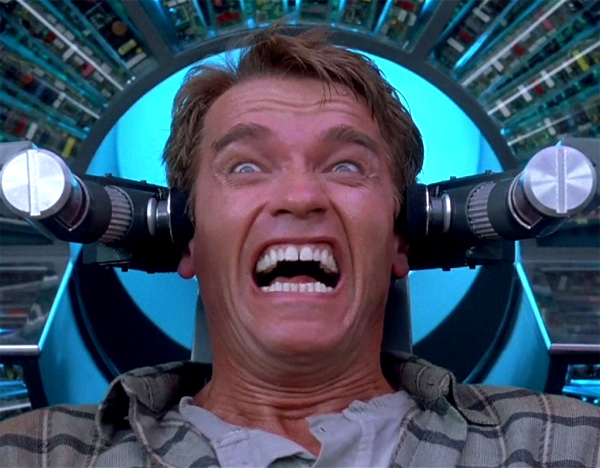
Arnold Schwarzenegger in Total Recall


I should say here that it is possible to incorporate questions about perception and virtual reality into riveting stories. Take, for example, maybe half of the works of Philip K. Dick. Dick may have done such a good job of it because he was genuinely afraid of not being able to distinguish between reality and artificial memories, and he let his real fear come through into his writing.

Friday, December 25, 2015

Bokononist Last Rites

These are the Last Rites of Bokononism. These lines are meant to be spoken by a minister of the faith and repeated by the dying person while the two are engaged in ritual boko-maru.
God made mud.
God got lonesome.
So God said to some of the mud, 'Sit up!'
'See all I've made,' said God, 'the hills, the sea, the sky, the stars.'
And I was some of the mud that got to sit up and look around.
Lucky me, lucky mud.
I, mud, sat up and saw what a nice job God had done.
Nice going, God!
Nobody but You could have done it, God! I certainly couldn't have.
I feel very unimportant compared to You.
The only way I can feel the least bit important is to think of all the mud that didn't even get to sit up and look around.
I got so much, and most mud got so little.
Thank you for the honor!
Now mud lies down again and goes to sleep.
What memories for mud to have!
What interesting other kinds of sitting-up mud I met!
I loved everything I saw!
Good night.
I will go to heaven now.
I can hardly wait...
To find out for certain what my wampeter was...
And who was in my karass...
And all the good things our karass did for you.
Amen.
From Cat's Cradle by Kurt Vonnegut

Friday, December 18, 2015

Google vs. the Family of Philip K. Dick

I knew that Google had a phone called the Nexus that uses the Android operating system. But it wasn't until I recently re-read Philip K. Dick's Do Androids Dream of Electric Sheep? that I put the words "Android" and "Nexus" together and they clicked. 

In Dick's novel (and in the movie it spawned, Blade Runner), the most highly sophisticated androids are called Nexus 6s.

When Google first came out with the Nexus 1 for Android in 2010, the Dick family was already onto them. At the time, the Wall Street Journal reported that Dick's daughter, Isa Dick Hackett, sent Google a cease-and-desist letter warning them not to use the "Nexus" brand name, or a lawsuit would follow.

Google did end up using the name "Nexus," but the issue still wasn't settled even as late as 2014, when Google was actually due to launch the Nexus 6. According to several sources, there was suspicion that Google might call the phone the Nexus X instead of the Nexus 6 because of the legal issues (and, of course, because the phone was a highly sophisticated homicidal android virtually indistinguishable from humans without sophisticated empathy testing).

As Chris Matyszczyk wrote in an article for CNET, the name "Nexus" had to be more than a coincidence, and it was legitimate for Dick's family to call Google to account:

Naturally, one wouldn't dream of accusing Google of having some kind of disregard for intellectual property (facetiousness intended). And the word "nexus" has been used in many contexts. Moreover, just because you're a character in a novel, it doesn't mean you immediately get legal protection. It seems to be one of those nuanced problems that lawyers find lucrative.
The word "Droid," however, was deemed different. It was thought to be so characteristic of the "Star Wars" series that Verizon paid Lucasfilm a fee to license the name.
Perhaps "Star Wars" is simply a more famous movie than "Blade Runner." Perhaps Verizon is trying to be honorable in its business dealings. Perhaps, though, in such instances, it sometimes depends on whose pockets and determination are the deepest.
"You have got to be kidding me," says Nexus-6 Roy Batty.

By the end of 2014, the whole issue was eventually settled out of court with a confidential settlement amount, and Google released the Nexus 6. I hope that Hackett got lots and lots of money to let them use the model name her father invented.

Friday, December 11, 2015

Book Review: Cat’s Cradle (Part II: Writing & Themes)

Kurt Vonnegut
1963
Nominations: Hugo
Rating: ★ ★ ★ ★ –

This post talks about Kurt Vonnegut’s writing and general themes in his work, particularly as used in Cat’s Cradle. For my synopsis of the plot of Cat’s Cradle, please see my last post.

Vonnegut's Style

Vonnegut’s style was very different from what most other authors were doing when he first started publishing novels in the 1950s and early 1960s.

His chapters are tiny—sometimes just a page or two. (Cat’s Cradle, for example, is less than 200 pages long and has 127 chapters.) The chapters also have a tendency to break right in the middle of a conversation or anecdote.

His writing is rapid-fire, hurtling through plot and character development at high speed. And he frequently punctuates his main narrative with side references and little bits of added information that seem totally out of left field but often come up later in unexpected ways. They are always funny without being overly clever. He constantly makes you wonder: how the hell did he think of that?

A clever writing style does not by itself make a person a great author, however. What made Kurt Vonnegut great were the subjects he dealt with, his willingness to lay himself on the line emotionally, and his drive to get to the truth, however painful. And how he tied it all together with a brilliantly dark sense of humor.

Vonnegut's History

Vonnegut did not have an easy early life, and much of his largely pessimistic and cynical outlook was undoubtedly formed by major traumas he experienced in his teens and twenties. He was born in 1922 and when he was still a young child, his parents were all but destroyed, economically and psychologically, by the Great Depression. His mother eventually ended up committing suicide shortly before he was sent off to World War II.

And the war itself was horrific for him, as the Kurt Vonnegut Memorial Library’s biography of the author describes:
When World War II broke out, Vonnegut was 16; at 20, he entered the army and was shipped off to Europe, where he almost immediately was captured by the Germans in the Battle of the Bulge.
He was sent as a POW to Dresden. On February 13, 1945, British and American bombers destroyed the city by dropping high explosives followed by incendiary bombs. The resulting firestorm turned the non-militarized city into an inferno that killed up to 60,000 civilians. Vonnegut and his fellow POWs survived by accident only because they were housed some 60 feet underground in a former meat locker and slaughterhouse.
Vonnegut’s job for weeks after the bombing was to gather up and burn the remains of the dead.
Dresden after the 1945 Firebombing
It is no wonder that Vonnegut wrote so much about the pain of war and the pointlessness of religion, business, and patriotic fervor. And it is no wonder that he was so sensitive to falseness, both large- and small-scale. Vonnegut spent much of his time in his writing trying to strip away artifice and to get to the truth.

Vonnegut's War

War is less of a central theme in Cat’s Cradle than in some of Vonnegut’s other novels, but it still rears its head in significant places.

First, of course, the narrator gets sucked into the San Lorenzan/ice-nine mess in the first place because he is writing a book about the day the atomic bomb was dropped on Hiroshima. He—along with Vonnegut, presumably—wants to know how the intelligentsia of America coped psychologically with what they had done to the people of Japan.

And the ceremony honoring San Lorenzo’s Hundred Martyrs to Democracy is a cynical and, at the same time, heartbreaking take on the hero-worship of soldiers who die in war.

The story of the Hundred Martyrs is that when World War II broke out, one hundred San Lorenzan men volunteered to fight. They all got onto a ship and took off for the war, but a U-boat sunk the ship and all one hundred soldiers died before it even got out of the harbor. Every year since then, San Lorenzo has held a ceremony to honor these heroes in which cardboard cutouts of world dictators are floated in the harbor and shot at by San Lorenzo’s six war planes.

After learning about the ridiculousness of both the martyrs’ deaths and the ceremony honoring them, we are prepared for total buffoonery at the ceremony itself. But instead we are forced to come face to face with the true awfulness of it all by the U.S. Ambassador to San Lorenzo, who says in his speech:
    “We are gathered here, friends,” to honor…children dead, all dead, all murdered in war. It is customary on days like this to call such lost children men. I am unable to call them men for this simple reason: that in the same war in which [these martyrs] died, my own son died.”
    “My soul insists that I mourn not a man but a child.”
    “I do not say that children at war do not die like men, if they have to die. To their everlasting honor and our everlasting shame they do die like men, thus making possible the manly jubilation of patriotic holidays.”
    “But they are murdered children all the same.”
    “And I propose to you that if we are to pay our sincere respects to the hundred lost children of San Lorenzo, that we might best spend the day despising what killed them; which is to say, the stupidity and viciousness of all mankind.”
Vonnegut's Religion 

Religion is much more prevalent than war as a theme throughout Cat’s Cradle. Vonnegut’s vehicle for talking about it is Bokonon, San Lorenzo’s local holy man, a former sailor and somewhat questionable figure who, after being marooned on the island, created his own irreverent and unholy religion.
   
The Books of Bokonon, which Vonnegut’s narrator John learns about on the flight to San Lorenzo, are a series of parables and lessons in the form of calypso songs. They tend to reflect on the ridiculousness of life and to send the message that the only thing that is really holy is humankind itself.

The General Electric Company Board
Bokonon teaches that everyone belongs to a karass: a group of people with whom you are cosmically connected and are fatalistically destined to do God’s will, whether you want to or not. He also teaches that people often try to create artificial karasses, which he calls granfalloons, which are groups that people think are significant but which really have zero meaning on a cosmic scale. Examples of granfalloons, groups that appear to be meaningful but which are not, are: the General Electric Company, Cornell alumni, and any country at all. 

Vonnegut's Truth

Vonnegut had a real distaste for falsehoodfrom the big lies told by churches, corporations, and countries to get people to do what they want, to the little white lies told by individual people to make themselves look and feel better.

On the large scale, Vonnegut's shredding of both war heroism and religion is an expression of his general struggle to cut through these lies. Through the stories of the Hundred Martyrs and the Books of Bokonon, Vonnegut shows us that much of what we revere is self-deception; we are desperate to feel like we are part of something big and important, so we construct institutions to convince ourselves that we are.

And on the small scale, his characters usually seem pretty normal at first but then, through seemingly innocuous conversations and throw-away remarks, piece by piece, he reveals their odd and often depressingly sad backstories. Supposedly happy marriages turn out to be shams; supposedly successful people turn out to feel like tremendous failures; supposedly tight-knit families turn out to be full of tension.

In fact, the people who openly admit from the start that they are liars—like Bokonon and Newton Hoenikker—end up being the only truly honest people in the book. Bokonon admits that everything he says is a lie—and therefore Bokononism is the only religion John feels he can believe in. And Newton illustrates the destructiveness of untruth with a story about how his father at one point became obsessed with cat’s cradle, the string game. His father kept waving the cat’s cradle in Newton's face and demanding that he pay show some interest. Newton explains how confusing this was for him as a child, and how this kind of thing would teach a kid to doubt what he sees:
    “One of the oldest games there is, cat’s cradle. Even the Eskimos know it.”
    “You don’t say.”
    “For maybe a hundred thousand years or more, grown-ups have been waving tangles of string in their children’s faces.”
    “Um.”
    Newt remained curled in the chair. He held out his painty hands as though a cat’s cradle were strung between them. “No wonder kids grow up crazy. A cat’s cradle is nothing but a bunch of X’s between somebody’s hands, and little kids look and look at all those X’s…”
    “And?”
    “No damn cat, and no damn cradle.”
And, indeed, for Vonnegut himself, the more blatant and ridiculous he is with his lies in his writing, the more believable he is. It is his mission to peel the onion, to strip away the false fronts his characters put on until we are left with the bare and painful but also honest and funny truth.

Cat's Cradle String Game
It is distressing, but it also feels right. It feels better to come to grips with the truth, however depressing, than to carry on the ridiculous and always even more pathetic lies people tell to cover it up.

Vonnegut's Humor

All of this is pretty heavy stuff, of course. But Vonnegut’s books are never too heavy to read because of his biting, sarcastic, cynical wit. His dark humor is present throughout all of his writing, from silly acronyms and funny names to the embarrassing ways people die and the tremendous effort people put into pointless tasks.

On the surface, his humor might make it seem like he is being flippant about really serious subjects. But his flippancy and his deadpan delivery actually make the serious issues even more horrifying than if he had tried to present them seriously.

Vonnegut could not look at life in anything other than a clear-headed, unvarnished way. This was a blessing for his readers but was probably a curse for him. Given the overwhelming depression that he experienced at times, it is amazing that he was able to create stories with such humor in addition to such insight. It is a measure of his genius that he was able to make us look directly at such difficult topics, and make us question our own assumptions and actions, and make us laugh while he was doing it.

From The First Book of Bokonon:

     In the beginning, God created the earth, and he looked upon it in His cosmic loneliness.
     And God said, “Let Us make living creatures out of mud, so the mud can see what We have done.” And God created every living creature that now moveth, and one was man. Mud as man alone could speak. God leaned close as mud as man sat up, looked around, and spoke. Man blinked. “What is the purpose of all this?” he asked politely.
     “Everything must have a purpose?” asked God.                                 
     “Certainly,” said man.
     “Then I leave it to you to think of one for all this,” said God. And He went away.

Friday, November 27, 2015

Book Review: Cat's Cradle (Part I: Story & Review)

Kurt Vonnegut
1963
Nominations: Hugo
Rating: ★ ★ ★ ★ –

This week’s post contains a synopsis of the plot of Cat’s Cradle and a short review of the book. In my next post I’ll talk a bit about Vonnegut’s style and recurring themes in his work.

As authors go, Kurt Vonnegut is one of my all-time favorites. His writing is witty, dark, cynical, honest, and courageously personal. He used his books to express his feelings about the heavy issues that preoccupied him—war, religion, and the general futility of human endeavor—and he did it with narratives that are completely depressing and totally hilarious at the same time.

As with many of Vonnegut’s novels, many of the character details in Cat’s Cradle are autobiographical. The main character and narrator, John, is a writer (like Vonnegut) originally from Indiana (as was Vonnegut) who attended Cornell (as did Vonnegut). John is a little bit obsessed with World War II (as was Vonnegut). He wants to write a book about what important Americans were doing the day the United States dropped the atomic bomb on Japan.

One of these important Americans is Felix Hoenikker, one of the fictional fathers of the bomb. John writes letters to Hoenikker’s three children, who all turn out to be very quirky people. The daughter, Angela, is a six-foot-tall extreme social introvert married to a former lab assistant of her father’s who now works in a secret government factory. The oldest son, Frank, has somehow become second in command to “Papa” Monzano, the dictator of an isolated, infertile, poverty-stricken island in the Caribbean called the Republic of San Lorenzo. And the youngest son, Newton, is a four-foot-tall layabout who dropped out from Cornell before graduating (as did Vonnegut). “Newt” is the only one of the three who writes John back, and he provides juicy information about not only his father but also his two siblings.


Meanwhile, through other lines of research, John learns from Hoenikker’s former supervisor that one of the non-bomb-related projects Hoenikker had been working on was a substance called ice-nine, which was designed to make liquids freeze at temperatures up to 130° F. The motive behind developing ice-nine was so that Marines would no longer have to slog through mud; when they encountered a section of mud they would otherwise have had to slog through, they could drop the ice-nine into it and the entire mud puddle would become solid.

The supervisor was using ice-nine as an example of the way Hoenikker worked, single-mindedly obsessing about projects even when they were physically impossible. Or so he thought. He didn’t realize that Hoenikker had actually succeeded in creating ice-nine, and that each of Hoenikker’s children had a thermos of it.


Ice-nine works by teaching other water molecules that are touching it how to freeze in a different way, at a higher temperature than normal ice. Once the molecules next to the original piece of ice-nine are frozen, they in turn teach the molecules next to them how to freeze at that higher temperature as well. The problem is that the chain reaction is unstoppable. If someone were to drop a piece of ice-nine into any body of water, anywhere, it would make that water freeze… and any streams or rivers next to that water would freeze… and any bodies of water touching those streams or rivers would freeze… and so on until every bit of water on earth was frozen.

In other words, it’s a bad idea to use it. Which is why the Hoenikker children keep it secret, locked in their thermoses, and bring the thermoses with them where ever they go.

Anyway, in a typically Vonnegutian series of coincidences, John becomes rapidly wrapped up in the Hoenikker family’s adventures, and, eventually, because of the ice-nine in the Hoenikker childrens' thermoses, the fate of all of humanity:


First, John gets assigned to write a newspaper story about a philanthropist who lives on the Republic of San Lorenzo. He ends up on a flight to the island along with the new U.S. ambassador to San Lorenzo and his wife, a bicycle manufacturer and his wife, and Angela and Newton Hoenikker, who are there to attend their brother’s wedding to “Papa” Monzano’s daughter.

John socializes with all of them (sometimes uncomfortably) during the flight, which leads to him being swept up in the ambassador’s entourage, invited to a ceremony at the palace to honor San Lorenzo’s World War II heroes, and eventually offered a job as successor to dictator “Papa” Monzano.

                                
Eventually, too, John learns that the ice-nine isn’t really a secret, and that practically everyone knows about it—including the CIA, the Soviets, and “Papa” Monzano. And, of course, by the end of the novel the ice-nine comes inevitably, ridiculously, horrifyingly, disastrously out of the bag (or thermos).

As a story, Cat’s Cradle is not one of my absolute favorites of Vonnegut’s novels. There are others in which I felt more of a connection to the characters; the people in this book, even including narrator John, are all somewhat aloof. 


But it is still one of his most potent books for me, delivering its anti-war, pro-humanity, we-are-all-fatalistically-doomed messages in the striking, succinct, and funny way that all of his best work does. Cat’s Cradle was also the first of Vonnegut’s books that I ever read, when I was very young. And it made a huge impression on me.

First, the concept of ice-nine was extremely powerful. I couldn’t stop thinking about it: the idea of what would happen if something like that really existed and got into the water system, quickly zipping out like icy tentacles freezing tributaries and rivers and oceans until everything was ice. It's brilliant and terrifying.

Second, and more importantly, I had never yet read anything that had such an irreverent, hysterical take on serious issues like war and religionand yet still clearly took those issues very, very seriously. It felt more genuine and made its points better than any other more moralistic work I had read covering the same topics. He made me feel like I was laughing maniacally with him as we were falling off the edge of a cliff.

Friday, November 6, 2015

Book Review: Blackout

Seanan McGuire (writing as Mira Grant)
2012
Nominations: Hugo
Rating: ★ ★ ★ – –

BEWARE… SPOILER ALERT FOR FEED, DEADLINE, AND BLACKOUT.

And at last we arrive at Blackout, the third and final novel in Mira Grant’s Newsflesh trilogy.

Blackout has most of the same pluses and minuses as Deadline. It has the same engaging post-zombie-apocalypse setting and the same appealing cynicism and irreverence in its main characters. It’s got the same witty writing style, which is mostly still fun to read but at times, in this third book, seems to be getting a bit sloppy.

It has the same annoying conversational techniques for attempting to draw out the suspense. It has the same crazy Shaun hearing Georgia’s ghost in his head, and the same unnecessarily disruptive commentary about it. And the plot seems similarly haphazard and forced, especially when it comes to Shaun’s story line and the motivations of the evil CDC.

But at least Georgia is back, in the flesh, which makes a huge difference for the good. Georgia is by far the best character and narrator Grant has got, and it’s great to have her again.

Blackout picks up where Deadline ended, with Georgia waking up in a cell in a CDC facility. She quickly figures out that she is a recently-awakened clone of her original self with all her memories intact, right up to the moment Shaun shot her in the back of the head when she was about to turn into a zombie.

Aside from confirming that she is a clone, the CDC staff won’t tell her anything; they won’t tell her where she is or what’s going on or even let her go to the bathroom without an escort. But through secret messages passed to her she finds out that the EIS—the Epidemic Intelligence Service, a subdivision of the CDC—has undercover agents inside the CDC and that they are working on a plan to break her out.                

The EIS agents show her other Georgia clones being grown in the lab and explain that she’s just one of many. The CDC is trying to build a malleable, docile version of her that will do what they say, and then they will use that clone to lure Shaun in and imprison him. She herself is too much like the original Georgia, inquisitive and rebellious, so she is on a time limit. Once they are able to build a more brainwashable clone, she will be “decommissioned.”

She is also able to find out one key thing on her own. Her CDC doctors let her walk for exercise in an agricultural biodome attached to the facility, which, because of her knowledge of CDC installations, lets her know that she’s in Seattle.                                                                              

Meanwhile, her brother Shaun and the rest of the After the End Times blog staff are hiding out from CDC security at Dr. Abbey’s CDC-blacklisted lab in Oregon. Their main goal is the same as it was in Deadline, which is to find out why the CDC wants to kill people who have Kellis-Amberlee reservoir conditions when they are the best hope for adaptive immunity, and to publish the answer online for the entire world to know.

And Dr. Abbey also wants to know more about the Cuban mosquitoes that are now spreading Kellis-Amberlee through Florida. The virus is too large for a normal mosquito to carry, which suggests that the Cuban species was deliberately bred.                                                           

What follows is a series of contrived misadventures designed to get Shaun and Georgia back together so they can pursue the truth as a team again. It starts with Dr. Abbey sending Shaun and Becks on a mission to Florida to try to get a sample of the mosquitoes, so she can do genetic testing to find out where they came from. Shaun and Becks make the mistake of stopping first at his adoptive parents’ house in Berkeley to get a map—a questionable plan in the first place—only to find that the Masons have told the CDC they were coming. They escape from the CDC police and flee from Berkeley, not to Florida, but instead to…

…Seattle, of course, where they meet up with Mahir and Maggie, who have gone up there to get fake IDs from a shady character called “The Monkey.” The Monkey agrees to give them IDs if, conveniently enough, they first break into the Seattle CDC and plant bugs for him.

At this point, the EIS determines it is time to enact Georgia’s escape. They have just surgically removed all her tracking chips and self-destructing bio-bombs when Shaun’s invading team causes the CDC to go into lockdown. The EIS doctors think that the lockdown is because of them, and stay to distract security while sending Georgia off in the direction of the exit, where she runs smack into Shaun without either of them running into any CDC staff first.

After fighting off a horde of zombies and at least two more CDC security detachments, they make their way back to Dr. Abbey’s lab, where it is determined that they really need to go all the way to Washington, DC, to ask the president the truth about Kellis-Amberlee and the mosquitoes and all that.

When they finally make it in to see the president, he is, of course, there with an evil CDC doctor who tells them the truth about Kellis-Amberlee and the mosquitoes and all that, and then tries to enlist them into his evil PR machine to keep it secret. And, of course, when it turns out they won’t keep it secret, he tries to kill them, and they, the president, vice president, and a bunch of Secret Service agents have to escape by shooting their way out of the White House through another horde of zombies.

A bad guy whose motivation
I can understand
The main issue I had with Blackout, as with Deadline, is that I just do not buy the bad guys’ motivation. Usually bad guys are motivated by money, revenge, religious fervor, or a desire for world domination, all of which I can completely understand. But these CDC guys seem to really be doing what they’re doing because of an always vaguely and often incomprehensively articulated societal benefit argument that doesn’t have much convincing pull. I don’t understand how they could have been willing to spend millions of dollars and kill people, much less die, for their cause.

I’ve read and re-read the sections of Deadline and Blackout where the bad guys explain themselves. From what I can piece together, their thinking seems to go like this:

  • In a very, very small minority of cases, some people with reservoir conditions can either develop immunity themselves, or convey immunity to people who are close to them.
  • The CDC doesn’t want to tell people that there is a tiny possibility that some people with reservoir conditions could recover or that some people might be immune, because then people will hesitate to pull the trigger when somebody amplifies, and then more people will die. Most of the time the person will turn into a zombie and then will turn around and eat the person who should have pulled the trigger.
  • So, for the time being, they are killing people who have reservoir conditions.
  • They think they will eventually find a strain of Kellis-Amberlee that doesn’t cause reservoir conditions. When they do, they want to infect the entire world with it.
  • The genetically-engineered mosquitoes were supposed to be their distribution method, once they came up with a strain they liked. But they got out too early. So, oops—they killed millions of people on the U.S. Gulf Coast.

Killing people who have reservoir conditions seems like way too much of a leap, even for crazed evil CDC doctors. I cannot believe they would really do that just based on the fear that knowing that people have the potential to be immune would lead to a few more deaths by recently-turned zombies. How about developing a test for immunity instead? Maybe that would be easier than having a secret cloning program and a secret mosquito genetic modification program and finding subtle ways to kill thousands of innocent U.S. citizens?

Early on in Blackout, Georgia observed, almost in passing, that the CDC was keeping people controlled “through unnecessary security and exaggerated fear.” We see this in real life all the time when we are required to go through blood tests or loyalty tests or other security checks to go about our normal business, security checks that are more stringent and intrusive than the real odds of danger would warrant, as a way to keep us as a population cowed and obedient. There would be plenty of potential for realistic governmental evil and oppression by means of security theater; it seems like maybe that would have been a ripe area to explore further, instead of the medical mumbo-jumbo.