Friday, March 5, 2021

Book Review: Room to Swing

Ed Lacy
1957
Awards: Edgar
Rating: ★ ★ ★ ★ –

This novel just goes to show that you can’t judge a book by its ridiculous cover – or its teensy size.

It proves that just because a book is short (a tidy 128 pages) and just because it went out of print and had to be resurrected by a tiny publisher who obviously scanned in the original text and then didn’t edit it afterwards so that there are typos, skipped sentences, and "& pound; s" scattered throughout the text, and whose extensive cover design consisted of reprinting a tiny picture of the original 1957 cover artwork (shown here) surrounded by an enormous plain black border, and who jammed the text so close to the tops of the pages that the headers and page numbers are practically cut off, doesn’t mean it can’t be action-packed and establish great characters.

The plot is tried-and-true mystery fare: the main character, Toussaint Moore, is a New York detective hired to track a man who quickly winds up being murdered. Moore is the first to find the body and is of course mistakenly accused of the crime; he then has to solve the murder in order to prove his own innocence.

I loved Moore’s style. He doesn’t take any guff and doesn’t go out of his way to make other people feel comfortable. He is abrupt, snappy, and slangy, like Raymond Chandler's Philip Marlowe at his best. But Moore is also human, and his fears are plain.

Lacy’s writing is fast-paced, clear-headed, and straightforward–which is the only way the book can be this complex and this short and still work. I liked that he starts by dropping you right smack in the middle of the story, so you have to put the background together for yourself as he gives it to you. And what I liked even more was that you got the clues and solved the mystery at the same time Moore does. It seems like this might make it less suspenseful, but it actually makes it more so.

What makes this novel unique for 1957 is that Moore is black. (He is, in fact, described on the back of my copy of the book and in several reviews as “the first credible black detective” in popular mystery fiction.)

For Moore, a black detective in the ‘50s, racism is never far away. Especially when most of the people he has to deal with in the story are white, including the people who hired him, the police who are chasing him, and the man he was trailing and is accused of murdering. This is a constant additional tension, to say the least, that a white detective would not have had to cope with.

In the course of solving the crime, Moore ends up traveling from New York to Bingston, Ohio, a small town just north of the Kentucky border. The contrast is educational for him. Bingston is plainly, overtly racist; Moore can only make phone calls from certain gas stations, can't eat at the cafeteria or stay at the hotel, and is constantly called “boy” and treated with hostility.

New York is certainly better than Bingston on the surface; black people have a wider choice of professions, have at least the legal right to eat and lodge anywhere they want, and night clubs often have both black and white patrons. (It even has out-of-the-closet Lesbians (capitalized), whom, by the way, Moore is totally okay with.)

But even with the most “liberal-minded” white New Yorkers, Moore constantly walks a tightrope of behavior, judging when to put up with insensitive remarks or outright insults and when to defend himself. And he still has to fight the pressure, even from his girlfriend and his own pesky conscience, to give up his risky detective agency venture and run to a safe civil service job.


An earlier version of this review originally appeared on Cheeze Blog.

Friday, January 8, 2021

Book Review: The Hours Before Dawn

Celia Fremlin
1958
Awards: Edgar
Rating: ★ ★ ★ ★ –

This was an unexpectedly enjoyable and well-crafted book. It was scary and suspenseful but also funny. And it did not disappoint at the end. 

The book takes place in 1950s London. The main character is Louise, a harried housewife and mother with a new baby who can never get enough sleep so she is constantly tired and making mistakes and losing things (including her baby). 

To earn some extra money, Louise and her husband take in a boarder who appears at first to be a mild-mannered schoolmistress but who becomes more and more sinister throughout the story.

I love the way Fremlin writes: very matter-of-fact-ly. She is sympathetic to Louise and her family but also shows their faults. She has surrounded Louise with neighbors and "friends" who constantly gossip and criticize and offer advice, but who never are actually any help. Among the "friends" are some "progressive" mothers who advocate the latest in child care (which in the '50s apparently means being as uninvolved as possible and leaving it up to your neighbors to feed and entertain your children). It all creates a perfectly crafted atmosphere of stress and chaos that makes Louise feel like she's going off her rocker.

Many of the Edgar award winners I have read start out strong, with a great and original idea, but then falter. This one does not have a super-original plot, but it was engrossing and satisfying right up to the very last sentence.


An earlier version of this review originally appeared on Cheeze Blog.

Friday, November 13, 2020

Book Review: The Eighth Circle

Stanley Ellin
1958
Awards: Edgar
Rating: ★ ★ ★ – –

The cover of the 1959 paperback edition of this book makes it look like a trashy piece of pulp fiction. It has a drawing of the main character, handsome private detective Murray Kirk, being leaned on by a lovely young lady who is half out of her satin dinner dress and matching heels. A block of text next to the pair describes the book as “a story about the special world of a private detective.”

But it’s actually a perfectly decent detective story.

And, as far as I could tell, Kirk never actually sleeps with any of the ladies he runs across. Not one. Oh, sure, one falls asleep on the rug in front of his fireplace and stays the night there, and he has to help another off with rain-soaked clothes and warm her up in his shower to prevent her from passing out from the cold, and there is certainly a lot of racy talk and innuendo, but no major hanky-panky.

And not only that, but the case doesn’t revolve around a murder; it’s just a book-keeping scandal. And I think only one or two of the bad guys even has a gun.

What happens is that Kirk, who runs a successful detective agency in New York, gets personally involved in a minor case, the arrest of a policeman accused of taking payoffs, because he’s madly in love with the cop’s fiancée. He’s hired by the cop’s lawyer to dig up information that will prove his client’s innocence, but he actually hopes that his client is guilty so the fiancée will call it off and go out with him instead. Of course the case gets extremely complicated and pulls in plenty of characters from both high society and the unsavory underworld.

While it wasn’t fantastic, it was generally a well put-together, mostly page-turning mystery. It definitely stayed true to its genre and vintage; I wouldn’t read this book expecting anything unusual or stereotype-flouting.

For the most part, I liked Kirk. He doesn’t always guess right about clues and certainly has bad days. He’s no-nonsense and savvy but not quite as hard-boiled and gruff as, say, Philip Marlowe. He’s a little slicker than that. He’s also relatively kind to the women in his life (for a 1950s P.I.).

The men, both good and bad, are pretty well developed characters. The women, on the other hand, are completely one-dimensional. Each one is absolutely beautiful and in dire need of his help except for his (naturally) super-efficient, loyal, middle-aged secretary (who used to be absolutely beautiful).


This review originally appeared on Cheeze Blog.

Friday, September 18, 2020

Book Review: The Progress of a Crime

Julian Symons
1960
Awards: Edgar
Rating: ★ ★ ★ – –

This book is not a stereotypical murder mystery with a lot of drama and gore. As advertised, it follows the progress of a crime very closely and realistically, from the murder to the trial of the chief suspects. You experience the investigation from the point of view of several people trying to figure out what happened – reporters, policemen, and lawyers. Sometimes they get information through good detective work, and sometimes they get it accidentally. You find out what they know as soon as they know it, and you put the story together with them.

The story had twists that I did not expect, precisely because the twists were caused by what would happen in real life – people being confused, people saying things inarticulately, people not knowing quite what they want or what they are doing.

The story is set in a small city outside of London. A gang of youths acts rowdy and gets thrown out of a dance by a prominent local citizen. A short time later, amid the confusion of a Guy Fawkes Day fireworks and bonfire celebration, the youths come back and manage to stab the prominent local citizen to death. It so happens that Hugh Bennet, a reporter for the local paper, was covering the Guy Fawkes Day bonfire when the murder happened. He thus simultaneously becomes not only an investigator of the crime but also a witness to it.

Bennet isn’t a typical lead character; he is unsure of himself and gets confused like any normal human being. He is a relatively new reporter and tends to romanticize his editor, his job, and his co-workers. He becomes disillusioned with them when a big-time reporter from a London paper comes out to cover the case and gives him a little more perspective. Then, in turn, he gets disillusioned by the big-time reporter as he learns more about his world.

Bennet’s girlfriend is a real person as well; she gets frustrated and doesn’t always act in the best or most attractive way.

The lead detective on the case, Twicker, mishandled a previous case and Scotland Yard has given this one to him as a sort of a test. I thought the whole time it was going to be a stereotypical Hollywood-type story where he was going to pull it out of his hat and dramatically redeem himself to the Yard but, as with everything else in this book, things don’t always go exactly as Hollywood would have you expect.

The lawyers for the prosecution and the defense are charismatic characters but they're not superhuman or brilliant like the ones on Law & Order. They have moments where they shine and moments of trouble, and none of them care particularly about the boys they are prosecuting or defending; they care primarily about their jobs and reputations.

The case does make many of the characters reevaluate their lives and their careers, especially Bennet. But it doesn't tie up neatly or end terrifically happily for everyone. Things come out better for some, worse for others; some find their resolution depressing and others try to make the best of theirs. Just like real life.


This review originally appeared on Cheeze Blog.

Friday, July 24, 2020

Book Review: Beast in View

Margaret Millar
1955
Awards: Edgar
Rating: ★ ★ ★ – –

This murder mystery takes place in Los Angeles in the 1950s. A wealthy, antisocial woman, Helen Clarvoe, starts getting weird, threatening phone calls from an old acquaintance. The calls scare her, so she hires her family’s financial advisor, Mr. Blackshear, to try to find out who is calling her and why. This leads Mr. Blackshear on a nice investigation in which he uncovers all sorts of interesting secrets about Helen’s past and the other members of her family, and during which one of the people he is investigating commits suicide and another is murdered.

What I liked about this book most of all was the author’s clear, straightforward style. It was a pretty complicated story, and Millar certainly doesn’t use a simple vocabulary, but her writing is nevertheless easy to read. She is not deliberately obscure or pretentious or too obvious about trying to create suspense.

The book was also small, a tidy 156 pages. I think that Millar knew the story she wanted to tell and didn't feel that she needed to add a lot of unnecessary fluff around it. Which I appreciate.

I also enjoyed reading a mystery about post-war non-Hollywood society in Los Angeles by somebody with a very different take on it than Raymond Chandler.

One notable aspect of this book is that one of the key characters, Helen’s brother Douglas, is gay. I thought that his character was handled amazingly well, considering that this book was written in 1955. Douglas is a full, complex person, not a monster or a silly stereotype. And when his mother finds out and wants to take him to a clinic to get “cured,” he explains to her (and the reader) that this is a part of who he is and it isn’t anything that he can be cured of.

The back cover of the 2000 edition of this book advertises that it pulls the main characters into a world of “extortion, pornography, vengeance, and murder." I don't know if it's really all that exciting, but it was a good read, with a clear style and plot twists that kept me interested through to the end.


An earlier version of this review originally appeared on Cheeze Blog.

Friday, May 29, 2020

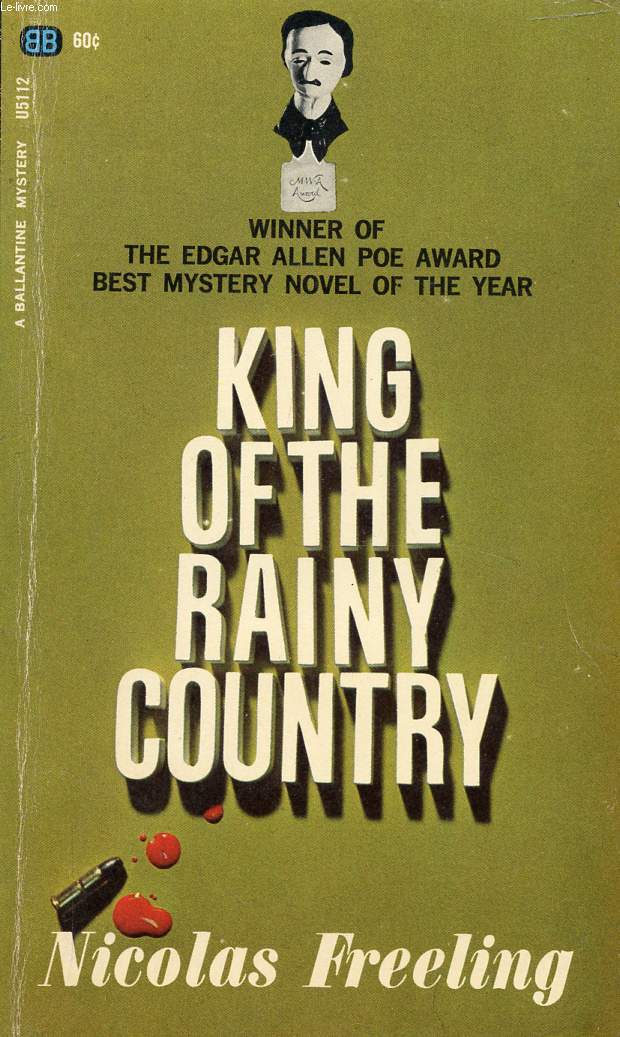
Book Review: The King of the Rainy Country

Nicolas Freeling
1966
Awards: Edgar
Rating: ★ ★ – –


This book is a detective story along the lines of Raymond Chandler, but it takes place in Europe instead of Los Angeles.

The main character, Van der Valk, is a police detective from Amsterdam who gets assigned to track down an eccentric millionaire who has run away from home. The hunt involves a lot of competitive skiing and car chases through the Austrian alps, west across France and finally down to the western border with Spain.

Throughout the book Van der Valk endeared himself to me by comparing himself to Philip Marlowe and James Bond and other fictional detectives that he felt he should be more like, but wasn't. 

I liked the story a lot but sometimes it was a struggle for me to follow Freeling's writing, what with all of the author's European 1960s-era historical and literary allusions. I read it with Wikipedia at hand and it was quite an education. 

For example, I didn't know that bleach was originally called "eau de Javel," after the town where it was first invented. Or that "blackwater" is an awful complication of malaria that brings on chills and jaundice. I learned that the gentian flower can be used to flavor liqueur and that Lethe is the name of the river of forgetfulness in Hades. I also got to learn all about the "Incident at Mayerling," an 1889 murder-suicide scandal involving the heir to the Austrian empire, and about an infamous bloodbath of a battle that was fought in the French town of Malplaquet during the War of Spanish Succession.

It's a fun read, but be prepared to pull out the encyclopedia.


An earlier version of this review originally appeared on Cheeze Blog.

Friday, April 3, 2020

Book Review: All the Birds in the Sky

Charlie Jane Anders
2016
Awards: Nebula, Locus (Fantasy)
Nominations: Hugo
Rating: ★ ★ – – –

All the Birds in the Sky is a story in the old traditional pattern of boy meets girl, boy loses girl, boy and girl become central figures on opposing sides in a potentially world-ending conflict. It had a lot of potential, and certainly some funny, endearing, and dramatic moments. But, on the whole, it did not wear as well as it might have.

The novel is the story of two kids, both outcasts, who meet in elementary school and become frenemies. Patricia is a nascent witch who loves the outdoors and, at least at one point, learns how to talk to birds. Laurence is a techno-nerd who is building an artificial intelligence in his bedroom closet. Their parents are hopeless and the other schoolchildren taunt them both mercilessly.

Saddled with talents they don’t yet know how to control, they struggle through junior high and high school, unaware that they’re being stalked by a ninja assassin posing as their guidance counselor, whose plots they keep escaping by accident.

Eventually they each respectively find groups of people who understand and support them, and who train them to focus their powers in productive but opposing directions. In Patricia’s case, it is a group of witches, and in Laurence’s case, it is a group of astrophysicists working for a multizillionaire inventor patterned a little too obviously after Elon Musk.

Both Patricia and Laurence are trying to solve the problem of global climate changes from their own angles. But Laurence’s team’s experiments go horribly wrong and send one of his co-workers into another dimension of space-time. Patricia helps him out by rescuing the co-worker with witchcraft, but her help, as is the case with most powerful spells, comes with unintended consequences, and unintentionally ratchets up the simmering tension between Laurence’s team and the team of witches.

Eventually the whole thing culminates in a somewhat contrived apocalyptic battle royal of magic versus science, with Patricia and Laurence on opposite sides. The fate of the Earth hangs in the balance while they try to figure out how to end the conflict and how to admit how they feel about each other.

As a coming-of-age romance, it is generally effective and enjoyable. As a science fiction story of an Armageddonish duel between two formidable sides, it is wanting.

There are certainly funny episodes in the book. The first time the birds talk to Patricia is hilarious. And it’s amusing when Patricia jokingly identifies their guidance counselor as an assassin based on his shoes, because, of course, he really is an assassin.

But the way the kids think and talk doesn’t always ring true or consistent; in particular, Laurence is a little too precocious and snarky when he talks to his parents, compared to the way he talks and thinks the rest of the time. Anders also tries just a little too hard to be funny in Laurence’s internal dialog, and most of the time it ends up clanking, like when he interprets his dinner as “turnip slurry.” (FEED author Seanan McGuire does this sort of thing much more skillfully, in a somewhat similar genre with somewhat similar main characters.)

The wealthy inventor Laurence works for is a little too obvious a carbon copy of Elon Musk. Anders relies too much on the cleverness of the very slight changes she makes to his image and company, rather than using him as inspiration and putting her own unique twist on the character.

And although Anders puts all she has into the Transformers/monster-movie-style climax, it is more workmanlike than actually exciting. In general, the backstories of the kids—especially Patricia—and the ramp up to the final confrontation are more interesting than the confrontation itself. In the end, I'm afraid to say that the book falls disappointingly flat.

Friday, February 7, 2020

Book Review: Project Pope

Clifford D. Simak
1981
Nominations: Hugo
Rating: ★ ★ ★ – –

I like Clifford Simak’s novels a lot, and I think part of the reason might be because he started out as a journalist. His writing is clear and accessible without being simplistic. His main characters tend to be thoughtful loners who still care about other people. And he is able to use his kind, thoughtful little stories to raise big questions about big topics, without being didactic about it.

Project Pope’s big questions all revolve around the reconciliation of faith with science in the search for truth. And as a framework for these questions, Simak invents a paradoxical thing: a society of robots trying to build a religion.

The actual plot is a little peculiar. There are certainly moments of violence, danger, and even at least one murder. But his main characters are generally trying to do the right things even if they mess up sometimes. And even though they face threat, they face it with kindness and an earnest interest in puzzling out the solution.

---

The book starts with a pretty darned exciting scene. On the remote planet of Gutshot, doctor Jason Tennyson has just run afoul of the law for the crime of having his boss, a city bigwig, happen to die on his watch. In a daring escape, he stows away on the next vessel leaving Gutshot’s spaceport, which turns out to be headed to the planet End of Nothing.

As the name would suggest, End of Nothing is the most remote planet in the known galaxy. And, for that reason, it was chosen by a group of cast-off robots from Earth to be the site of their project to create a new robot Vatican, complete with a robot Pope.

On Earth, robots were forbidden from developing their own religion So the ones who founded End of Nothing are extremely skittish about visitors and publicity, and this has piqued the interest of the only other human passenger on Tennyson’s ship, reporter Jill Roberts. Having received no response to her many written requests for information from the new Vatican, she is headed there in person to get some answers.

When they arrive at the End of Nothing, one of the human residents has had a severe accident, and the only human doctor there has recently died. So the robots, who don’t ask too many questions about legality anyway, ask Tennyson to stay and be their new doctor. He assents, not having too many other options. And, in an attempt to make things more palatable for Tennyson and to co-opt Roberts, they offer her a position as Vatican historian.

Roberts and Tennyson learn that the new Vatican employs a select group of semi-telepathic humans as sort of cosmic scouts; these people are able to travel in their minds to other worlds, and they do so, searching one world after another for Heaven.

They do this in service of the new Pope, who is convinced that religion can be derived from science. He believes that if he is able to search wide enough and far enough, he will discover the physical location of Heaven, and then he will be able to have a scientific basis for his faith.

But there is an underground faction of robots that believe that this is the wrong way to approach it; that faith must come first, and science must come after. This is the fundamental tension of Project Pope: the conflict between robots who believe faith must be derived from science, and those who believe science must be derived from faith. And, unbeknownst to our main characters or the Pope, both sides have adherents that are willing to make deadly cases for their beliefs.

While this dispute is simmering, Tennyson strikes up a friendship with Decker, a cabin-dwelling loner who has been on End of Nothing for most of his life, and Decker’s close companion, a sparkly trans-dimensional being named Whisperer that can also itself travel telepathically to other worlds. Whisperer takes Tennyson and Roberts on several journeys to meet the various wacky inhabitants of different worlds, and there they make the acquaintance of a group of aliens that look like giant dice that can print mathematical equations on their surfaces.

Eventually, one of the Vatican’s scouts finds Heaven--or is at least convinced that she has. She suffers a nervous breakdown as a result, but Whisperer is able to read enough of her mind to trace the scout’s journey back to the world she thought was Heaven, and to bring Tennyson and Roberts there.

What they discover there is not actually Heaven but instead a strange city world peopled by a motley group of aliens--including a duplicate of Decker, a furry alien shaped like a haystack, and an octopus-being that constantly plops up and down making a sound like liver being slapped on a countertop. One of these creatures turns out to be one of the faith-firsters, and it is determined to destroy Heaven, and possibly the rest of the universe along with it, by blowing itself up. There is a simultaneously tense and funny climactic scene in which Whisperer, Tennyson, and Roberts are able to avert catastrophe by bringing in their equation-surface-dice friends, and everybody lives, if not happily ever after, at least to see another day, albeit with lingering questions about God, the Devil, Heaven, and the nature of the universe.

---

In the introduction to her novel The Left Hand of Darkness, Ursula LeGuin explained that the great thing about descriptive science fiction is that each piece is a “thought-experiment.” She said:
In reading a novel, any novel, we have to know perfectly well that the whole thing is nonsense, and then, while reading, believe every word of it. Finally, when we're done with it, we may find - if it's a good novel - that we're a bit different from what we were before we read it, that we have been changed a little, as if by having met a new face, crossed a street we never crossed before. But it's very hard to say just what we learned, how we were changed. 
The artist deals with what cannot be said in words. The artist whose medium is fiction does this in words. The novelist says in words what cannot be said in words.
To some extent, Simak does this with Project Pope. It is not the world’s greatest piece of science fiction. But, at the end, if he has done his job for you, you wind up having enjoyed a somewhat quirky story about robots and aliens, while also simultaneously engaging your mind on questions that might not otherwise be easy to conceptualize. Is it better, he asks, to search for universal scientific truths, and to allow religious belief to develop from that? Or to grab hold of a religion--to search for Heaven--first, and then to use that idea of truth to frame your search for scientific knowledge?

Each reader is going to have to answer that question for themselves, of course. Simak provides the framework that enables you to think about it, but does not (and cannot) provide an answer. As Tennyson tells the robot Pope: if you asked a hundred humans whether faith should come out of knowledge or knowledge out of faith, you’d get all sorts of different answers, and any of them may be right.

But, being humans, we still want to ask the question. “We grasp for knowledge;” says Simak, through the thoughts of his main character. “Panting, we cling desperately to what we snare. We work endlessly to arrive at that final answer, or perhaps many final answers which turn out not to be final answers but lead on to some other fact or factor that may not be final, either. And yet we try, we cannot give up trying, for as an intelligence we are committed to the quest.”

Friday, December 13, 2019

Book Review: The Three Body Problem

Cixin Liu
2010
Awards: Hugo
Nominations: Nebula
Rating: ★ ★ ★ – –

The Three Body Problem is the first book in Cixin Liu’s Remembrance of Earth's Past trilogy. Its events are set in motion by a Chinese astrophysicist who, because of the atrocities she witnessed during the Cultural Revolution, has become so disillusioned with humanity that she invites a race of ruthless alien overlords from Alpha Centauri to come take over Earth.

If you like quick, tidy resolutions in your fiction, you may want to be aware that you won’t get anything of the sort in this novel. You will need to read the trilogy’s next two installments to find out what happens to the protagonists (not to mention humanity as a whole) But the ride of this book is worth it: it has an excellent, engaging premise, and this first part of the journey is filled with sometimes puzzling, sometimes disturbing, often funny, and increasingly surreal imagery, events, and characters.

~~~~~~~~~~~~~~~~~~~~~~~~~~

The book opens with a one-two punch of gut-wrenching scenes from the 1960s civil wars that followed the Chinese Cultural Revolution. The first is the shooting of a fifteen-year-old rebel by Red Union regulars. And the second is the beating death of a professor of physics during an anti-intellectual show trial, during which his wife is one of the key witnesses for the prosecution.

The physics professor’s daughter, Ye Wenjie, witnesses the whole trial, including her mother’s betrayal and her father’s death. The traumatized Ye goes to her university mentor for help, only to have her mentor commit suicide shortly thereafter. And then Ye herself, who refuses to denounce the beliefs of her dead father, is judged an enemy to the revolution and is sent to a reeducation camp in Mongolia. There, she is caught with reactionary propaganda (a copy of Rachel Smith’s Silent Spring), framed for writing a letter reporting the camp’s deforestation of the area, and thrown in prison.

However, Ye is an astrophysicist, and the military needs her expertise. So she is given a reprieve of sorts: her life is spared, and she is sent to work on a top-secret radar installation called Red Coast Base. But by this point, Ye doesn’t care. And any shred of faith she might have had in humans is long gone.

Ye’s story pauses here, in the late 1960s. The narrative fast-forwards forty years or so to 2006, when Wang Miao, an unassuming professor of applied research working on nanotechnology, is pressured by the army to try to infiltrate a secret physics society called the Frontiers of Science—a society where several prominent members have recently committed suicide.

After reluctantly accepting the assignment, strange things start to happen to Wang. Most disturbingly, he starts to see a countdown appearing in strange places: like on a roll of negatives he shot from his camera, and in the corners of his eyes while reading. The tiny numbers show up everywhere, relentlessly counting down. It is driving him crazy. So he goes to the Frontiers of Science for help. His key contact there, physics professor Shen Yufei, tells him to stop his nanotech research, and the countdown mysteriously stops.

Then, on one of his visits to Shen’s house, Wang happens to catch her playing an immersive game called 3body. Curious, he plays it himself. The game puts him onto an alien planet with three suns. The suns are sometimes big, sometimes small, never moving in a consistent direction or at a consistent speed. Sometimes they disappear for weeks or years (which he can observe because time passes much more quickly in the game than in real life). The planet is also populated by other, usually quite quirky players who take on avatars of characters from history like Galileo Galilei and Isaac Newton. The players are all trying to find some formula that will allow them to predict the movement of the suns, but they never do. And with every play, Wang is only able to see civilization advance just a little bit further before some combination of the suns’ movements burns the planet to the ground and the inhabitants have to dehydrate themselves, waiting out the heat until the next period of solar stability.

Wang realizes that the game is an illustration of the three-body problem, a classic physics puzzle. The problem is that when a planet has three suns, the suns’ competing gravitational behavior will make them behave so erratically that their movements cannot be predicted by any known formula—and will periodically result in unexpected destruction of the planet. The game’s creators hope that it will help people to come up with an algorithm that will predict the movements of the suns, and thereby find a way to avoid the carnage that results from unfortunate solar combinations.

And when Wang attends a user group meeting, he learns that this is not just a theoretical concern. The world of the 3body game is a real place: a planet near Alpha Centauri that really does have three suns, and where the native population of “trisolarians” lives in constant danger of being wiped out by an unlucky sun alignment.

Which brings us back to Ye Wenjie’s story. Because when she was at Red Coast base in the 1960s, she discovered that she was able to use our sun’s radiation as a natural amplifier. So one day, furious with humanity, she sneaked into the control room and bounced a message off the sun in the direction of Alpha Centauri, saying, basically, “we are useless; come take over.” The trisolarians received it, and began preparing to come and take over our planet as their own.

Ye couldn’t be more strongly in favor of this idea. And, in fact, has co-founded an organization with a radical millionaire environmentalist to welcome the trisolarians with open arms. They are closely affiliated with the Frontiers of Science, and the 3body game is one of their brainchilds.

I should say at this point that I do most of my reading on the subway, on the way to and from work. I was innocently reading on the train one morning, minding my own business, when the guy sitting next to me said, “Is that The Three Body Problem? That book is crazy. It just keeps getting crazier and crazier. I read it in one night straight through, and then I read the other two books in like two more days. I can’t get enough of his writing. It’s completely nuts.”

And my traveling companion was correct. After the message gets through to the trisolarians, the book does start to get odd, eventually ramping up to the point where it is indeed pretty nuts.

For one thing, we become privy to the trisolarians’ preparations for the invasion of Earth, including their launch of a science-disrupting bombe surprise—a set of instructions encoded on the inner surfaces of two protons—which will get to Earth many light years before they will, and which they have to test with often hilarious results on their home planet first.

For another, simultaneously, Wang teams up with an international task force to gather (or steal by force) intel from the Frontiers of Science, which culminates in an effort to saw a supertanker into pieces using a device that is essentially a gigantic egg slicer.

And the 3body game keeps getting progressively more and more bizarre, with the repeated, inevitable destruction of the planet by one or another sun causing increasingly demented historical avatars to come up with increasingly wacky ideas to solve the sun problem, and to deyhdrate themselves into little people-prunes over and over again.

It all builds up intense anticipation for the arrival of the trisolarians...which, unfortunately, we have to wait until a later volume in this trilogy to see.

~~~~~~~~~~~~~~~~~~~~~~~~~~

This book does require a little bit of familiarization with the history of the Cultural Revolution, for those not already aware of its complexities. I took Chinese history in college, and still needed quite a bit of help, what with the confusing civil wars after the revolution, and the references to reactionaries and the material dialectic. The translator’s footnotes help a lot here.

The physics can also sometimes be difficult, and so advanced as to be almost surreal. But there is enough explanation in that area, too, that with just a little effort it’s still very possible to follow the main stream of the story.

The characters—human and alien, real and virtual—are engaging and quirky. They can be earnest, dedicated, and smart, but also sometimes inappropriately, sweetly frank and obnoxious. (The  message sent out by the Chinese equivalent of the SETI program to announce themselves to whichever alien race is listening, for example, is adorably imperious.)

Most of all, I loved the clever, off-the-wall situations in the 3body game, which do allow scientists to conduct thought experiments they never could do when constrained by Earthly physics. One of the best is when in one of Wang’s forays into the game he encounters the emperor Qin Shi Huang, who uses his vast army to create an enormous, human-scale computer processor, including a CPU, memory, system bus, and hard drive, and processor messages sent by semaphore and horseback.

It was brilliant in a way similar to the binary language instruction scene in Neil Stephenson’s The Diamond Age. And, indeed, this book had many elements in it that reminded me of Stephenson’s best work—combined with the funny and accessible multi-dimensional physics of Edwin Abbott, the surreal settings of Roger Zelazny, and the alien invasions of H.G. Wells.

Friday, October 18, 2019

Book Review: Radiomen

Eleanor Lerman
2015
Awards: Campbell
Rating: ★ ★ – – –

This novel is...okay. It gives a somewhat new twist to the aliens-are-among-us genre, and kept my interest up a reasonable amount of the time. But it reads a little too much like a young adult novel trying to be grittier and more hard-boiled than it actually is. It’s like Judy Blume trying to be Raymond Chandler. And some of the writing gets a bit sloppy.

The main character, Laurie Perzin, is directionless and isolated. She lives in a down-at-heel part of Queens near warehouses where shady activities go on in the wee hours of the night. Every day she shuttles back and forth from her home to her job as a night-shift bartender at Kennedy airport, keeping her head down, uninvolved in everything around her.

The one interest she has is in ham radio, a hobby borne out of her close childhood relationship with her now-deceased radio enthusiast uncle Avi. But even that hobby is soured by the memory of a vivid dream from that childhood. In the dream, she and Avi were outside the family’s summer vacation rental in Rockaway, trying to listen to signals from Sputnik. Avi lost the signal and went up to the roof to fix the antenna. While he was gone, a gray, fuzzy humanoid form appeared in front of Laurie, telling her not to make a sound while it fixed the radio.

The dream has always disturbed her. So, at the start of the book, without really intending to, Laurie calls in to a psychic appearing on a late-night radio talk show. The psychic, Ravenette, repeats the dream to Laurie unprompted. Laurie hangs up, but the psychic tracks her down and tries to get her to talk about the dream humanoid, and also tries to convert her to a cult-like religion that is almost an exact copy of Scientology called The Blue Awareness.

Ravenette won’t leave Laurie alone. So Laurie turns to the radio show’s host, Jack Shepherd, for help. Jack is sane and sympathetic, but suggests that maybe her “dream” was actually a real incident that she is repressing. Jack thinks that the gray humanoid she saw was an alien, and that there are others on Earth besides the one she saw, and that other people have seen them, and that her uncle might have known about them, too.

In fact, Jack thinks that, Howard Gilmartin, founder of the Blue Awareness, knew about the aliens too, and built his cult around them. Jack’s theory is bolstered when thugs from the Blue Awareness start harassing Laurie, insisting that she submit to “tests” using their “blue box,” which is basically just a box with an electric field in it. She makes the mistake of telling them that she has her own box—one her uncle built to prove that theirs was fake—whereupon they break in and ransack her apartment to steal it.

After the break in, Laurie’s Malian neighbor gives her a watchdog; a very strange but cute and loyal dog that protects her from other incidents and seem to have its own knowledge (and distrust) of the creepos from the Blue Awareness. Jack suspects that the dog is descended from a long line of dogs cared for by the Dogon people of Mali, which may have been given to them originally by the aliens hundreds of years ago as a gift.

Eventually, Laurie is contacted by Raymond Gilmartin, son of Howard and current leader of the Blue Awareness. Raymond thinks she has another piece of her uncle’s radio equipment, a repeater, and he wants it and won’t leave her alone about it. Then there is a weird incident where Ravenette channels an alien who says that it is the aliens who actually need the repeater.

Jack is curious about all of this, so he builds a new repeater when they can’t find Avi’s, and then Jack and Laurie agree to meet Raymond and Ravenette at Laurie’s family’s old vacation rental in Rockaway to give them the repeater, in exchange for them leaving Laurie alone. The Blue Awareness thugs show up and it all threatens to go bad until like a bazillion dogs show up to protect Laurie. And then who should show up but the alien himself, amazing everyone and silencing the Blue Awareness for good.

Lerman’s thesis is an interesting one in principle: that in spite of their superior science, the aliens visiting us are as much in the dark about god and the meaning of life and all that as we are. This could have been turned into a thought-provoking statement about how technology won’t answer those sorts of questions for you, and that no matter how smart you are, you still have to look inside yourself to find meaning in your life. But that does not happen in this novel.

Lerman tries hard to make Laurie tough, but she just doesn’t have the gravitas and attitude to pull off the noir persona it seems that Lerman is going for. She always comes across like a continually disillusioned kid. And many of her movements seem pointless, or at least needlessly slow; like her first visit to her family’s old beach rental on Rockaway, or to her uncle’s grave.

In keeping with a noir atmosphere, Lerman includes huge amounts of gritty scenery description, especially of the seedier parts of New York City, which in a Dashiell Hammett novel would give the story a crucial atmosphere, but which here get, well, boring. Everything is continually soggy, gray, forlorn.

And there are a ton of similes, often combined with comically long run-on sentences, that are pretty hard to read. To wit:
“Dr. Carpenter turned to look toward the window, where a block of dusty summer sunlight seemed to sit on the sill like a package someone had forgotten to bring inside.”
“The structure resembled a pile of dark concrete whose colonnaded facade had been stripped bare and refurbished to emanate a steampunk look that someone must have felt represented the aesthetic of early twentieth-century manufacturing even better than the name of the long-departed box-making firm still chiseled above the entranceway.”
The Blue Awareness is a little too bare-facedly and disappointingly an imitation of Scientology—even down to the Ted Merrill / Tom Cruise star spokesman—without any real significant alteration.

And the ending is awkwardly unsubtle. Characters are supposed to grow and change over the course of a novel, but it is supposed to be self-evident; not proclaimed. At the end of Radiomen, Laurie comes right out and tells the reader that she has changed from a person plodding head down through life to a curious person alive with possibilities. (Which isn’t actually all that apparent.) And, as a bonus, Laurie lists the other key characters and tells us how they have changed, too. It clanks hard.

If anything rescues this novel at all, it is the dogs. They provide the moments of real heart and meaning; they have their own agendas and personalities, and are some of the best characters in the book. If only they were the protagonists as well.

Friday, August 23, 2019

Book Review: Cuckoo’s Egg

C.J. Cherryh
1985
Nominations: Hugo
Rating: ★ – – – –

SPOILER ALERT...but does it really matter?

You just never know where your most excruciating reading experiences are going to come from. My most recent came in the form of Cuckoo’s Egg: a slim, 200-page novel that offers the reader a unique combination of boredom and pain, and which took me a good two months to force my way through.

Cuckoo’s Egg is purportedly the story of a rigorously dutiful, misunderstood warrior and the child he sacrifices nearly everything to raise alone. But it is really the story of a co-dependent, abusive relationship, thinly disguised by an abstract writing style and held together by the thinnest of plots.

On a distant planet orbiting a distant star lives an intelligent, bipedal dog-like species with nascent spacefaring technology and a highly developed social structure. Duun, one of our two co-protagonists, is one of these dog-creatures. He is a battle-scarred, tough-as-nails, high-ranking member of the hatani, a class of soldiers who are bound by tradition and duty to do the unpleasant but necessary work that more polite society won’t do itself. The hatani are on the fringes of respectability: needed and respected by the common folk for the work that they do, but, at the same time, feared because of their military skill, and resented for the fact that they have to exist at all.

For reasons we don’t learn until the very end of the book, Duun is assigned a human baby to raise as his own. The baby is called Thorn. Duun raises Thorn as his own son, on his country estate, with no one else around but the peasants he displaced to claim his ancestral lands, who are a bit ticked off about being displaced.

As Thorn grows from babyhood into teenagehood, Duun raises him to be tough—very tough. Dunn challenges him constantly, both physically and with tricky, hostile riddles. And the masters of the hatani also put Thorn through somewhat ridiculous Kung-Fu-like tests, which include things like having to scour his rooms for the tiniest pebbles that were put there to see if he could find them all. 

But Thorn is sensitive. He can’t really be as tough as Duun wants him to be. His heart is in his throat every time he is tested; indeed, his heart has been in his throat for almost all of his entire short life up to this point. And there is no obvious reason why his upbringing has had to be this harsh. He lives in seemingly pointless fear and suffers seemingly pointless cruelty from Duun and the hatani masters, all under the guise of it being for his own protection.

When Thorn is a teenager, he actually gets up enough gumption to run away. But he is almost killed by scared villagers, and Duun has to rescue him, and has to kill a villager to do it. Which, in turn, means that Duun and Thorn have to abandon the country estate for the city where there won’t be angry villagers at every turn waiting for either one of them to make a misstep.

I think Thorn believes that Duun loves and protects him. And I think Duun believes that he loves Thorn. And I think Cherryh believes that she’s portraying a loving and protecting relationship that has been forced into harshness by circumstance. But their relationship is really one of toxic abuse and manipulation.

When they move to the city, Thorn finally gets to have company his own age; he is put into an actual classroom with four classmates. But they are more his tutors than his peers; they stay aloof from him even as they teach him; and they reinforce for him just how different he is from everyone else. And when Thorn falls for one of his classmates and tries to kiss her, he gets in trouble and she is immediately removed. (To add insult to injury, she is also revealed to have been an agent of the ghotanin, unscrupulous mercenaries who are the rivals of the hatani and who are trying to gain information about Thorn.)

As the nearly irrelevant plot plugs along, eventually, as part of his education, Thorn is forced to learn to reproduce what seem to be nonsense vocalizations, played on tapes, sound for sound. Gradually, though, he realizes that the taped voices are actually speaking a strange language, and the only known source of that language is the tapes that they’re making him memorize. And the more he listens to the tapes, the more he starts to understand them. And his dreams start to match what he hears: he starts to dream about a space station, filled with people like him—humans.

Meanwhile, the ghotani step up their attacks against the hatani, forcing Duun to step up his Thorn timeline, and finally, mercifully, forcing Cherryh to reveal Thorn’s purpose. It turns out that the tapes Thorn was forced to memorize are indeed from humans. Apparently a ship of them arrived at Duun’s planet a very long time ago. Duun’s people accidentally killed them all, but the humans back on Earth are still sending messages in an attempt to reach their long-lost ship. So the hatani created Thorn as a clone based on genetic information taken from the original ship’s passengers, and they hope that he will be able to translate what the human messages are sayingso as to hopefully either serve as an ambassador to broker a peace, or at least warn them when more humans will be coming.

Duun takes Thorn up into space, to a space station, to interpret the new messages being received from Earth by the station’s radio. And there, after about 150 pages of the total 175 or so, Duun stops manipulating and playing needless mind games, and finally gives Thorn a little honesty.

But it is about 149 pages too late. And I barely was able to make it that far as it was. Most of the time, while reading this book, I would read one paragraph and then, before I got very far into the next one, find myself zoning out, looking up, reading the ads on the bus, making grocery lists in my head. 

Sometimes it was because of the unrelentingly, needlessly cruel relationship between Duun and Thorn. It was a life that kept Thorn constantly off balance, with Duun one moment seemingly on the verge of kindness and then the next moment spinning off into anger and violence. Thorn lives in desperation; he hates Duun, but is terrified of being abandoned on a world where he knows no one else. All of his needs for trust and friendship and kindness and love are denied and invalidated.

And other times it was because I just did not care. Neither one of the main characters is in any way appealing, and neither one gave me any reason to want to find out what happened to him. And, in fact, nothing ever really does. There is zero reward for sitting through the unremitting cruelty of this dysfunctional relationship.

Friday, June 28, 2019

Book Review: Millennium

John Varley
1983
Nominations: Hugo
Rating: ★ ★ ★ ★ –

I made the mistake of starting to read this book while on a plane. This was a very bad idea. The plot revolves around a mid-air plane collision between a DC-10 and a Boeing 747 in the skies over Oakland, California. And the first two-thirds or so of the book describe various aspects of the crash in excruciating detail, from the charred, severed limbs of the victims to the play-by-play of both cockpit voice recorders as the crew realized the trouble they were in. I had to put the book down several times mid-flight before eventually giving up and finishing it after I’d gotten safely back on the ground.

Once I did, I found that Millennium is a compact, well-plotted, well-paced time-travel novel with big, prescient warnings for those of us living in the here and now. It predicts a horrifying potential future that is the natural result of our disdain for our planet, and the least advantaged people who live on it. And it does it in a hard-boiled way that doesn't come off the least bit preachy.

The book is told in the form of intertwining testimonies from its two major characters. One testimony is that of Bill Smith, the National Transportation Safety Board Investigator in Charge who had the bad luck to be on call when the plane collision happened. He is a struggling alcoholic with the usual associated family troubles. But he's also doggedly determined to unravel all the threads of the crash mystery until he figures out what happened, and why.

The other testimony is that of Louise Baltimore, the leader of a time-traveling clean-up crew from forty thousand years in the future. Her job is to do “snatches,” during which they use a time portal to board airplanes before they crash, pull off all the still-living passengers through the portal into the future and replace them with staged, faked dead bodies—why, we don't know yet—and then go back and fix anything that went wrong during the snatch that could alter the timeline between ours and hers.

Louise and her staff are on board both of the planes, attempting to remove all the passengers before they collide, when they run into unexpected trouble: a hijacker shoots one of the Louise's crew members, and, in the subsequent confusion, one of them loses her stunner on the plane.

During his investigation, Bill starts to piece together things that make him realize that this crash is an odd one. On the bodies he has recovered, for example, all the watches are set exactly 45 minutes ahead. And on the black box recording, one of the crew is heard yelling about how everyone on the plane is burned and dead—before the crash happens. And then Bill sifts through every piece of debris and finds the stunner. Which means Louise has to go back and find Bill before he finds the stunner, and retrieve the gun from the debris before it screws up the timeline.

Inevitably, Bill and Louise meet and develop a sympathy and attachment to each other that prevent them from doing their jobs as dispassionately as they should, and the timeline starts to get more and more screwed up, and Louise's present starts to unravel.

In the process, we learn just how painful Louise's present is. The earth is next to unlivable, ecologically. And everyone suffers from all sorts of defects and degenerative organ diseases, so that the lucky ones don't die until their late twenties, having had most of their organs and limbs replaced and their bodies covered with artificial skin suits. And we learn that the stolen passengers from the crashes are part of the future's desperate, last-ditch attempt to save humanity.

The time travel in Millennium has plausible governing principles surrounding paradoxes: big events matter to the timeline, but little details generally don't, which allows Louise's clean-up crew some much-needed wiggle room. The settings, especially the future forty thousand years from now, have a bare-bones, Dashiell-Hammett-type grittiness. And so do the characters; Bill and Louise are both reluctant to get emotionally involved with anyone. If anyone in this pair is the sensitive one, it is Bill; Louise, raised in a nearly hopeless world, is a tough, hard-boiled cynic. But both of them have hearts of gold buried under their alcoholic and/or sarcastic exteriors, and they somehow are able to see that in each other and to join forces to try to save a future neither one will ever see. The result is an unexpectedly moving story.

Friday, May 3, 2019

Book Review: Probability Sun

Nancy Kress
2001
Rating: ★ ★ ★ – – 

Probability Sun starts three years after the end of Probability Moon. After losing three members of the original team that investigated the planet World in Probability Moon, Drs. Dieter Grüber and Anne Sikorski have convinced the Solar System’s governing body, the Solar Alliance Defense Network (SADN), to go back to World to investigate the “device” they discovered buried deep in the Neury Mountains.

Grüber wants to go for scientific curiosity. Sikorski wants to go for the natives, who she feels responsible for protecting from SADN. And SADN wants to for military reasons; they’re hoping the “device” will turn out to be a weapon that will help them win humanity’s war against the Fallers.

SADN Major Lyle Kaufman, a consummate diplomat, is chosen to lead the mission. Grüber convinces Kaufman to include the world’s greatest physicist and radical crank, Dr. Tom Capelo, who insists on bringing his two young daughters and their nanny. And the military insists on including Marbet Grant, a “sensitive,” who is so skilled at reading body language that her insights are often confused with telepathy. Capelo’s job will be to figure out how the device works. Grant’s job will be to interpret, in the event a Faller is captured alive for the first time.

Which, in fact, happens. While Kaufman’s team is in transit to World, another SADN ship captures a Faller, and it is transferred to the brig in Kaufman’s ship. There, Grant begins learning the Faller’s body language in unorthodox and controversial but effective ways.

While Grant is learning to communicate with the Faller, the ship arrives at World. Because of what happened during the humans’ first mission to the planet, the team is worried that the natives will view them as “unreal,” or not a part of the shared reality that all the natives feel, and thereby condemned to death. What they don’t realize is that because of the unintentionally self-sacrificing, life-saving actions of a deceased schizophrenic crew member from the last mission, the natives now think humans are “real,” and that they share reality. They are therefore surprised when they are welcomed and treated hospitably—and they are glad to be reunited with Enli, a native who they worked with on the original mission, and one who was unusually open to their ideas, even to her own acute distress.

Grüber, Capelo, and a small team spelunk through the caves under the Neury Mountains to examine the device in situ. Soon, the spelunking team runs into a problem: they learn that the buried artifact in the Neury Mountains (a) is probably a particle destabilizer; (b) could probably be made into a quantum weapon; and (c) is also probably responsible for the quantum changes in the Worlders’ brains that give them their shared reality, upon which their entire civilization is based. So they have to wonder: will happen to the Worlders when the Terran crew removes the device to make their weapon?

What happens, of course, is that the Terran military does remove it, and the Worlders experience an absence of shared reality. For most, it is terrifying; for some, it is liberating. And its removal is going to bring transformative change to Worlders’ society, whether for good or for ill, whether they want it or not.

In the end, Sikorski and Grüber decide to stay on the planet permanently—to be with each other, and to help guide the people of World through their societal transition. Capelo figures out how the artifact works, and the result brings terrible, potentially civilization-destroying capabilities to the humans. Practically everyone is thrown in the brig. And the reader is left with an extremely shaky detente between Earth, World, and the Fallers, setting us up for the final installment in the trilogy.

The implications of the ideas introduced in Probability Moon come to full fruition in Probability Sun. Sun allows Kress to explore the ways in which having an enforced shared reality enables a society to be cooperative, pleasant, and peaceful but, at the same time, limits and represses people who otherwise would be curious, creative, and different. The absence of shared reality means that violence, deceit, and crime are all possible. But it also means that for those who want to engage in it, so is independent thought. 

Enli is a case in point. In the absence of the device, and shared reality, Enli begins to realize that reality is subjective; that people can have different realities from each other, and that all of those realities may be true in their own way. But it is difficult for those Enli loves to cope with these new ideas, much less embrace them—or to embrace the new Enli. Shared reality has swaddled her in a blanket of comfort and protection. But as soon as she begins to question that shared reality, she suffers oppression and brutality. 

Enli’s struggles after the loss of shared reality, the implications of what the device on World can do, and, to a lesser extent, Grant’s attempts to communicate with the captured Faller are really where the action is in Probability Sun. These scenes have more dramatic tension in them than any of the actual action scenes in the book, like the space battles with the Fallers or the societal fallout after the removal of the device from World. In this, Kress’s writing reminded me of Isaac Asimov’s, in that the real focus of her books is not shootouts or chases or romance, but rather puzzles of logic and morality.

In Probability Moon, Enli has to go through a major, painful change in her perception of both herself and her people. She has to decide whether it is worth voluntarily accepting repression of thought in order to have peace; and if it is worth breaking away from those she loves, or possibly from the only planet she has ever known, in order to satisfy intellectual curiosity. And the Terran crew has to answer an array of similarly weighty questions, like: how can we communicate with a race wildly different from ourselves? How does the artifact work? What are our responsibilities towards others when we have the power to destroy them completely? Should we destroy their culture to save ours? The book’s drama is there, in the puzzle-solving, the logical dilemmas, the internal arguments.And, in general, because of this, Kress’s books are appealing in the same way that Asimov’s are. (Even if Probability Sun does suffer a bit with the absence of my favorite character, Dr. Ahmed Bazargan.)

Another aspect of Kress’s writing that is appealing—and also similar to Asimov’s—is that she is really good at looking through alien eyes. A sizeable chunk of the book, for example, is spent on Grant’s struggle to achieve some kind of connection with the incredibly peculiar Fallers. And Kress has a talent for explaining the things the Terrans do on World using concepts the Worlders understand. To the Worlders, the Terran spaceships are flying boats; elevators are carts with no one to pull them; almost any vehicle of any kind is a bicycle, and when a spaceship takes off, it makes a noise like “a hundred bicycle wheels grinding.” 

Kress is almost always sympathetic to the Fallers’ and Worlders’ feelings and reactions, even when they do terrible things out of ignorance or fear. She presents it all to us such that we are sympathetic to them, too. And maybe this is her central aim, in the end: to have us understand even those most alien to us.

Friday, March 8, 2019

Book Review: Probability Moon

Nancy Kress
2000
Rating: ★ ★ ★ ★ –

This book did not win any of the major science fiction awards, but it is the first book in the trilogy that includes Probability Space, which won the Campbell. And it should have won an award, because it is way, way better than either Harry Potter and the Goblet of Fire, which won the Hugo that year, and The Quantum Rose, which won the Nebula. With the minor exception of the ending, it is a well-paced, accessible, engaging, relatively original story; almost a cross between an Ursula Le Guin alien-planet story and a Jack McDevitt space adventure novel. And it is quite effective in making you want to read its sequel, Probability Sun.

In the near-future setting of Probability Moon, humans have expanded throughout the solar system with the help of a series of wormholes connecting various parts of our galaxy, which were put there by some vanished ancient alien race as yet unknown, and whose technology is still not really understood.

These wormholes have led human explorers to hundreds of habitable planets and several sentient alien species. Most of these species are humanoid and peaceful, and one, the Fallers, is definitely neither humanoid nor peaceful. The Fallers simply want to exterminate us, without negotiation or diplomacy. Humanity is now in a constant low-level war with the Fallers, with each side trying to upgrade their weapons technology as fast as possible and thereby gain military advantage over the other.

Probability Moon opens after an initial human (Terran) recon team has returned from their investigation of a new planet recently discovered via the ancient wormholes. The team reported that the inhabitants, which call their planet “World,” are peaceful and have organized their entire economy and social culture around the cultivation and worship of flowers. They also reported that of the planet’s seven moons, one is not actually a moon, and may be of intense interest to the military.

This intrigues the Terran government, which sends a larger exploratory crew to investigate World at greater length. Half of the crew—the purported reason for the mission—is a natural science team, including an anthropologist, a biologist, and a geologist. They are deployed to the surface of the planet to learn as much as they can about the native culture. The other half of the crew—the real reason for the mission—is a military astrophysics team sent to investigate the “moon” of interest.

The surface team quickly discovers that the planet’s natives have an unusual characteristic: they share a common reality. All of them understand a single, uniform truth in any situation. If someone questions that truth, it gives the natives severe head pain, sometimes to the point where they cannot function. And if someone reveals that they do not share the same common reality with the others, that person is declared “unreal.” The best that can happen to an unreal person is that they are shunned by society until they have served some sort of penance; the worst that can happen is that they are condemned to death.

The surface team ingratiates itself into the household of one of the wealthier inhabitants of World, and becomes particularly close to one of the servants, Enli, who has been declared unreal for having killed her brother, and who is serving her penance by spying on the Terrans. This outreach goes relatively well at first for the team, but gradually their position becomes more and more dangerous, since it’s obvious they do not share the same reality with each other, much less the natives, and are increasingly at risk of being designated as unreal and being condemned to death.

Eventually they do have to flee to the comparative safety of a highly radioactive mountain range where they hope to be rescued by the spacebound half of their crew—and where they discover what just might be the source of the natives’ shared reality.

The problem is that while the ground team was involved with the natives on the surface, the spacebound team was getting itself in even deeper hot water in orbit. First, they discovered that the planet’s seventh moon is not, in fact, a moon at all, but a piece of technology left there by the original wormhole builders. Then, their testing revealed that it is a weapon: a powerful one that could potentially serve to turn the tide of the war with the Fallers. And then, of course, the Fallers show up, and there is a terribly tense game of cat-and-mouse as the humans and the Fallers both try to gain control of the moon-sized weapon.

Probability Moon is somewhat unsatisfyingly unresolved at the very end. And the characters aren’t terrifically charismatic; none of the aliens really caught my interest, even Enli, and neither did most of the humans. My favorites were Bazargan, the leader of the on-planet surface team, and Gruber, the surface geologist, who were the most individual and appealing; the others were either undistinctive or creepy.

But, in general, this book is fun. It has a plausible galactic political and military structure, a well-developed alien planet ecosystem, and a non-human sentient species with a unique social structure. The Faller threat adds dramatic tension. And although the surface plot gets much more narrative time than the space plot, both are well-paced and build up nice lines of parallel suspense and then intertwining action.

And it could be that the ending is ambiguous because Kress is setting us up for the sequel, Probability Sun—so I won’t judge too harshly until I have read that one.

Friday, January 11, 2019

Book Review: Earthquake Weather

Tim Powers
1996
Awards: Locus (Fantasy) 
Rating: ★ ★ – – – 

Earthquake Weather is the third novel in Tim Powers’ somewhat roughly connected Fault Lines trilogy. It is not really a sequel, but it continues some of the story lines from both of the previous two novels, Last Call and Expiration Date. And it pulls in several of the same characters, although the main characters in this one are new.  

It also takes place in the same world of magic as the other two books. Which is most definitely not the light, floaty, Disney variety; the magic of Powers’ trilogy is a hard-boiled, real-world, practical magic conducted using everyday objects. It is an impressive amalgamation of ancient gods, ghosts, spirits, religions, superstitions, rituals, faiths, totems, and traditions—old and new and east and west.

And it, too, is set against a backdrop of the grittiest parts of America: diners, bars, mental institutions, curanderías, big city streets. The cars are always big, old, beaten-up American models. The characters are people from the edges of society—the poor, insane, criminal, fugitive, orphaned, lost. They tend to drink a lot—mostly Coors, vodka, and cheap red wine. (It can tend to get a little gross.)

At the beginning of Earthquake Weather, Janis Plumtree, a woman with multiple personality disorder, has killed Scott Crane (the man who was crowned as the Fisher King in Last Call). She killed him on a lonely road near Los Angeles by jamming a trident into his throat.

A faction of Crane’s supporters and believers—the Fisher King’s army, if you will—found his body before the police did and are hauling it around with them, trident included, preparing for the day when they can perform the necessary rituals to resurrect him. They are also protecting a pre-teen boy, Koot Hoomie "Kootie" Parganas, who appears to have been spiritually designated as Crane’s successor to the Fisher King’s throne in the event of Crane’s permanent death, as evidenced by the constantly bleeding wound in Kootie’s side, and the fact that he needs to tie his belt in a Mobius strip and drink lots of alcohol to keep himself from being found and possessed by ghosts. 

Into this picture comes Sid Cochran, a man who checked himself into a mental institution because he keeps seeing random people turning into bull-headed gods, and hearing people speak in the voice of his dead wife. Except that he’s not insane; those things actually are happening to him, because he’s been chosen to be one of the vessels of the god Dionysus, after an accident he once had in a vineyard where he almost got his hand cut off trying to protect an old vine stump from being cut down. In the institution Cochran meets Plumtree, who was put there by the police when she came to them claiming to have killed Scott Crane (whose body they can’t find). 

Cochran and Plumtree strike up a friendship (she with him and him with most of her personalities), and eventually they break out of the institution, narrowly escaping the clutches of the evil chief psychiatrist Dr. Armentrout, who “cures” his patients by eating the parts of their souls that are misbehaving. Eating soul parts gives Dr. Armentrout lots of spiritual power, and the fact that it sometimes kills his patients doesn’t really bother him at all. 

Plumtree’s good personalities want to atone for the bad one that killed the Fisher King, so she drags Cochran with her to track down the band of people preparing for the Crane’s resurrection. It isn’t hard, given all the portents pointing to their house in Long Beach, and the people drumming and dancing in front of it twenty-four hours a day. 

Kootie and his adopted parents-cum-spiritual shields, Angelica and Pete Sullivan, and Crane’s old friend Arky Mavranos, take in Cochran and Plumtree as wary allies. They then go on a chaotic journey up to San Francisco filled with pretty random-seeming diversions and plot twists, to perform the king-restoring ritual. 

The whole time they are pursued by Armentrout, who has hooked up with some anti-Fisher-King zealot thugs. Armentrout’s aim is to capture Crane’s body and to keep it alive but in a perpetual coma, so he can feed eternally on the spirit of the Fisher King, making him super powerful in the magical world. He doesn’t mind the idea of kidnaping Kootie as well, holding him coma-hostage in the event Crane dies for good. And if Cochran and Plumtree die along the way as well, so much the better for him. 

The Cochran/Plumtree/Kootie allies race around San Francisco gathering the necessary materials to prepare for the awakening ritual. All kinds of things go wrong to cause them setbacks, not least of which is the fact that one of Plumtree’s personalities is the not-quite-dead ghost of her evil father--the personality that killed Scott Crane--who keeps telling Armentrout where they are. There is also a genuinely exciting car chase scene when a ghost steals the car that has Crane’s body in it, and Angelica and Pete and Arky have to race it down and leap on to it while hurtling down the highway to regain control (over the car and the body). 

It all eventually comes to a climax in a giant turbulent scene at the Sutro Baths, where the final battle for Crane’s life (or death) is fought out with both temporal and fearsomely magical weapons. 

One of the best things about this book is that Powers has a stupefying amount of knowledge of a hugely broad range of spirit world arcana. He brings in ghosts, spells, portents, charms, remedies, and rites from a wide variety of traditions from around the world. This is no American Gods lightweight gimmicky hack job. 

And the magic is cleverly done using practical, real-world objects; for a knowledgeable person in the world of Powers’ books, almost anything can have a magical use. His characters use wind chimes made of chicken bones and radio parts as alarms to warn of incoming malevolent entities. They hook up old television sets and record players to talk to spirits. They use ashtrays as substitutes for fireplaces to send ghosts, literally, up in smoke. They use clove and regular tobacco cigarettes as masking tools, but actual rubber masks (of clowns, in this case) can serve the same purpose, in a pinch. Wine is used for all kinds of purification, masking, and sacramental purposes—although Coors can work, too, sometimes. 

The main problems with this book (which was also true of Last Call) are that it is dense, complex, and seemingly, for the most part, unplanned. Although there was generally an anticipatory build-up, a climactic confrontation, and a resolution (of a sort), the plot trucks along largely haphazardly towards those ends. 

I rarely understood why any of the specific incidents over the course of the book happened; most of them seemed to come out of left field. It felt like the characters were dropped into situation after situation with little or no lead-up or connection to the next. They went from Chinatown to a maze-house to a car chase to a hotel with no apparent logic. 

I also didn’t understand why voices spoke to Cochran when they did, or why he saw the signs he did, or what the bull-headed god meant in any particular situation; it seemed like the god was just saying, “hi, I’m here, be afraid.” I didn’t understand why Plumtree changed personalities when she did, or how they knew to use this or that piece of equipment. 

I tried to go with the flow and let it all just soak into my head naturally. And that worked to some extent, but generally it was so hard to make connections and follow the characters’ non-logic—especially when so much of it was somewhat repellently fueled by Coors and vodka—that I ended up skipping a lot of text. 

And, at the end, it didn’t feel like everything finally connected together and made sense; it felt like it all fell together by accident, in spite of itself, and in spite of the chaotic actions of the characters. All in all, it was just too much reading whiplash.

Friday, November 16, 2018

Book Review: Brute Orbits

George Zebrowski
1998
Awards: Campbell
Rating: ★ ★ ★ – –

Brute Orbits is set in the near future, in the middle of the 21st century. Beset by global warming, overpopulation, and rampant criminality, the governments of Earth have come up with a solution to their problems: they capture nearby asteroids, hollow them out, fill them with criminals, and use them as flying prisons.

It seems to be the perfect answer. As each rock is filled with prisoners, it is sent out on a long elliptical orbit timed to return that batch of convicts to Earth at the end of their sentences. The habitats are self-servicing and don’t need wardens, or guards, or maintenance staff, so they are worry-free and much cheaper than the existing supermax penitentiaries.

And if a rock is accidentally sent into an orbit that is longer than it was supposed to be, so that it has no chance of coming back before all its inhabitants are dead, so much the better. And if, among the rapists and murderers and thieves, there are also some political prisoners--insurgents and radicals whose only crime was advocating for alternatives to the governing regime--so much the better.

It is pretty clear that Zebrowski wrote Brute Orbits primarily as a vehicle for expressing his (legitimate) frustration with our current prison system. He was writing during the 1990s, but the problems he illustrates through his book are similar to those we have today. The majority of the book consists of not of plot or character development, but of exposition and backstory, which explain the history of the asteroid capture program, the thinking of the leaders who implemented it, and its failings.

There are a few characters whose narratives we follow loosely here and there. The one we follow most consistently is Yevgeny Tasarov, career criminal, political agitator, and philosopher. He is famous on Earth for masterminding the semi-successful Dannemora prison break, during which he escaped; after the breakout, he lived under a false ID for a while until authorities caught up with him and put him into rock #1. We also follow (very briefly) a couple of small-time crooks on some of the other rocks, and Abebe Chou, a political agitator on rock #3--the first one to allow women. (Chou is raped by a circle of high-minded intellectuals during a blackout, in what must be some kind of horrible statement on intellectualism.)

For the most part, however, the characters are incidental and irrelevant, except insofar as they further Zebrowski’s polemicizing. The themes that Zebrowski keeps coming back to--sometimes repeating in the exact same words, through the mouths or pens of different characters--are these: that ruling aristocracies think that they can perfect society by simply physically removing undesirable elements. That they think that by eliminating the criminals, there will be peace and safety for the perfect citizens remaining. But that it is impossible to separate criminality from humanity; it is inherent to who we are. And that even if you remove the most obvious criminals, more will invent themselves--whether overtly or more discreetly violent.

And, further, by treating criminals with incivility, as if they were less than other humans--such as sending them into unending orbits with no chance to connect to those back home, no chance of parole, and no chance of redemption--society is committing an irredeemable crime against the criminal, and become criminals ourselves. A true justice system, he says, is one where the criminal is tried and sentenced and then allowed to serve that sentence without the system perpetuating additional crimes against them.

Tasarov, the person who comes the closest to being the main character in this novel, is also undoubtedly Zebrowski’s representative in fictional form, since he is preoccupied with the same themes that recur in the exposition. As Tasarov writes in his journal:
“The arrogance of the Earth that had sent them out continued to astonish him. It worked its criminal justice systems with the illusion of clean hands, but they were not even moderately clean hands. The Earth was a mosaic of interlocking corporate societies and extortionist governments, where criminality was in fact the legal way of things. The system in fact created most criminals and then sought to punish them. For most of the human history he knew, social systems were the criminal’s true parents, whelping lawbreakers uncontrollably like the mythical salt mill which could not stop making salt. Certain kinds of criminality could be prevented, and that would eliminate most crime. But he was certain that even a very advanced social system, one that gave its citizens nearly everything they needed, leaving them nothing to covet, might still harbor the creative criminal, one who would undertake special projects simply because they were possible. Could that kind of enterprise be socially engineered out of human beings?
“It had always been clear to him that a sane criminal justice system was possible: one that would try the criminal, assess the prince he must pay, short of death, and strive to commit no crimes of its own against the criminal.”
I happen to think Zebrowski is right on about all of these criticisms. The problem is that it is all done as exposition, not embedded into the plot as it unfolds. The themes and how we’re supposed to feel about them are explicitly explained to us, rather than us being made to learn them or feel them ourselves. It is far too polemical and too didactic to make it a really readable story. And his points are repeated so often, in his own words and in those of his characters’, it reaches the point where even those who most agree with him may start getting a little tired of it.

Gradually, over the decades, Earthbound society does improve in Brute Orbits, mainly because humans hand over their governments to artificial intelligences who do all the planning and make all the tough decisions. Scarcity becomes relatively unknown on Earth, leading to plummeting crime rates.

Eventually, the first prison asteroid makes its way back to the vicinity of Earth, many decades after its promised thirty-year return. Two historians whose job it is to document all of humanity’s history (and seemingly drawn straight from Asimov’s Foundation series) go out to near-Earth space to investigate it. There they find Tasarov’s diary and read about the injustices he and the other criminals experienced.

It hits their consciences hard. “For thousands of years,” Justine the historian says, “we lacked the tools and knowledge to deal with social evils, so in place of tools and knowledge we applied religiously derived exhortations and enforced them as best we could with police forces.” They are so appalled by the asteroid strategy developed by primitive Earth that they decide that, in the name of justice, they must investigate all the other rocks as well.

What they discover is somewhat surprising. Some of the asteroids contained both men and women, which means that, even though the original prisoners are almost entirely long since dead, their descendents live on. And, after all the lectures Zebrowski has given us about how violence will only beget more violence, and how criminality is inherent in humanity, the space-traveling penal colonies that still house living humans have created their own peace out of necessity. What started out as ruthless gladiator arenas have all eventually settled into a curious, sustainable equilibrium of nonviolence.

And, in an ironic sort of fulfillment of the original plan, once they are contacted and given the option to decide their own fate, all of the rocks decide to break permanently from Earth. 

This ending feels abrupt, and maybe a bit naive, and entirely contradictory to the bulk of the rest of the book. But it is at least a lot less depressing than an ending in which they just lived in unremitting violence until their supplies ran out. It could be that Zebrowski was at last trying to give the prisoners some sort of final victory over the crimes committed against them.